


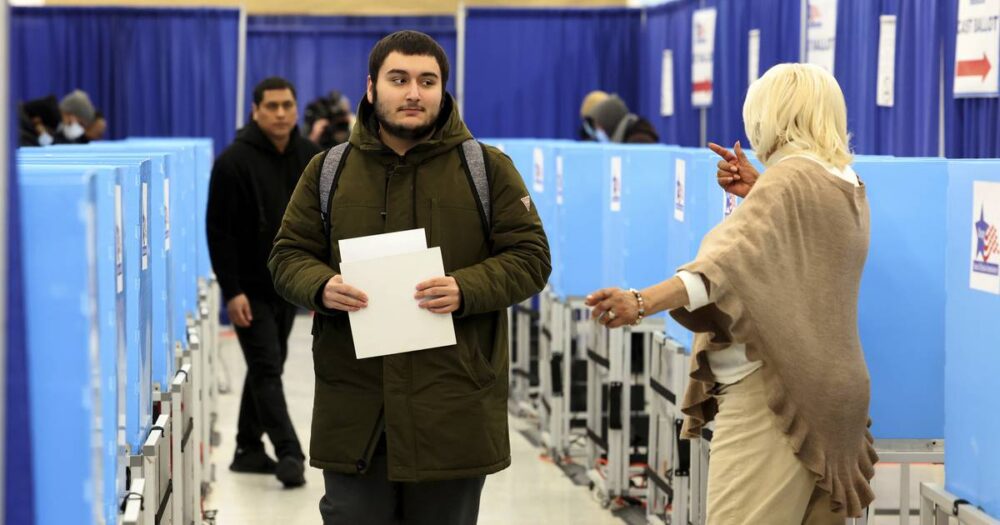
More people have chosen to vote early in the Chicago runoff election than cast votes early in the February election, but whether that leads to a higher overall voter turnout this time around remains to be seen.
With Chicago election officials urging voters to head to the polls before Tuesday to avoid severe weather predicted for the afternoon of Election Day, the total number of ballots cast so far has eclipsed the already record-setting pre-Election Day voting that occurred in the first round of voting that ended Feb. 28.
You can search your ward, polling place, and drop box locations here.
Through Sunday night, about 155,000 people voted early in person, while 95,000 had turned in their mail ballots for a total of nearly 250,000 ballots cast. In the February election, the total number of ballots cast two days before Election Day was a little more than 211,000. After all mail ballots were counted, February turnout was 36%, slightly higher than both rounds of the 2019 election, but lower than the 2011 election and the runoff in 2015, when it was 41%.
Besides having only two candidates to choose from for mayor — rather than nine — higher early turnout could be driven by families of Chicago Public Schools students opting to vote early in person before heading out for spring break. Early votes were similarly high in 2015, when CPS’ spring break was also scheduled during Election Day. In 2019, spring break fell after elections.
While overall totals are higher, vote-by-mail totals are lower than they were at this time before Feb. 28.
Through Sunday, about 7,000 fewer voters had turned in mail ballots. Even so, Chicago Board of Elections spokesman Max Bever said he was “honestly a little shocked” the board had nearly caught up to totals from this time in February. The turnaround between the proclamation of results from the Feb. 28 elections and the Apr. 4 runoff meant mail ballots could not be sent until March 18.
“This turnaround between the municipal and runoff elections has always been tight,” Bever said, but the board had more than 200,000 mail ballots to get to voters this cycle — three or four times higher than previous municipal elections. That made it “nearly impossible to get everything done in a timely way for voters. We plan to address this with legislators with an ask to more fully fund our vote-by-mail department moving forward so we can scale up to voters’ expectations (for example, expedited postage fees are more expensive than ever).”
Turnout is difficult to predict for runoffs. It rose after the first round in 2015, which featured the head-to-head battle between Rahm Emanuel and Jesús “Chuy” García, plus 18 aldermanic runoffs. Turnout in 2019′s April runoff election was lower than the first round: it featured a mayoral race between Lori Lightfoot and Cook County Board President Toni Preckwinkle, plus the two-way treasurer’s race and 15 aldermanic runoffs.
This year’s runoff for mayor features former CPS CEO Paul Vallas versus Cook County Commissioner Brandon Johnson plus 14 aldermanic races.


