


Close Menu
  • Home
  • News
    • Local
  • Opinion
  • Business
  • Health
  • Education
  • Sports
  • Podcast

Subscribe to Updates

Get the latest creative news from FooBar about art, design and business.

What's Hot

OP-ED: For Us It’s Feel-a-Nomics

OP-ED: Is Creativity a Superpower in Early Education?

Mathew Knowles Shares Breast Cancer Survival Story at Houston’s Inaugural Pearl’s Pink Promise Gala

Facebook X (Twitter) Instagram
  • Lifestyle
  • Podcast
  • Contact Us
Facebook X (Twitter) Instagram Pinterest Vimeo
The Windy City Word
  • Home
  • News
    1. Local
    2. View All

    Youth curfew vote stalled in Chicago City Council’s public safety committee

    Organizers, CBA Coalition pushback on proposed luxury hotel near Obama Presidential Center

    New petition calls for state oversight and new leadership at Roseland Community Hospital

    UFC Gym to replace shuttered Esporta in Morgan Park

    Mathew Knowles Shares Breast Cancer Survival Story at Houston’s Inaugural Pearl’s Pink Promise Gala

    It’s Time to Lose Weight Before the Holidays

    NFL Round-Up: Caleb Williams strikes back, Panthers, Browns and Titans secure victories

    HBCU Football Roundup: Homecoming Wins for Howard, Tennessee State and Jackson State

  • Opinion

    Rep Davis, Olive Post CDR., Call on Trump to Restore file of Black Vietnam War Hero to Website

    Capitalize on Slower Car Dealership Sales in 2025

    The High Cost Of Wealth Worship

    What Every Black Child Needs in the World

    Changing the Game: Westside Mom Shares Bally’s Job Experience with Son

  • Business

    Illinois Department of Innovation & Technology supplier diversity office to host procurement webinar for vendors

    Crusader Publisher host Ukrainian Tech Businessmen eyeing Gary investment

    Sims applauds $220,000 in local Back to Business grants

    New Hire360 partnership to support diversity in local trades

    Taking your small business to the next level

  • Health

    Mathew Knowles Shares Breast Cancer Survival Story at Houston’s Inaugural Pearl’s Pink Promise Gala

    It’s Time to Lose Weight Before the Holidays

    OP-ED: She’s Not Non-Compliant, She’s Hungry: Addressing Food Justice to Improve Breast Cancer Outcomes

    Cash for Moms: As Medicaid Cuts Loom, Cities Test a New Approach to Black Maternal Health

    More Families to Benefit from Evidence-Based Home Visiting

  • Education

    Ancestral Responsibility: Young Native Voters Fight Political Invisibility

    Kickstarter CEO Everette Taylor Shares Tips on Creating and Growing a Business

    Author Kristen Amundson Explains ‘The Grandparent Effect’ and How It’s Helping Children Thrive Through Love, Support, and Connection

    Responsible AI Development Requires a Seat at the Table for Black America

    COMMENTARY: Being Frank: a Safe Place

  • Sports

    NFL Round-Up: Caleb Williams strikes back, Panthers, Browns and Titans secure victories

    HBCU Football Roundup: Homecoming Wins for Howard, Tennessee State and Jackson State

    Jaguars Do Better: Top of Ladder or Resting at the Bottom

    NFL: Bryce Young is Proving “Patience is a Virtue”

    WNBA Playoffs: DeWanna Bonner and Atlanta Dream dominate on defense, Win Game 1

  • Podcast
The Windy City Word
Local

University of Chicago professor wins 2022 Nobel economics prize alongside former Federal Reserve chair

staffBy staffUpdated:No Comments4 Mins Read
Facebook Twitter Pinterest Telegram LinkedIn Tumblr Email Reddit
Share
Facebook Twitter LinkedIn Pinterest WhatsApp Email

A University of Chicago finance professor considered one of the world’s foremost minds regarding the banking industry is one of three winners of the 2022 Nobel Memorial Prize in Economic Sciences for his influential research on the banking system.

Douglas Diamond, a widely respected professor who has worked for the Booth School of Business since 1979, became the 95th scholar associated with university to be a Nobel winner and the 33rd in economics, according to the university.

Advertisement

Diamond receives the prestigious award alongside former Federal Reserve Chair Ben Bernanke, who oversaw the 2008 financial crisis, and professor Philip Dybvig of Washington University in St. Louis “for research on banks and financial crises,” according to the Nobel Foundation.

The trio will split the prize money of 10 million Swedish kronor, or about $885,000.

Advertisement

BREAKING NEWS:
The Royal Swedish Academy of Sciences has decided to award the 2022 Sveriges Riksbank Prize in Economic Sciences in Memory of Alfred Nobel to Ben S. Bernanke, Douglas W. Diamond and Philip H. Dybvig “for research on banks and financial crises.”#NobelPrize pic.twitter.com/cW0sLFh2sj

— The Nobel Prize (@NobelPrize) October 10, 2022

The official announcement from the the Royal Swedish Academy of Sciences came just before 5 a.m. Chicago time. While calling the award a high honor in front of colleagues and members of the media on campus Monday, Diamond told reporters that there was a moment during the early morning phone call from Sweden that he thought it might be a prank from colleagues.

“I was sound asleep, so my main reaction was trying to figure out where my phone was,” said Diamond, 68, a Merton H. Miller distinguished service professor, when asked about his first reaction to winning.

“So I heard this Swedish voice on there saying, ‘Are you professor Doug Diamond?’ … I said, ‘Yes.’ I did know this was the day that they announce the prize, and I thought it was probably legit,” he said to laughter. “But you never know — I have some friends with a good sense of humor.”

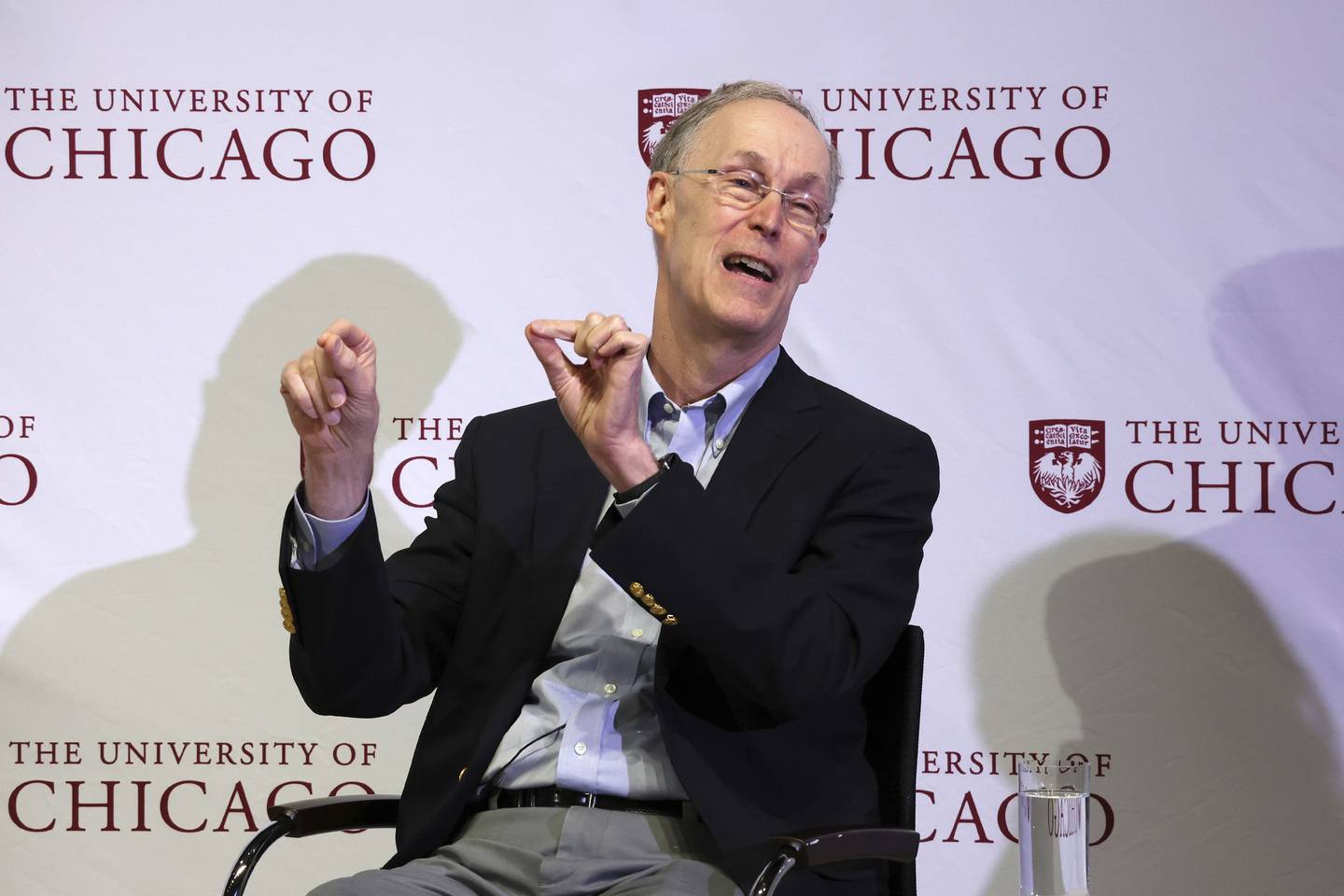
University of Chicago professor Douglas Diamond speaks during a news conference in Friedman Hall on Oct. 10, 2022, after he was awarded the Nobel Memorial Prize in Economic Sciences. (Terrence Antonio James / Chicago Tribune)

Diamond’s early research in the 1980s with Dybvig created theoretical models that illustrated why banks succeed and fail, and explained the connection between liquidity and mass bank withdrawals by worried customers. Among their recommendations, the pair suggested government-backed bank deposit insurance as a way of counteracting jittery customers.

“Modern banking research clarifies why we have banks, how to make them less vulnerable in crises, and how bank collapses exacerbate financial crises,” the Royal Academy said in a statement. “The foundations of this research were laid by (the three laureates) in the early 1980s. Their analyses have been of great practical importance in regulating financial markets and dealing with financial crises.”

Diamond’s work with Dybvig is considered seminal among economists, and Diamond’s advice was essential in the days after the 2008 collapse.

“Doug Diamond is the foundation scholar of much of what we know about banking and financial institutions,” fellow U. of C. professor and former Obama administration economic adviser Austan Goolsbee told the Tribune. “He’s also extremely practical — was an unheralded key adviser to policymakers during the financial crisis and beyond about how to make the system safer.”

Afternoon Briefing

Afternoon Briefing

Daily

Chicago Tribune editors’ top story picks, delivered to your inbox each afternoon.

Diamond is also a trusted voice for friends and co-workers seeking personal advice, Goolsbee added.

Advertisement

“Everyone is over the moon about his winning except for the fact that he’s the person all the other faculty turn to for life advice about which UChicago health plan to choose, which retirement plan is best, what’s the best place to buy appliances, etc.,” Goolsbee said. “So now everyone is worried they won’t have Doug to figure things out for them now.”

Diamond suggested that he would stick around the university to complete research projects before considering retirement, along with possibly bumping up his retirement accounts.

After briefly commenting on his career at Booth and his relationship with colleagues and students, Diamond held court answering audience finance questions, ranging from the current state of the banking system — which he called “in reasonably good shape” — to his take on the reliability of cryptocurrencies, which he viewed as highly risky.

Chicago Tribune’s Maddie Ellis contributed.

wlee@chicagotribune.com

Twitter @Midnoircowboy

Share. Facebook Twitter Pinterest LinkedIn Reddit WhatsApp Telegram Email
Previous ArticleRound Lake Beach head-on crash sends 5 to hospitals
Next Article Industrial developers setting new construction records, but gold rush likely to end in 2023
staff

Related Posts

Youth curfew vote stalled in Chicago City Council’s public safety committee

Organizers, CBA Coalition pushback on proposed luxury hotel near Obama Presidential Center

New petition calls for state oversight and new leadership at Roseland Community Hospital

Leave A Reply Cancel Reply

Video of the Week
https://www.youtube.com/watch?v=AxFXtgzTu4U
Advertisement
Video of the Week
https://www.youtube.com/watch?v=OjfvYnUXHuI
ABOUT US


The Windy City Word is a weekly newspaper that projects a positive image of the community it serves. It reflects life on the Greater West Side as seen by the people who live and work here.

OUR PICKS

Marvel Has No Problem Finding Room for Spider-Man. So, Why Wasn’t There Room for Blade?

Election Night on The Yard at Howard University

Will Cutting Salaried White Collar Workers Help Stellantis and Nissan?

MOST POPULAR

Mathew Knowles Shares Breast Cancer Survival Story at Houston’s Inaugural Pearl’s Pink Promise Gala

It’s Time to Lose Weight Before the Holidays

OP-ED: She’s Not Non-Compliant, She’s Hungry: Addressing Food Justice to Improve Breast Cancer Outcomes

© 2026 The Windy City Word. Site Designed by No Regret Medai.
  • Home
  • Lifestyle
  • Podcast
  • Contact Us

Type above and press Enter to search. Press Esc to cancel.