


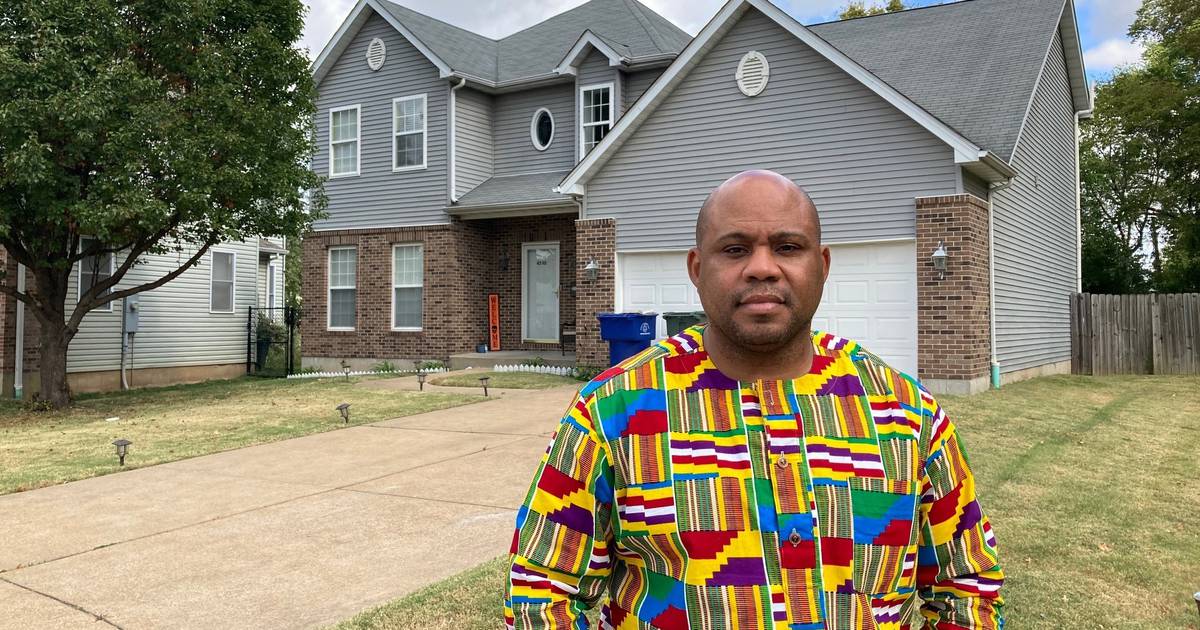
When Abdul-Kaba Abdullah decided to sell his home two years ago, he listed the neatly-kept, four-bedroom house at $175,000 based on presale evaluations.
But once a buyer made an offer, an appraiser valued the home at only $150,000, and the bank wouldn’t give a loan for the original asking price.
Advertisement
Curious, Abdullah looked at the appraisal report and found the photos weren’t even of his home in the predominantly Black area of north St. Louis. The photos had been pulled off the internet, and were not new photos showing updates he had made.
“I immediately knew, well, we have an issue here,” Abdullah said.
Advertisement
It’s a struggle Black Americans have lived with for decades. Now, some leaders in the real estate industry are apologizing for past discrimination while promising to address problems that still remain.
Last month, St. Louis Realtors — the St. Louis area’s largest real estate trade group — issued a formal apology for past discriminatory practices. The National Association of Realtors issued an apology in 2020. Realtor groups in cities like Atlanta and Chicago have shown similar remorse.
“The discrimination to which the Black community was subjected to was part of a system designed to cause residential racial segregation, led by the federal government, supported by the banking system and the real estate industry, and driven by practices like redlining and the use of restrictive covenants,” the apology from St. Louis Realtors states.
St. Louis was notorious for housing discrimination in the mid-20th century, when Black applicants were frequently denied mortgages, white homeowners were encouraged by real estate agents to move once a neighborhood began to integrate, and certain areas of the region were “redlined,” meaning loans to buy homes in those areas were nearly impossible to get.
Will Jordan, executive director of the Metropolitan St. Louis Equal Housing and Opportunity Council, said change is happening far too slowly.
“Redlining and those types of issues are still playing out in the St. Louis metropolitan area,” Jordan said. “I’ve seen notes on appraisals that are written by banks saying, ‘nothing north of Delmar can possibly be that much. Let’s rewrite this.’” Delmar Boulevard is infamously known as the dividing line between predominantly white and Black areas of St. Louis.
“North of Delmar, it’s still very difficult to get any bank to finance something,” Jordan said.
It’s part of the reason the city’s once vibrant north side has struggled in recent decades with rampant crime, high vacancy rates and a dilapidated housing stock.
Advertisement
Katie Berry, president of St. Louis Realtors, said past discrimination was no accident. Federal lending program maps used green lines to indicate places where loans would be approved — predominantly white areas. Red lines indicated high risk, “and those areas were Black communities or integrated communities because the theory was that once you integrated a community, the home values are going to drop,” she said.
Making matters worse, once integration began in a neighborhood, real estate agents would participate in what was known as “blockbusting.” An agent would help a Black family move into a white neighborhood, then “start knocking on doors of the neighbors saying, ‘Hey, did you know this Black family’s moved in? Home values are going to plummet. You should go ahead and list your house with me. Hurry up and get out of here,’” Berry said.
Meanwhile, a provision of the National Association of Realtors’ Code of Ethics from 1924 to 1950 instructed realtors to avoid “introducing into a neighborhood a character of property or occupancy, members of any race or nationality, or any individuals whose presence will clearly be detrimental to property values in that neighborhood.”
A report released earlier this year by the National Association of Realtors showed that while 72.1% of white Americans own their homes, the rate for Black Americans is just 43.4%. The report also found that Black and Hispanic applicants for mortgage loans were far more likely to be rejected than white and Asian applicants.
Bryan Greene, vice president of policy advocacy for the NAR, said apologies are important because realtors “need to atone for our failures.”
The Atlanta Realtors Association apologized in 2021 for past discriminatory practices.
Advertisement
“We can’t change our history but we can choose to learn from our past, make current powerful decisions, and act with intention to write future chapters that leave a positive legacy,” then-President Cynthia Lippert wrote in a letter of apology.
In 2019, Chicago Association of Realtors President Tommy Choi issued an apology on behalf of the organization for being “on the wrong side of history.”
Lydia Pope, president of the National Association of Real Estate Brokers, which promotes Black homeownership, said the apologies are good starting points.
“Now show us that you want to do better, that you are willing to do more to help create an environment where everyone is treated equally,” Pope said in a statement.
Greene said the NAR has taken several steps, including creation of a Fair Housing Policy Committee. The national group also adopted an action plan in 2020 that emphasizes accountability, culture change and training local realtors in fair housing practices.
As part of the effort to change, realtors in Atlanta have undergone unconscious bias training and are seeking relationships with diverse real estate associations such as the National Association of Hispanic Real Estate Professionals and the LGBTQ+ Real Estate Alliance, the group said.
Advertisement
In St. Louis, the realtors’ association hired a director of diversity, equity and inclusion, is working with lawmakers to reduce barriers to homeownership for minorities, is seeking to address housing vacancies, and is pushing to bring in more Black real estate agents.
Berry knows change won’t happen quickly.
“People have been harmed for generations,” she said.
Abdullah, 44, is executive director of Park Central Development, a company that works to attract investment and keep people in their homes in St. Louis. So he’s familiar with fair housing laws. From the outset, he questioned the appraisal of his home by an appraiser from a mostly-white neighboring county.
When Abdullah filed a complaint with Jordan’s office, the bank eventually agreed to increase the loan value to $160,000, and Abdullah sold. Still, he asked the U.S. Department of Housing and Urban Development to investigate. The case remains unresolved.
“Just because I’m in this line of work, I didn’t think I was exempt from these things happening to me,” Abdullah said. “People have a right to the American dream.”