



Browsing: Local Stories

A 15-year-old student at the Latin School of Chicago was “tormented on a regular basis” by students at the prestigious school until he died by suicide in January, a lawsuit filed Monday alleges.The suit, filed by the boy’s parents, Robert and Rosellene Bronstein, accuses administrators at the school of “willful failure” to do anything about the bullying, even though they received numerous complaints from the boy and his family. The complaint, filed in Cook County, names the school, a number of employees and parents of the alleged bullies.AdvertisementLatin, a top-ranked school that charges more than $40,000 per year in tuition, includes former first lady Nancy Reagan, former U.S. Supreme Court Justice John Marshall Harlan II and other well-known public figures as alums.In a statement, the school called the claims unfounded. It said it “deeply grieves” the death of one of its students, but that it plans to “vigorously defend itself.”Advertisement“The allegations of wrongdoing by the school officials are inaccurate and misplaced,” the statement read. “The school’s faculty and staff are compassionate people who put students’ interests first, as they did in this instance.”The boy, identified as N.B. in the suit, transferred to Latin from Francis Parker School due to Latin’s in-person learning during the COVID-19 pandemic, according to the complaint.A student at the school, whose parents are named in the suit, spread a false rumor that the boy was unvaccinated, the suit alleges. Though he was vaccinated, the boy was harassed about his perceived vaccination status, the suit says. The Bronsteins reached out to the student’s family about the alleged harassment, according to the suit.The bullying escalated from there, according to the lawsuit. He was told by a teacher in front of a class that he was going “nowhere in life,” the suit alleges, and was cyberbullied in a group text message thread by members of the junior varsity basketball team and on the social media app Snapchat. A Snapchat message circulated around the school said of the boy: “Ur a terrible person.”On Dec. 13, a student sent a Snapchat message to the boy encouraging him to kill himself, the suit alleges.N.B. then met with a Latin administrator to report the bullying, the suit says, but the administrator did not discipline any of the students involved in the cyberbullying.Rosellene Bronstein had also been in communication with a school counselor about the bullying, the suit says. At one point, she told the counselor she believed her son might hurt himself and asked for a recommendation for a psychiatrist.Rosellene Bronstein notified school employees about the bullying numerous times, but the school dismissed her concerns as “family issues,” the suit says. In November and October alone, she contacted Latin more than 30 times.AdvertisementStudents walk through a bridge connecting buildings at Latin School of Chicago in 2020. (Antonio Perez / Chicago Tribune)Despite having anti-bullying policies and a stated “zero tolerance” policy for hate speech, school administrators turned a “blind eye” to the “increasingly desperate” pleas for help from the Bronstein family, according to the complaint.The boy also reported the bullying to a school dean about “monthslong abuse” but was disregarded, the complaint says.He died Jan. 13.The suit maintains that Latin violated a state law that requires all Illinois schools to investigate reports of bullying and notify parents of students involved. It also accuses the school of allowing a culture of bullying, as documented in an Instagram account that highlights alleged instances of bullying, harassment and hate speech. The suit says N.B.’s sister was also bullied at Latin.After N.B.’s death, Head of School Randall Dunn and some board members “conspired to withhold all of the above information from law enforcement authorities, from the full Latin Board, from other constituents of Latin and from N.B.’s family,” the suit alleges.The suit asks for an award of $100,000,000 on multiple counts of the suit. In a news release, the Bronsteins said they plan to share any money from the suit with anti-bullying organizations.AdvertisementThey said they demanded the school commit to an outside investigation, but Latin refused.“My son was so alone,” Rosellene Bronstein said in the release. “Not only were the administrators who were supposed to protect him ignoring his cries for help, but they had the self-serving gall to try to protect their own reputations after his death rather than just having the decency of being honest with his grieving family. This is a legal and moral failure that has caused us indescribable pain and agony.”For 24/7 help, call the free and confidential National Suicide Prevention Lifeline at 1-800-273-8255.mabuckley@chicagotribune.com

In just one week in April, the bodies of three women and a man were recovered from Chicago lake and river shores but the causes of their deaths remain unknown.AdvertisementThere are no suggestions of criminal activity, nor is it known if any of the deaths are connected, authorities have said. But why would so many appear around the same time?The situation may mirror that of 29 years ago. In early April 1993, the Tribune wrote that the bodies of two women had been found in the lake and a third in the Calumet River. The torso of an unidentified woman was also discovered.AdvertisementThat spring the Tribune reported that the annual thaw could be to blame. The bodies of those who drowned during the winter months could appear alongside more recent cases.“During the winter months, especially in areas where it’s really cold, decomposition gets delayed or stops especially if the water starts freezing,” said Dr. Ponni Arunkumar of the Cook County medical examiner’s office.“What happens when a person drowns is they sink down and as the bodies start decomposing, because all of us have bacteria in our intestines and bacteria in the water surrounding, during the decomposition process the gasses make the body lighter so they come to the surface and that’s when people see the bodies and report them.”Yuet Tsang, 80, was one of the women pulled from the Chicago River. The Near North Side woman was discovered April 16 off the 2800 block of South Eleanor Street near Bridgeport, according to the medical examiner’s office.Within an hour another woman, who has not been identified, was discovered at the 100 block of North Riverside Plaza in the West Loop Gate neighborhood, officials said. The next day, on April 17, the body of an unidentified man was discovered in Lake Michigan near the 3000 block of South Fort Dearborn Drive.A week later, a Back of the Yards woman later identified as 31-year-old Karina Alanis was found near the 2600 block of South Damen Avenue, officials said.Arunkumar said that decomposition can start at 60 degrees.“In the summer months, the process is much faster,” Arunkumar said. “People nearby will see these bodies quicker meaning someone who (drowns) may be seen within a few days.”AdvertisementIn 2020 and 2021, 60 to 70 drownings were reported, according to Arunkumar. That number includes all bodies of water but also indoor cases.tatturner@chicagotribune.com

Wednesday’s Chicago White Sox game against the Kanas City Royals at Guaranteed Rate Field has a new start time.Due to a forecast of cold temperatures, Wednesday’s game has been changed to 1:10 p.m. from the originally scheduled time of 6:10 p.m.AdvertisementAccording to a Sox news release, “game tickets, parking coupons and Huntington Bank Stadium Club passes for the 6:10 p.m. start will be honored for the 1:10 p.m. first pitch. Fans do not need to exchange any game tickets, parking coupons or Stadium Club passes to attend the rescheduled game.”[ [Don’t miss] Going to a Chicago White Sox game? Here’s what to know if you’re headed to Guaranteed Rate Field this season. ]The parking lots will open at 11:10 a.m. and the gates open at 12:10 p.m.Due to a forecast of cold temperatures, the start time for tomorrow’s game between the Chicago White Sox and Kansas City Royals has been changed to 1:10 p.m. CT from the originally scheduled time of 6:10 p.m. pic.twitter.com/WZ7GEUvxgd— Chicago White Sox (@whitesox) April 26, 2022

Facing elimination in their first-round series with the Milwaukee Bucks, the Chicago Bulls were dealt another blow Tuesday when Zach LaVine entered health and safety protocols.LaVine will likely be out for Game 5 of the series, which tips off Wednesday night at 6:30 p.m. The Bulls will drive up to Milwaukee to prepare for Game 5 Tuesday night.AdvertisementWith Alex Caruso in concussion protocol, the Bulls might be down two starters for their must-win game.LaVine has averaged 19.3 points per game on 42.9% shooting in the first four games of the series. He is one of three Bulls players — alongside DeMar DeRozan and Nikola Vučević — to average double-digit scoring in the first four games of the Bucks series.AdvertisementThis is LaVine’s third round in the league’s health and safety protocols in the last year. He previously tested positive for COVID-19 last April, missing several weeks during the Bulls’ push for a play-in game. LaVine tested positive again last December during the league-wide outbreak following the omicron variant surge. LaVine said he was asymptomatic during both bouts of the virus.Bulls assistant coaches Chris Fleming and Damian Cotter missed Games 1 and 2 after testing positive for COVID the week before the series began. At that time, coach Billy Donovan said most of the Bulls players and coaching staff were not required to participate in a regular testing cadence.Donovan said the NBA allows individuals to wait 90 days after testing positive for COVID or receiving a booster shot to begin testing again. This policy doesn’t change after individuals on a team return positive tests and Donovan wasn’t required to test even after his assistant coaches tested positive.“We’re all concerned,” Donovan said. “You try to be as safe as you can as much as you can. I don’t know if it’s going back up again, but that’s certainly a challenge when that happens.”

Prosecutors in the federal bribery case against a longtime confidant of former House Speaker Michael Madigan and three others told a judge Tuesday they have rejected having a bench trial, meaning the bombshell allegations will be heard by a jury in September.Attorneys for the four defendants had requested last month that the case be tried by U.S. District Judge Harry Leinenweber instead of a jury — a rarity in political corruption cases that would have required the approval of both prosecutors and the judge.AdvertisementDuring a statues hearing Tuesday, however, Assistant U.S. Attorney Amarjeet Bhachu said his office was rejecting the proposal, officially setting the case for a jury trial starting Sept. 12.The trial is expected to last about a month, with questionnaires mailed to prospective jurors a week ahead of time to help weed out any potential conflicts.AdvertisementCharged in the November 2020 indictment were Michael McClain, a former state legislator and lobbyist who was part of Madigan’s inner circle; Anne Pramaggiore, the former CEO of ComEd; John Hooker, a longtime ComEd lobbyist; and Jay Doherty, a consultant for the utility and one-time head of the City Club of Chicago.The 50-page indictment alleged that beginning in 2011, McClain and the other defendants “arranged for various associates” of Madigan — including his political allies and campaign workers — to “obtain jobs, contracts and monetary payments” from ComEd even in instances where they did little or no actual work.McClain and the other defendants also conspired to have ComEd hire a Madigan-favored law firm and lawyer, previously identified in public testimony as Victor Reyes of Reyes Kurson, and to accept into ComEd’s summer internship program a certain number of students who lived in Madigan’s 13th Ward, according to the charges.Pramaggiore and McClain also allegedly took steps to have Juan Ochoa, the former head of the Metropolitan Pier and Exposition Authority of Chicago, appointed to ComEd’s board of directors at the request of Madigan and McClain, the indictment stated.Madigan and McClain were indicted last month on separate racketeering charges that include the alleged ComEd scheme.At Tuesday’s status hearing, meanwhile, McClain’s attorney asked for an early deadline for both sides to file proposed jury instructions on the federal bribery statute, saying that their entire defense strategy will likely rest on what instructions Leinenweber will read before the jurors go back to deliberate the case.“We feel that this is such a crucial issue that it is appropriate to address it early,” said attorney Patrick Cotter, who represents McClain.Bhachu objected, arguing that the issue was not all that complex. But Leinenweber said he saw no reason not to do it early, ordering both sides to submit their proposals by May 16.AdvertisementIn pretrial motions, the defendants accused prosecutors of misusing the federal bribery statute, arguing that there was no quid pro quo agreement and that jobs, contracts and other payments to chosen Madigan political operatives constituted legal lobbying.But Leinenweber denied a motion to dismiss key counts of the indictment, writing in a ruling earlier this year that legal precedent dictated that the charges outlined were sufficient.jmeisner@chicagotribune.com
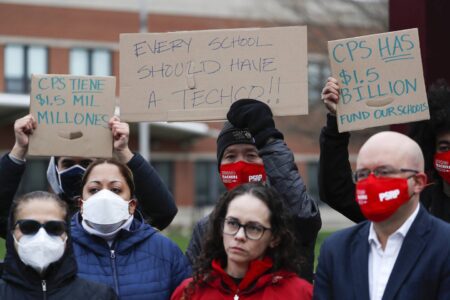
Emiliano Zapata Academy teachers and elected officials gathered Tuesday outside the Little Village elementary school to protest a proposed $894,000 cut to the school’s budget for the upcoming year.Last month Chicago Public Schools presented preliminary individual school budgets for the 2022-23 school year. If those figures hold, Zapata’s budget would be $5.9 million, down from $6.8 million this school year. On Tuesday school community members called on the district to spend federal COVID-19 funds to ensure no school would have to experience cuts, but especially those in Little Village, which was hit hard by the pandemic.Advertisement“We here at Zapata are projected to lose eight or nine teachers, which will most definitely dramatically increase class sizes. In my own classroom, I am projected to have 30 distinctly unique little human beings in front of me instead of the 20 that I have this year,” Zapata fourth grade bilingual teacher Jaquelina Salgado said. “There is no good reason why my future students should be crammed into a classroom where I will have great difficulty meeting their academic, their social, their emotional needs. They deserve so much more.”In a conversation with news reporters last month, CPS CEO Pedro Martinez said school enrollment was a major factor in the creation of the individual budgets. District enrollment declined from 340,000 students the last school year to 330,000 students this year. Zapata counted 554 students, down from 621, according to CPS data.AdvertisementPeople rally outside Zapata Academy in Chicago’s Little Village neighborhood on April 26, 2022, as they protest a proposed $894,000 cut to the school’s budget for the upcoming year. (Jose M. Osorio / Chicago Tribune)Martinez emphasized lower-enrollment schools and schools with the greatest needs would have enough resources for the fall, and more support from the central office would be provided to all schools.Local School Councils at CPS schools were directed to approve school budgets by April 19. It’s unclear if the figures the district released last month are the final numbers or if any schools were able to negotiate more money. CPS did not immediately provide comment.In all, about 200 of CPS’ 500-plus district-run schools were on track to receive less money, based on figures provided last month by CPS.Troy LaRaviere, president of the Chicago Principals and Administrators Association, said at last month’s Chicago Board of Education meeting that the raw numbers don’t tell the whole story.LaRaviere said they fail to account for a 5.5% to 6% increase in staffing costs when you factor in raises and “step” increases, which automatically boost an employee’s salary for adding a year of experience.“It is a fact that some schools receive roughly the same amounts they received last year. However, the CEO used that fact to imply these budgets would create stability. That was false,” LaRaviere said.“Handing (out) the same amount of money provides zero stability for students if that money doesn’t secure the same staff and services. If expenses go up and your budget remains the same, you create instability.”Outside Zapata on Tuesday, eighth grade civics teacher and parent Juan Sanchez was among those calling for the use of COVID-19 funding to stabilize school budgets.Advertisement“CPS has received over $2 billion in federal funds during the dawn of the pandemic, the majority of which has not made its way to our classrooms, and many of which remains unspent,” Sanchez said. “CPS has chosen — it’s a choice — to undercut, to underfund and to undermine schools like Zapata’s ability to adequately educate our children.”CPS is expected to receive $2.8 billion in direct emergency pandemic relief funding over five fiscal years. The district recently admitted it’s been slow to spend this money, but it also said it doesn’t want to create positions it can’t afford when the pandemic money runs out.Ald. Michael Rodriguez, 22nd, said he will work with teachers, parents and advocates to restore funding to Zapata and other Little Village schools. CPS is still formulating its overall budget plan for the next school year, which includes capital spending on construction projects. This year’s budget was $9.3 billion.A “Free the Funds” protest over proposed budget cuts is scheduled for 9:30 a.m. outside CPS headquarters in the Loop before Wednesday’s monthly board meeting.tswartz@tribpub.com
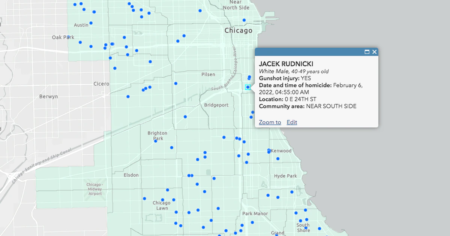
Information about homicides is released daily by the city of Chicago. The release of homicide victims’ names is delayed by two weeks to allow time for the victims’ families to be notified of a death by Chicago police.[ City reached at least 800 homicides in 2021, a level not seen in 25 years ]The homicide figures do not include killings that occurred in self-defense or in other circumstances not measured in Chicago police statistics. Homicide data from Illinois State Police, which patrols the city’s expressways, also is not included here.AdvertisementIn Chicago, 797 people were slain in 2021 — 25 more than in 2020.Data, which is updated on this page weekly, is through April 24, 2022.Advertisement[ In 2021, violence spread into Chicago neighborhoods that normally enjoy a sense of security, rattling nerves and putting city leaders on the defensive ]
Where each homicide has occurred so far in 2022
Through April 24, 2022
Sources: City of Chicago, Tribune reporting
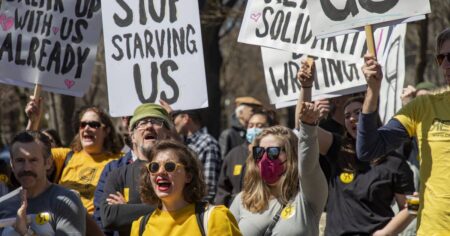
Chicago Reader co-owner Len Goodman and three board members stepped down Tuesday amid protests from employees, freeing the embattled alternative newspaper to transition to a nonprofit organization.The Reader has been stuck in limbo since December, when a planned transition to a nonprofit model was delayed over concerns about alleged censorship of an opinion piece written by Goodman, who pushed for an investigation into the matter and more representation on the successor board.AdvertisementGoodman announced Tuesday he was stepping away from the Reader immediately over “an unresolvable impasse” with fellow co-owner, Chicago real estate developer Elzie Higginbottom, who wanted to move forward with the planned transition to a nonprofit newspaper.“We cannot continue the fight without destroying the Reader,” Goodman said in a statement. “I am stepping aside. I will sign off on the sale so that the Reader can transition immediately to NFP status.”AdvertisementBoard members Dorothy Leavell, Sladjana Vuckovic and Carol Bell, who were aligned with Goodman’s concerns, announced they were also stepping down immediatelyFrustrated Reader editorial employees organized a rally last week in front of Goodman’s Lakeview East home and planned another one for Thursday morning in an effort to get the Chicago criminal defense attorney to relinquish control and let the newspaper move forward as a nonprofit. Goodman blamed Reader management for not addressing his concerns.In 2018, Goodman and Higginbottom bought the Reader from the Chicago Sun-Times for $1 and the assumption of debt. Since then, they have invested more than $1 million each to keep it afloat, weathering the pandemic and supporting the money-losing publication as it planned to transition to a more sustainable nonprofit model.That plan was delayed after editors pushed back on a November opinion piece by Goodman expressing concerns about vaccinating his 6-year-old daughter against COVID-19, which created backlash on social media for some disputed scientific claims.More to come.rchannick@chicagotribune.com
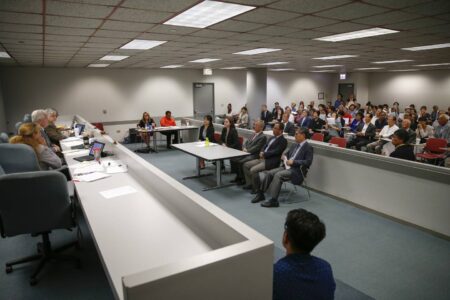
When a group of Democratic state senators joined Republicans in rejecting two of Gov. J.B. Pritzker’s nominees to the Illinois Prisoner Review Board last month, it became clear that crime has become such a big issue in this year’s elections it is even driving some divisions within the governor’s own political party.How a little-known state board became a flashpoint for controversy also demonstrates how much has changed about politics and crime in just a few short years. When Republican Gov. Bruce Rauner took office in 2015 he pledged to work to reduce the state’s prison population by 25% over 10 years, a move at the time applauded by Chicago Democrats.AdvertisementFast forward through Rauner’s administration and most of Pritzker’s and the situation is radically different. Gun violence in Chicago has spiked along with other major U.S. cities since the start of the COVID-19 pandemic prompting Republicans to call for a more law-and-order approach while opponents point to systemic problems in the criminal justice system as a reason for it to be reformed.And for panels such as the Prisoner Review Board, those who have served on it say, that means often nuanced decision-making about releasing men and women from prison is relegated to little more than political talking points.Advertisement“Board members spend a lot of time studying these cases, reflecting on them to discussing them, having extensive interviews with both the offender and anyone else who wants to comment on the case,” said Craig Findley, a former Republican state lawmaker who was chairman of the review board until his retirement earlier this year. “These are not casual decisions the board makes.”The interim board members rejected by the Illinois Senate last month were Jeffrey Mears and Eleanor Kaye Wilson. A third Pritzker appointee, Oreal James, resigned just hours before the Senate was expected to vote on his appointment.Craig Findley, chairman of the Illinois Prisoner Review Board, far left, speaks regarding the Andrew Suh executive clemency hearing as supporters for Suh, middle seated, look on during a hearingat the Thompson Center in 2017. (Jose M. Osorio / Chicago Tribune)Much of the senators’ professed ire concerned board votes paroling now-elderly men and women who were convicted of high-profile killings.Shortly after the Senate rejected Wilson’s appointment — with 17 Republicans and 14 Democrats voting against her — she told the Tribune she voted to release prisoners who had been incarcerated for decades and were no longer a threat to anyone either due to their old age or poor health.“It is clear that these senators have a general distaste for the work of the PRB if the Prisoner Review Board does not follow their dictates and beliefs,” Wilson wrote in a letter to Pritzker obtained by the Tribune, noting some Republican senators tried to “vilify my tenure.”“(Decisions) are made based on the inmate’s record of behavior in prison, conditions to be followed upon release, housing and job possibility,” added Wilson, who is also the godmother of former President Barack Obama’s children. “These along with the redemptive and rehabilitative nature of the inmates serve as the principle guide for parole. Given these criteria, it is impossible for any one PRB member to make a sole decision about parole.”But Republicans said Pritzker’s appointees have voted to let some men and women out of prison far too often, and that such votes send a bad message about criminal justice. The Senate GOP produced statistics showing that since Wilson and James were appointed as interim members in April 2019, the two voted more than 40% of the time to grant parole for a specific category of older prisoners — a rate the GOP contended was too high.“Gov. Pritzker has been completely negligent on the Prisoner Review Board from day one. And he’s putting Illinois families in danger in two ways,” Republican state Sen. Jason Plummer of Edwardsville told the Tribune the day after Mears was rejected by the Senate. “One, by putting, in some cases, very extreme people on the Prisoner Review Board and on the second case, by not following his job and making sure that the board is fully functional.”AdvertisementMuch of the debate has centered on older individuals who have been incarcerated in state prisons but are eligible for parole through so-called en banc hearings, which are specific hearings for aging prisoners who were given indeterminate sentences decades ago for serious crimes, such as first-degree murder.Most were incarcerated before 1978, the year Illinois limited parole in favor of an early-release system that makes men and women in state prisons eligible to be freed for certain crimes if they served at least 50% of their sentences. Those who go through the en banc proceedings are governed by the old law, and they’re tracked by the Illinois Department of Corrections through so-called C numbers.A Tribune review of C-numbered cases shows a steady uptick in the percentage of prisoners who have been paroled by the board, even before the COVID-19 pandemic hit and prisons across the nation tried to release low-risk inmates.In Pritzker’s first year as governor in 2019, the board, which included Rauner appointees, heard 51 cases and granted parole 15 times, a 29% rate, according to the board’s annual report that year. That’s a trend seen in minutes from en banc hearings in more recent years as well. The board that served while Rauner was governor from 2015 through 2018 heard 211 C-numbered cases and granted parole on 23 occasions, or 10.9% of the time, according to Prisoner Review Board annual reports.Before Rauner, when Democrats Pat Quinn and Rod Blagojevich were in office, the rates were lower. From 2004 to 2008, under Blagojevich, the board heard 925 C-numbered cases and granted parole just 7.2% of the time. From 2009 through 2014 under Quinn, the board granted parole for C-numbered prisoners only 3.7% of the time out of 613 cases, the review board’s annual reports show.Findley, the Republican former review board chairman, said he thinks the advanced age of those appearing before the board, coupled by the low recidivism rate for older people in the prison system, might explain why board members more recently have granted parole at a higher rate. Findley also said he thinks the quality of pro bono legal representation for parole candidates has improved over the years.Advertisement“Quality representation. Excellent parole plans. Those all contribute to confidence that parole is likely to be more successful,” Findley said. “And over the years as new board members take a fresh look at these old cases, they may discover things that we’ve missed.”Today, there are fewer than 100 men and women in prison eligible for en banc hearings, records show.Jennifer Soble, executive director of the Illinois Prison Project, said many are senior citizens who have medical needs that could be more costly to taxpayers if they’re continuously incarcerated.“So, a person who is eligible for parole has spent 44 years in prison. That means that they’ve had 44 years of inadequate medical care, of poor diet, of poor exercise, of basically no preventive care whatsoever. Their bodies are going to be significantly older than you think they are,” said Soble, who has represented individuals at these hearings. “And we can see this in our clients. They look older. They’re often in extraordinarily poor health. They’re wheelchair bound. A bunch of them are on dialysis.”Last year, two C-numbered men in state prison were Johnny Veal and Joseph Hurst. The decisions by the board to parole both men were cited by state senators as reasons why Wilson was rejected and why James likely would’ve been rejected in a Senate vote had he not resigned.Veal was convicted along with another man in the high-profile 1970 slayings of Chicago police Officers Anthony Rizzato and Sgt. James Severin, and sentenced to 100 to 199 years in prison. Hurst was convicted in the 1967 killing of Chicago police Officer Herman Stallworth and sentenced to 100 to 300 years behind bars.AdvertisementIn February 2021, James and Wilson each voted in 8-4 decisions to grant parole for Veal and Hurst. Among the eight board members who voted to parole Veal four were originally appointed by Rauner, and three of those same members also voted to parole Hurst, records show.James said in an interview with the Tribune that while the slayings were shocking, he learned that a few years earlier Veal was badly hurt while trying to protect a prison staffer during a confrontation and that Veal had a solid parole plan to find work, a place to live and had “a lot of family support.”According to review board records, Veal received a GED while in prison and was nine credits short of a bachelor’s degree. He became a certified law clerk and obtained numerous certificates in technology and electronics.“Is that 68-year-old man the same person he was at 18? No, he’s not,” James said of Veal, who turns 70 later this year. “The crime is the crime. Some people during the hearing, both for and against, wanted to retry the crime. That’s not our job. … This guy’s doing more at 70 than most 70-year-olds are as far as having an impact in the community.”James said voting to parole Veal wasn’t an easy decision because while Veal has denied playing a role in the deaths of Severin and Rizzato a jury found him guilty of killing the two officers as they walked across a field in the Cabrini-Green public housing complex “in probably the most cowardly way you can.”But “there is not a law in the book that says, ‘if you kill a police officer then you should never have parole,’ “ James said. “If there is, then that makes it a lot easier.”AdvertisementAs for Hurst, James said, it was Hurst’s poor health that played a major role in his decision to vote for parole. Hurst has admitted to killing Stallworth and while in prison received numerous disciplinary infractions during his roughly 50 years in prison, though not for violent acts.Hurst was 77 at the time of his hearing and was being held in the medical unit of Dixon Correctional Center. Review Board records show Hurst suffered a stroke in 2008, which caused partial paralysis on his right side.“When you look at it, he was probably much more of a liability staying in. He was probably much more of an issue for folks on the inside than he would ever be on the outside,” James said.For Mears, some senators questioned his votes to grant parole for two prisoners, Paula Sims and Zelma King.King, who was serving a 100-to-300-year sentence for a 1967 triple murder, had been up for parole in the past but never received any votes until being granted for parole last year at age 79. Review Board records show King received about 250 disciplinary infractions in prison, including for sexual misconduct, theft and drug-related activity.But leading up to his 2021 parole hearing, it had been a few years since he was accused of any serious wrongdoing. Others in custody indicated in letters to the board that King had mentored them and encouraged them to take classes and not violate rules, records show. King also worked as a machinist, and had parole plans to live with his brother, a retired attorney and associate vice president at Western Illinois University in Macomb, records show.AdvertisementMears and Wilson were two of the eight members of the board who voted to parole King.Sims, meanwhile, was convicted in 1990 of first-degree murder in the killing of her 6-week-old daughter. Evidence was introduced during trial showing Sims was also responsible for the 1986 death of her 12-day-old daughter.In 2021, Pritzker commuted Sims’ life sentence to a parole-eligible sentence. She and her lawyer had sought to convince the review board that she suffered from postpartum psychosis at the time of the crimes, a condition that includes hallucinations, mood swings and other mental defects. At her en banc hearing last year, two psychologists testified about the ailment in support of her parole. Sims also helped push for legislation addressing postpartum psychosis and postpartum depression before it was signed into law by Rauner in 2018, recognizing the illnesses as mitigating factors in sentencing for crimes.Her lawyer argued to the review board how “there is so much more known now” about these types of ailments than when Sims was on trial. At 62, she was released by the board in a 12-1 decision. James also voted to parole Sims, though Wilson did not attend Sims’ parole hearing.Mears’ rejection by the Senate caught some by surprise. For one thing, in the Sims case, only one board member voted against her parole. Secondly, Republican Ken Tupy, was confirmed by the Senate at the end of the legislative session even though he too voted to grant parole for Sims.Moments before Mears fell short of the 30 Senate votes needed to be approved for a permanent spot on the board, Republican state Sen. Terri Bryant of Murphysboro raised concerns about his parole votes for Sims and King.Advertisement“If you vote yes to confirm this individual, you are voting yes to confirm an individual who released a double murderer of her own children and a triple murderer that included a woman who was murdered,” Bryant during the Senate debate.While Mears declined to comment to the Tribune about the Senate’s decision other than to say “my voting record speaks for itself,” James said he was not bitter about feeling the need to resign but felt the decisions the board made were more nuanced than what politicians made them out to be.“I don’t fault any elected official for coming at it from an angle that they feel represents who they have to answer to,” James, who has worked for Illinois Attorney General Kwame Raoul when he was a state senator and in the restorative justice field, said earlier this month. “The difference is they have to answer to a voice that is maybe this today or that tomorrow, and what we on the board have to try to fulfill…on a continuing and consistent basis is what the law tells us to do.”jgorner@chicagotribune.com

Aldermen are pushing back against the three proposed finalists for a Chicago casino, as the city nears a final selection amid growing concern from residents about locating a casino in their backyards.The Special Committee on the Chicago Casino, which was created last month to help winnow the casino proposals from three to one, fielded questions at a virtual meeting Monday about everything from timing and process to whether two discarded proposals involving McCormick Place could be resurrected.AdvertisementThe city, which is banking on a casino to generate $200 million in annual tax revenue to plug its public pension funding holes, plans to submit its choice to the Illinois Gaming Board for approval in time to include upfront payments from the winning bidder in the 2023 fiscal budget this fall, said Ald. Tom Tunney, 44th, chairman of the committee.“We would like to be able to, hopefully, within the next month, get narrowed down to one and then obviously go through this process with the nominee,” Tunney said.AdvertisementIn March, Chicago Mayor Lori Lightfoot narrowed the city’s five proposals to three finalists: Bally’s at the Chicago Tribune Publishing Center in River West, Rivers at The 78 in the South Loop and Hard Rock at the proposed One Central development on the Near South Side.Reaction from residents at community engagement meetings held earlier this month was overwhelmingly negative, and aldermen representing nearby neighborhoods echoed concerns Monday about crime, traffic, safety, noise and the use of the Chicago River in two of the three proposals.Ald. Brendan Reilly, 42nd, objects to the Bally’s Tribune proposal adjacent to his ward, which includes River North. He cited an April survey by the River North Residents Association that found 86% of nearly 2,000 respondents were opposed to the casino.“Perhaps if the city had engaged with the aldermen on potential sites and helped gear that conversation and guide it with the potential developers and operators, that might have produced less acrimony and more upfront consensus on how best to locate this casino,” Reilly said during Monday afternoon’s three-hour committee meeting.Ald. Pat Dowell, 3rd, said “there is very little support” for the proposed Hard Rock casino among residents in her ward, while newly seated Ald. Nicole Lee, 11th, cited concerns about everything from crime to gambling addiction voiced by residents of Chinatown, which is adjacent to the proposed Rivers 78 casino.Bob Reiter, president of the Chicago Federation of Labor, was one of several members of the public who spoke at the meeting, urging labor peace agreements — which protect unionization efforts — be a prerequisite for approving Chicago’s casino proposal.Chicago CFO Jennie Bennett said the city asked the bidders to enter into such an agreement, but did not have an update on the status of negotiations.“We have every intention of entering into a labor peace agreement for the Chicago casino,” Tim Drehkoff, CEO, Rush Street Gaming, said in a statement Monday. “As Chicagoans ourselves, we know this is a union town and this will be a union casino.”AdvertisementA Rush Street spokesman declined further comment on the meeting, and efforts to reach Hard Rock and Bally’s Monday evening were unsuccessful.But Bally’s was the focal point Monday, in part because of accusations of preferential treatment. Rhode Island-based Bally’s, which owns and manages 14 casinos across 10 states, is hoping to make its proposed $1.74 billion casino, hotel and entertainment complex at the Freedom Center printing plant the flagship of its chain.One topic of discussion was the $300,000 fee that each applicant was required to submit to the city with its proposal. Last week, it was revealed that Bally’s, which submitted proposals for the rejected McCormick Place Truck Marshaling Yards site as well as the Tribune site, paid one fee, while Chicago-based Rush Street Gaming paid $300,000 each for its Rivers 78 and Rivers McCormick sites, the latter of which failed to make the cut.Ald. Brian Hopkins, 2nd, questioned why Bally’s was “given a waiver” for the fee.The city said Rush Street partnered with separate developers — Related Midwest at The 78 and Farpoint at McCormick ― making it two distinct applicants for the Rivers proposals. Kim Copp, an attorney with Taft, which is serving as outside gaming counsel for the city, said Bally’s did not receive preferential treatment.“In this case, what happened, Bally’s Corporation was an applicant,” Copp said. “They proposed two sites but were one applicant. It wasn’t a waiver of a fee.”AdvertisementSoo Kim, 47, is chairman of Bally’s and founding partner of New York hedge fund Standard General, the casino company’s largest shareholder, which made a bid in January to buy the entire company. He blamed “opposition research and the dark arts of public relations” for making the application fee an issue.“We’re the only bidder that’s offering $25 million (to the city) upfront to build the project,” Kim told the Tribune Friday. “We paid the fees that were asked. Don’t you think we would have sent another $300,000 if they asked us to?”In announcing the finalists March 22, the city reiterated the importance of an equity component requiring at least 25% minority investment in the casino. Bally’s was initially criticized for a proposed call option allowing the casino to buy out the minority shareholders after six years.While Kim told the Tribune earlier this month that Bally’s was eliminating the call option, it drew some heat again Monday from aldermen, and a clear line in the sand from the city.“The city is not accepting a forced buyout of minority participants,” Bennett said.Kim said Bally’s is “a few weeks away” from announcing its revised minority investment program, which has $200 million in commitments from more than 200 investors. In addition to eliminating the call option, the program is expanding to allow investors to put in as little as $1,000 and have “a real meaningful stake” in the casino, he said.AdvertisementBally’s casino proposal involves an option to buy the 30-acre Freedom Center printing plant site in River West, which was acquired in 2019 by Dallas-based Nexstar Media Group as part of its $4.1 billion purchase of Tribune Media — the former broadcast parent of Tribune Publishing.The plan requires demolishing the 41-year-old Freedom Center printing plant and relocating the Tribune printing operations to make way for building the permanent casino. Bally’s has a lease option on a former Tribune Publishing warehouse at 700 W. Chicago Ave., where it plans to open a temporary casino within a year, pending state approval.At the committee meeting Monday, Bennett made the case for Bally’s in highlighting its upfront fee to the city, the fastest track to opening a temporary casino and the “independence of operations” from other Bally’s properties. Florida-based Hard Rock has a casino in northwest Indiana, while Rivers operates the state’s high-grossing casino in Des Plaines. The nearest Bally’s property is in the Quad Cities, near Iowa.Kim dismissed accusations that Bally’s was receiving preferential treatment.“This is not our town,” said Kim. “I think that every bidder has had a chance to put out what their best bid was, and I think we’ve taken advantage of it.”rchannick@chicagotribune.com