




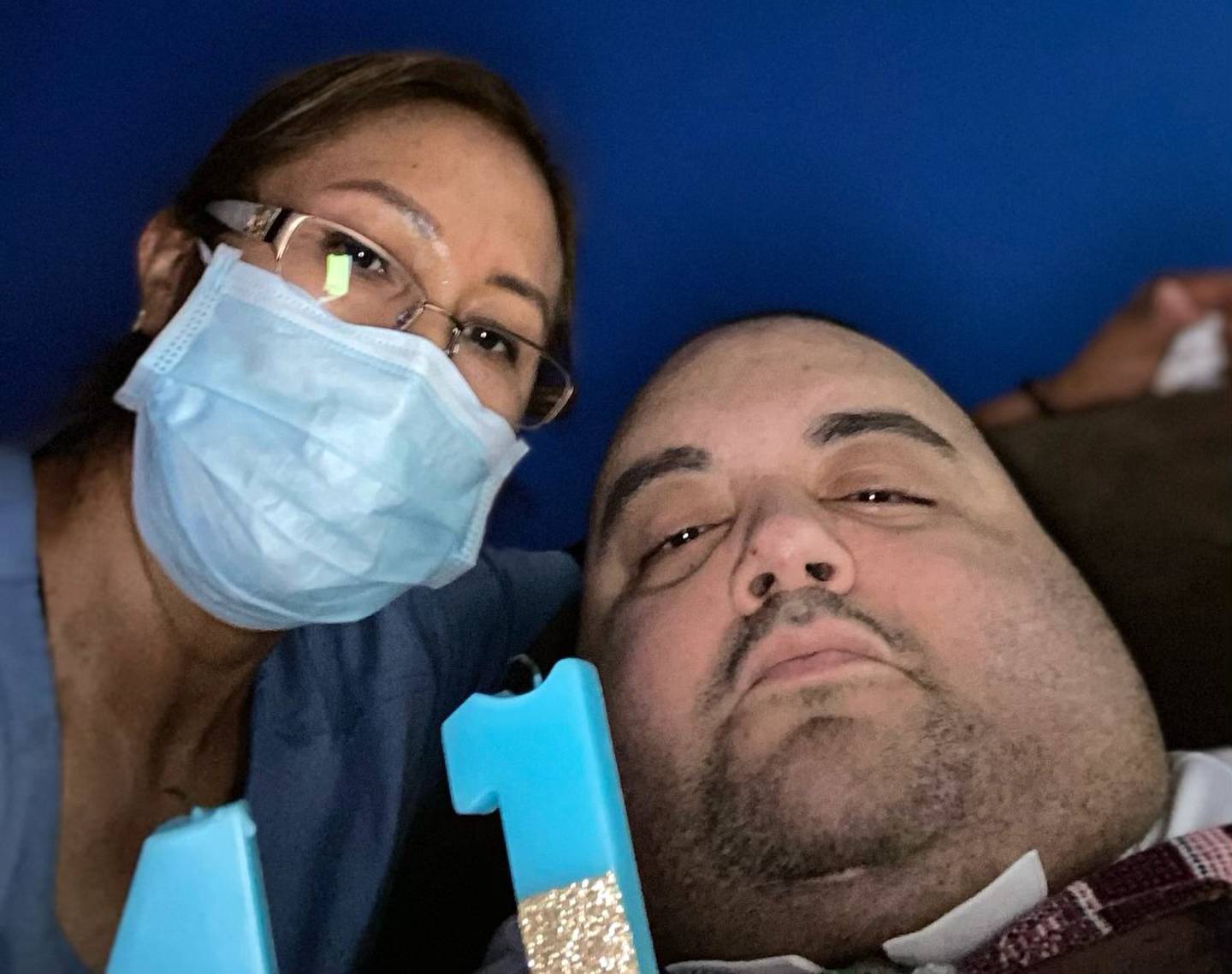
Former Army Sgt. Joel Gomez lies in a nursing home bed, struggling with complications related to the catastrophic injuries he suffered in the Iraq War nearly two decades ago.
The 42-year-old Wheaton man can’t walk, move his arms or use his voice above a short, whispered utterance. And now he can sense something is wrong with his lungs. He feels like he is drowning.
Advertisement
He asks again and again for Elva. Always Elva.
As Gomez’s condition worsens, Elva Cuahquentzi offers encouragement over the telephone from 2,000 miles away. She tells him he’s a fighter, that he’s an inspiration to so many and that she’ll see him soon.
Advertisement
They both know that promise comes with no guarantee. Cuahquentzi’s chances of seeing Gomez again depend on how quickly her immigration papers can move through a bureaucratic system that so far has been indifferent to the urgency she feels or how much a wounded veteran depends on her.
Cuahquentzi, 50, has been Gomez’s caregiver since 2007, when she was hired to help his overwhelmed parents deal with their son’s acute medical needs after he returned from combat in Iraq with a spine broken in two places. A trained nurse in her native Mexico, she quickly took charge of Gomez’s health and provided him with such quality care that as a person with quadriplegia he has been able to stay in his Wheaton home — a one-story, fully accessible house built specifically for him by the community — even after both his parents died.
“Elva truly has kept him alive,” says Gomez’s friend, Michelle Senatore, who led efforts to get a house built for him after he returned from Iraq in 2004. “I have no doubt our American hero would have never made it without her.”
But Cuahquentzi was ordered to return to Mexico last month to rectify her immigration status and has not been allowed back into the country since that time. Records show she was granted permission to reapply for a visa, but her attorneys have said it could take up to two years for the paperwork to be approved.
Without Cuahquentzi to care for him, Gomez was moved to a nursing home in the west suburbs because the U.S. Department of Veterans Affairs had only paid for a caregiver two days a week since his injury and his disability income wasn’t enough to pay for the full-time medical care Cuahquentzi provided at a low price, friends say.
During Gomez’s first three weeks in the nursing home, Cuahquentzi spent her time on the telephone, speaking with him four to five times a day and calling his nurses almost as often. He told her — told everybody, really — that he was terrified of being in a long-term care facility because of the lack of one-on-one care and the increased possibility of contracting COVID, which could be tantamount to a death sentence for someone in his fragile condition.
The situation became even more precarious last week, when Gomez complained of breathing difficulties and a friend called 911 when he believed the nursing home staff wasn’t reacting fast enough. The former soldier was diagnosed with pneumonia and admitted to the intensive care unit at Gottlieb Memorial Hospital in Melrose Park.
As of late Thursday, he was still in the ICU, where the staff placed him on a feeding tube amid concerns about his kidney function and the fluid in his left lung. It’s the second time since moving into the nursing home in early October that he has been hospitalized for a respiratory illness.
Advertisement
Cuahquentzi, who is living with family in Mexico while she awaits her paperwork, cries almost daily. She worries about big things such as his respiratory problems, and small ones like who’s around to scratch his nose when it itches. She blames herself for Gomez’s condition, wishing she had ignored her hearing date and stayed in Wheaton to care for him.
“I love him like he is my own son,” she told the Tribune from her mother’s home in Tlaxcala. “He begged me not to go, and I told him I had to do the right thing. Now I believe I did the wrong thing. It was wrong to leave him.”
Gomez had agreed to speak to the Tribune about Cuahquentzi and his fears of living in a long-term facility, but he was rushed to Gottlieb a day prior to the scheduled interview. He has not been alert enough over the past week to speak with visitors.
Gomez’s friends are trying to find ways to help, including pushing the U.S. government to expedite Cuahquentzi’s immigration application so she can return to Wheaton and care for him. They believe he has survived this long because of the one-on-one care she has given him and his ability to live in his own home.
“Elva has given amazing care to someone who sacrificed greatly for this country,” said Manny Favela, a former McDonald’s executive who befriended Gomez after his injury and now has his power of attorney. “I don’t understand why it has to take two years to approve the paperwork. Joel won’t last more than a year in a nursing home. The situation is dire.”
Terry Masterson, who ran the neighborhood Boys Club that Gomez belonged to as a young boy and remains a friend, said he has seen a sharp decline in Gomez’s physical and mental health since Cuahquentzi left. Masterson was the one who called 911 last week when Gomez experienced breathing difficulties at the nursing home and told multiple people he was “scared” he would suffocate.
Advertisement
As they waited in the hospital emergency department, Masterson said Gomez seemed, for the first time since his combat injury, truly defeated.
“In spite of everything, he’s always tried to put on a happy face,” Masterson said. “But that’s not happening now. He’s depressed, doesn’t have an appetite and is really terrified about his future. No one took care of him and eased his mind like Elva.”
Gomez suffered his devastating injuries on March 17, 2004, when the armored vehicle he was riding in toppled into the Tigris River while on a mission to capture enemy soldiers who had been firing on his base. It’s unknown whether an explosive device caused the incident or if the road crumbled under the Bradley Fighting Vehicle’s massive weight.
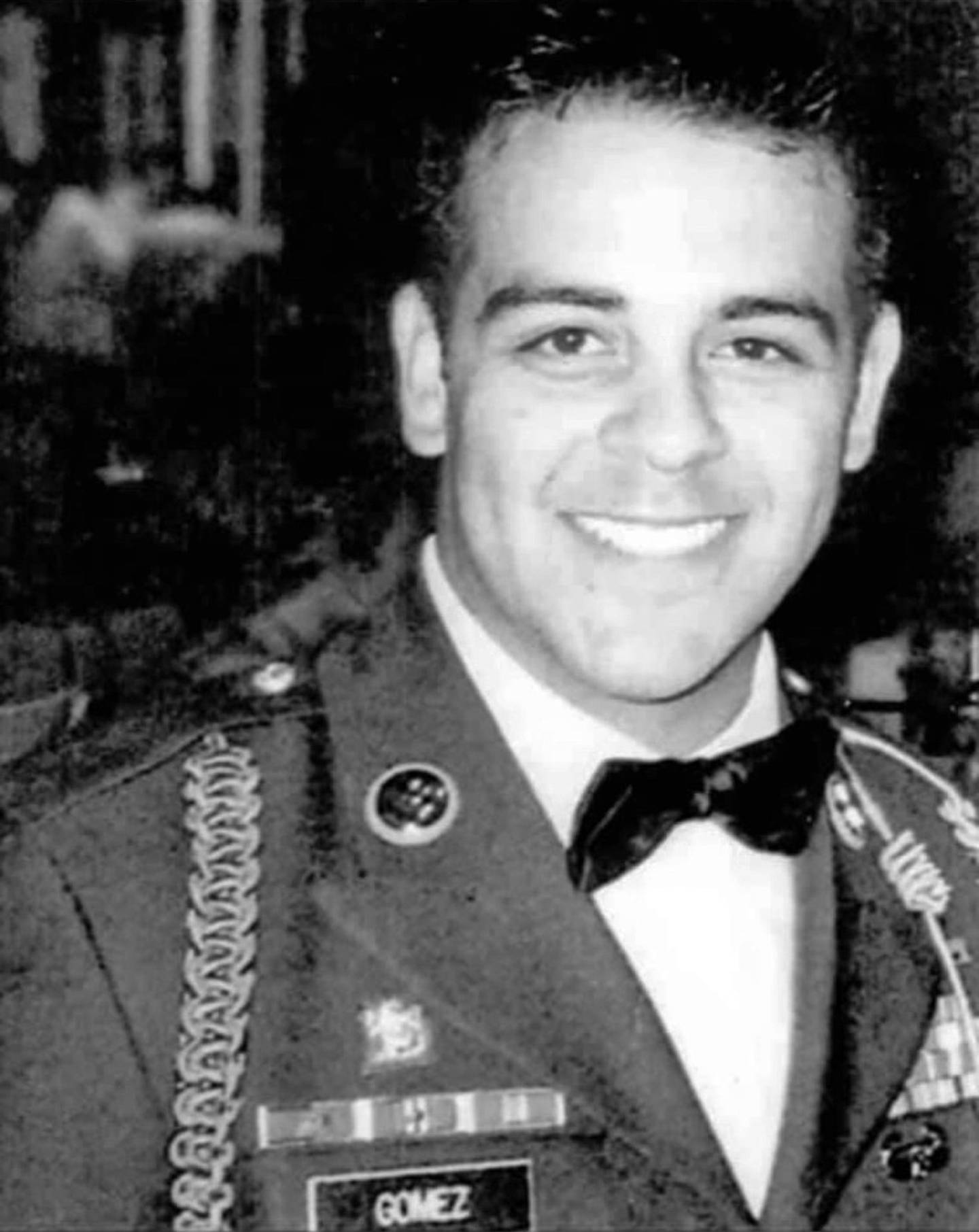
Two of the six soldiers aboard were killed. Gomez, then 23, was found half bent at the waist, with a box of ammunition resting on his back and his spine broken in two places.
He had grown up in Wheaton, an affluent suburb where his family lived in a subsidized apartment complex then-owned by Franciscan nuns. The family’s home was too small to accommodate Gomez’s medical equipment, so the community rallied behind him and built a fully accessible, 2,100-square-foot house on the southeast side of town.
Private donors raised about $300,000 for the home, while 52 contractors, subcontractors and laborers donated materials and time totaling about $375,000. Gomez moved into the home in September 2005, more than a year after being injured.
Advertisement
The situation quickly became too much for his parents, an immigrant couple who had Joel, the youngest of their three children, about seven years after moving to the United States and spoke limited English. His mother, Emilia, and father, Algirmo, have both died in the past two years.
Favela, who helped raise money for the accessible house, recognized the family’s struggle and offered to help keep Gomez’s finances in order and make sure all his many bills were being paid.

Since 2005, Favela — chief financial officer of McDonald’s Latin America division until his retirement in 2016 and the co-founder of Burrito Parrilla Mexicana — has held Gomez’s power of attorney and been his health care advocate. His career, however, has never allowed for him to handle the wounded soldier’s day-to-day needs.
That responsibility has fallen upon Cuahquentzi since 2007, long before both his parents died.
For the past 15 years, she has cared for Gomez, handling everything from clearing his trachea tube and managing his bowel care to dressing and bathing him each day. She clips his nails, keeps him clean shaven and makes his favorite meals. She maintains strict COVID protocols, requiring masks and vigorous hand washing before anyone enters his bedroom. She takes pride in the fact that he has never tested positive.
Gomez’s sister, a single mother of three who works outside the home, lives with him and handles nighttime duties after Cuahquentzi leaves for the day. When medical emergencies arise in the middle of the night, however, she often calls Cuahquentzi for help. And if he has to go to the hospital, Cuahquentzi goes too, serving as Gomez’s on-site advocate as she provides the doctors with his medical history and details the many medications he takes.
Advertisement
“She is Joel’s voice,” Favela said. “He has become her world.”
During hospital stays, Cuahquentzi has always made sure the nurses move Gomez constantly to ward off pressure sores that could threaten his life. She showed the staff how to turn him so it causes him the least discomfort possible.
“Sometimes I’m not always the most popular with the nurses, but I’ve learned his body like it was my own,” she said. “I know when he’s suffering.”
Janet Duncan, a home caregiver who has cared for Gomez four evenings a week for the past two years, praises Cuahquentzi’s work. She told the Tribune she has rarely seen Gomez with sores, despite the fact that he’s at high risk of developing them because he’s confined to his bed.
Duncan has visited Gomez in the past month. She says she has seen signs that he’s not receiving the same care as Cuahquentzi provides. He’s rarely clean shaven, she says, and the normally smooth skin on his legs became dry and flaky in the nursing home, suggesting he’s not drinking enough water. He also developed a bedsore within his first month at the nursing home.
She calls or texts Cuahquentzi before, during and after each visit.
Advertisement
“He needs Elva,” Duncan said. “She helped him create a sense of independence and control over his own life. It’s not too much for him to ask, especially when he has sacrificed so much for this country already. I keep asking myself, ‘how did we get here?’ ”
Cuahquentzi told the Tribune she and her two young sons came to the United States in 2005 at her then-husband’s insistence. She said she knew she didn’t have the proper paperwork when she crossed the border illegally, but she believed it was the only way for her boys to grow up with their father.
After settling in Elgin, she said, her husband left her. She married a permanent U.S. resident several years later and he adopted her youngest son in 2016, which put him on a potential path to citizenship. Her older son had already received permanent legal status through the DREAM Act.
With both her boys planning to stay in the United States, Cuahquentzi said she wanted the official papers, as well. She said she had felt guilty about not following the proper procedures when she immigrated nearly two decades ago and she believed her marital status, her sons’ citizenship and her long employment history with Gomez would make the process easier for her.
She filed the necessary paperwork and was told she had fly to Ciudad Juárez for an interview with the U.S. consulate. According to documents reviewed by the Tribune, the consulate found she had been in the United States illegally but could reapply for an immigrant visa.
Afternoon Briefing
Daily
Chicago Tribune editors’ top story picks, delivered to your inbox each afternoon.
Cuahquentzi’s attorney has told her the process could take up to two years, but the U.S. Department of Homeland Security has a long-standing practice of expediting applications in “extraordinary circumstances.” Gomez’s friends have appealed to U.S. Sen. Tammy Duckworth, who lost both her legs while serving as an Army helicopter pilot in Iraq, for help.
Advertisement
In the meantime, Gomez’s future remains uncertain. After the Tribune inquired about the situation, a VA spokesman said the federal agency “recently authorized additional care up to 12 hours a day and (he) will soon receive these services.”
Per Gomez’s request before he became incommunicative, he will be transferred to the ICU unit at Hines VA Hospital as soon as space becomes available.
“VA is committed to always providing world-class care and benefits to our veterans who earned and deserve that care,” the spokesman said. “We have personally looked into this situation and are working closely with the veteran.”
While welcoming the federal agency’s help, Favela said he can’t imagine a long-term solution that doesn’t include Cuahquentzi.
“If Elva comes back, then all the problems go away,” Favela said. “If not, his life is in the VA’s hands and I don’t know what will happen.”


