


Close Menu
  • Home
  • News
    • Local
  • Opinion
  • Business
  • Health
  • Education
  • Sports
  • Podcast

Subscribe to Updates

Get the latest creative news from FooBar about art, design and business.

What's Hot

Houston Texans’ Brandon Codrington Returns Home to Inspire Young Athletes at Free Youth Football Camp

This Play Doesn’t Just Portray Church. It Becomes Church.

Forgotten No More: Remembering Hattie Wooten Lewis, a Pioneer Who Provided Safety for Weary Black Travelers

Facebook X (Twitter) Instagram
  • Lifestyle
  • Podcast
  • Contact Us
Facebook X (Twitter) Instagram Pinterest Vimeo
The Windy City Word
  • Home
  • News
    1. Local
    2. View All

    Uncle Remus Says Similar Restaurant Name Is Diluting Its Brand and Misleading Customers

    Youth curfew vote stalled in Chicago City Council’s public safety committee

    Organizers, CBA Coalition pushback on proposed luxury hotel near Obama Presidential Center

    New petition calls for state oversight and new leadership at Roseland Community Hospital

    Houston Texans’ Brandon Codrington Returns Home to Inspire Young Athletes at Free Youth Football Camp

    The Plastic Problem Black Men Can’t Ignore

    What the Supreme Court’s Trans Sports Ruling Means

    Photo Gallery: FIFA Fan Festival keeps drawing massive crowds in Atlanta

  • Opinion

    Rep Davis, Olive Post CDR., Call on Trump to Restore file of Black Vietnam War Hero to Website

    Capitalize on Slower Car Dealership Sales in 2025

    The High Cost Of Wealth Worship

    What Every Black Child Needs in the World

    Changing the Game: Westside Mom Shares Bally’s Job Experience with Son

  • Business

    Illinois Department of Innovation & Technology supplier diversity office to host procurement webinar for vendors

    Crusader Publisher host Ukrainian Tech Businessmen eyeing Gary investment

    Sims applauds $220,000 in local Back to Business grants

    New Hire360 partnership to support diversity in local trades

    Taking your small business to the next level

  • Health

    The Plastic Problem Black Men Can’t Ignore

    Construction Site Injury Claims Shortchange Workers Most Exposed

    Black Women’s Deaths Are Exposing a Crisis We Can’t Ignore

    Mental Wellness Deserves a Bigger Seat at the Healthcare Table

    The Injury Compensation Mistakes Most People Don’t Realize They’re Making

  • Education

    Nurture, Inc., Negro Southern League Museum Look to Preserve History While Healing the Community

    Military Child Care, a National Model, Faces Limitations

    COMMENTARY: Joy of Educating Black Boys

    ‘Find a Way or Make a Way’: Congresswoman Nikema Williams Announces $250,000 in Campus Security Funding for CAU

    How UNCF is Cultivating the Next Generation of Legacy Leaders

  • Sports

    Houston Texans’ Brandon Codrington Returns Home to Inspire Young Athletes at Free Youth Football Camp

    What the Supreme Court’s Trans Sports Ruling Means

    Photo Gallery: FIFA Fan Festival keeps drawing massive crowds in Atlanta

    Isaac Cook: A Local High School Standout to Watch

    Photo Gallery: The FIFA World Cup 2026™ Vibes are in Atlanta!

  • Podcast
The Windy City Word
Entertainment

Op-Ed: Black Music Is Not Just Entertainment. It Is Survival.

staffBy staffUpdated:No Comments4 Mins Read
Facebook Twitter Pinterest Telegram LinkedIn Tumblr Email Reddit
Share
Facebook Twitter LinkedIn Pinterest WhatsApp Email

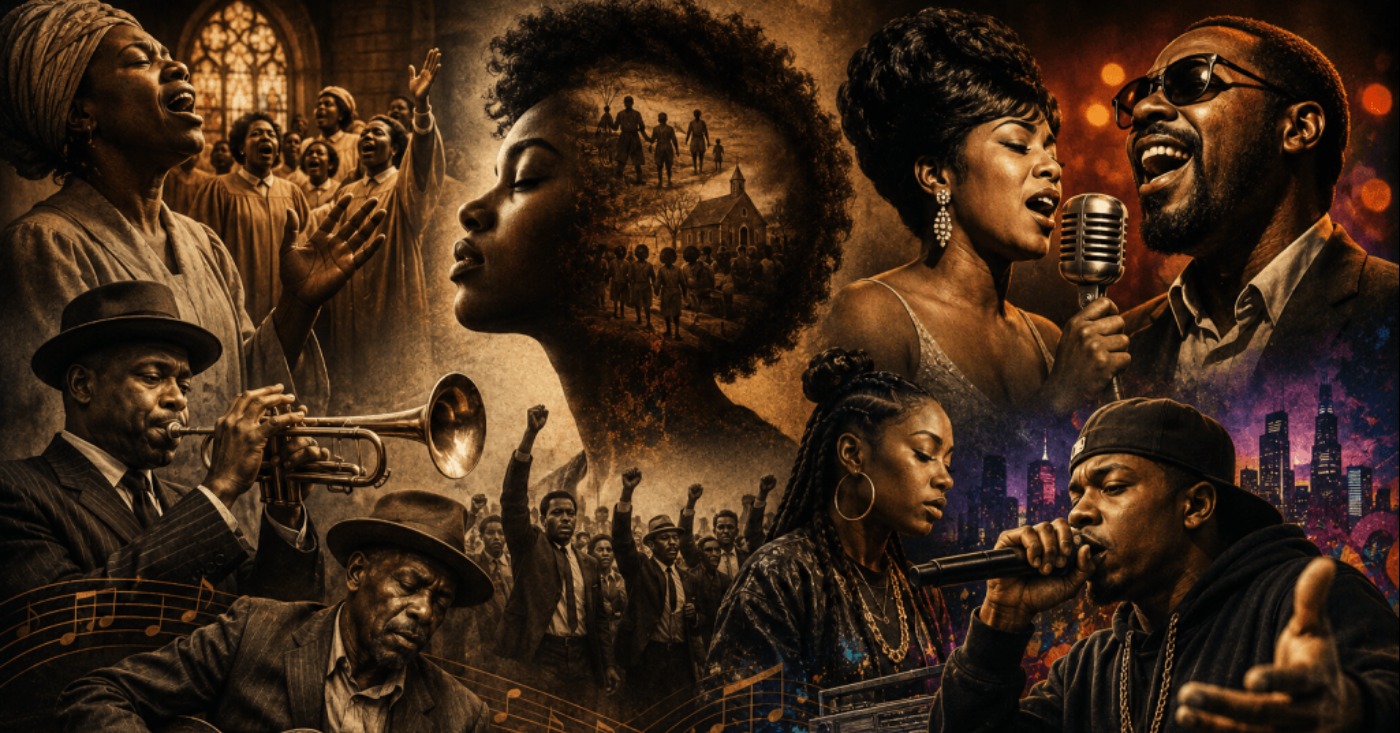
Long before history books or mainstream media documented the Black experience, spirituals, blues, and gospel music served as the community's primary archive of survival and resistance. Credit: Gemini

Long before Black Americans held political power, built economic influence, or could count on equal protection under the law, we had something untouchable. We had our music.

Before we owned radio stations, record labels, or corporate boardrooms, we had music. Before our stories made it into mainstream history books, they lived in our melodies. Long before America was willing to actually listen to our voices, we found a way to make sure it could never ignore our sound.

Black Music Month is over, but it’s incredibly easy to let the celebration stay on the surface. We praise the chart-topping hits, replay legendary award show clips, and dance to the tracks dominating our social media feeds. We debate the classic albums, rank the best vocalists, and argue over who belongs on music’s Mount Rushmore.

There is absolutely nothing wrong with any of that.

But if we only treat Black music as entertainment, we miss the entire point.

More than just a playlist, Black music has served as armor, history, and a powerful tool for survival across generations of American history. Credit: Getty Images

Black music has never just been about making people dance; it has always been about helping people endure. It is the most accurate, unfiltered historical archive of the Black experience ever created. For generations, when mainstream institutions refused to document our humanity, our music did the heavy lifting. When textbooks omitted us, songs remembered. When newspapers ignored us, songs testified. When laws oppressed us, songs fought back.

The spirituals sung by enslaved Africans weren’t just religious expressions. They were literal roadmaps, warnings, and coded escape routes sung right under the noses of overseers. Imagine the sheer courage it took to create beauty while enduring that level of brutality. That isn’t entertainment and defiance.

Then came the blues, born out of the cotton fields and back porches of the South. The blues gave Black people permission to speak out loud about heartbreak, poverty, and systemic injustice. It said, “This happened to me, and I am still here.” It taught generations that our individual stories mattered, even if the rest of the country wanted us to suffer in silence.

Gospel music carried that exact same spirit straight into church sanctuaries. During the heaviest years of Jim Crow, gospel became fuel for weary spirits, reminding people they were infinitely more than what a segregated society labeled them. It’s no coincidence that the songs echoing through Sunday morning pews became the same anthems fueling the Civil Rights Movement on Monday morning. The soundtrack of liberation was sung before it was ever written into law.

As the decades marched on, every genre inherited that same assignment. Jazz put Black genius on display and challenged musical convention. Soul music wrapped heavy political messages inside irresistible grooves. Funk celebrated Black joy unapologetically, while R&B chronicled our love stories and aspirations. And hip-hop gave neighborhoods a megaphone the government tried to make invisible.

You can learn everything you need to know about the Great Migration, economic hardships, and cultural triumphs simply by putting on headphones. Our artists have always stepped up as our community journalists and archivists.

When Billie Holiday sang “Strange Fruit,” she forced America to look at the horrors of lynching. When Nina Simone sang “Mississippi Goddam,” she turned performance into direct protest. Marvin Gaye asked “What’s Going On?” during a nation in turmoil, Public Enemy educated an entire generation on systems of power, and today, Kendrick Lamar continues that exact same lineage by dissecting race, trauma, and survival.

Different eras, different sounds—but the exact same job description: tell the truth.

That responsibility feels heavier today than ever. We are living through a time when efforts to rewrite history, sanitize uncomfortable truths, and erase Black stories from classrooms have become standard political battlegrounds.

But Black music is too stubborn to copyedit. It refuses to forget, and it refuses to let us forget. Every beat carries a memory. Every lyric carries a legacy.

This June, we need to listen differently.

When the bass drops, listen to the history. When the choir swells, listen for the endurance. When the lyrics hit a little deeper than usual, remember you aren’t just hearing a song—you are hearing survival. You are listening to the sound of a people who, when stripped of nearly everything else, used the rhythm of their own heartbeats to reshape the entire world.

So by all means, celebrate the artists. Attend the concerts, buy the albums, and dance until your feet hurt. But never forget that Black music is more than a soundtrack. It is our armor, it is our testimony, and it is the reason we are still here.

Based on reporting by Houston Defender.


The post Op-Ed: Black Music Is Not Just Entertainment. It Is Survival. appeared first on BlackPressUSA.


Share. Facebook Twitter Pinterest LinkedIn Reddit WhatsApp Telegram Email
Previous ArticleEnding Haitians TPS Send Shock Waves Through the Community
Next Article COMMENTARY: It Is Time to Redraw the Revolution, Again
staff

Related Posts

This Play Doesn’t Just Portray Church. It Becomes Church.

Forgotten No More: Remembering Hattie Wooten Lewis, a Pioneer Who Provided Safety for Weary Black Travelers

COMMENTARY: America Hangs a Help Wanted Sign: “FOR U.S. CITIZENSHIP – WHITES ONLY!”

Leave A Reply Cancel Reply

Video of the Week
https://www.youtube.com/watch?v=AxFXtgzTu4U
Advertisement
Video of the Week
https://www.youtube.com/watch?v=OjfvYnUXHuI
ABOUT US


The Windy City Word is a weekly newspaper that projects a positive image of the community it serves. It reflects life on the Greater West Side as seen by the people who live and work here.

OUR PICKS

Sober in the city: Rethinking celebration in Chicago

Bounce’s New Sitcom ‘Mind Your Business’ Follows Chicago’s Williams Family’s Party-Throwing Exploits

LIVE! — 2024 ELECTION – TAP IN WITH THE BLACK PRESS

MOST POPULAR

The Plastic Problem Black Men Can’t Ignore

Construction Site Injury Claims Shortchange Workers Most Exposed

Black Women’s Deaths Are Exposing a Crisis We Can’t Ignore

© 2026 The Windy City Word. Site Designed by No Regret Medai.
  • Home
  • Lifestyle
  • Podcast
  • Contact Us

Type above and press Enter to search. Press Esc to cancel.