




For months, Karian had tried to make it on her own in New York.
After the birth of her second daughter, she was diagnosed with postpartum depression, major depressive disorder and anxiety. A single mother who had moved from Boston to New York about 13 years ago, she often spent days at a time on the couch, unable to do more than handle the basics for her daughters.
“I wasn’t taking care of myself,” she said softly on a recent afternoon. “I was not really present.” The Hechinger Report is not publishing her last name to protect her privacy.
Karian’s mother urged her to move back home to the Boston area and offered to house her and her daughters temporarily. She started working the night shift at a fast food restaurant to save up for her own place while her mother and sister watched her children.
But in a city where fast food wages aren’t enough to pay the rent, her efforts felt futile. And then, a month after moving in with her family, her mother’s landlord told her the apartment was overcrowded and she had to leave. Karian and her girls, then 7 years old and 8 months old, moved into a homeless shelter, where her depression and anxiety worsened.
“I tried my best, but it’s not their home,” said Karian, now 31.
Karian’s children had joined the growing ranks of very young children experiencing homelessness. Between 2021 and 2023, the number of homeless infants and toddlers increased in 48 states and the District of Columbia. The most recent estimates found that in 2023 nearly 450,000 infants and toddlers in the United States were in families that lacked a stable place to live. That was a 23 percent increase compared to 2021, according to a report released last year by the nonprofit SchoolHouse Connection in partnership with Poverty Solutions at the University of Michigan.
The numbers could be even higher, experts worry, because “hidden homeless” children — those who are doubled up in homes with family or friends or living in a hotel — may not be captured in tallies until they start school.
High prices for diapers and formula, the exorbitant cost of child care, the rising cost of living, and rising maternal mental health challenges all contribute to the growing rate of homelessness among very young children, experts say. In 2024, one-third of infants and toddlers were in families that struggled to make ends meet, according to the nonprofit infant and toddler advocacy organization Zero to Three.
“We’re talking about families who have generationally been disadvantaged by circumstance,” said Kate Barrand, president and CEO of Horizons for Homeless Children, a nonprofit that supports homeless families with young children in Massachusetts. “The cost of housing has escalated dramatically. The cost of any kind of program to put a child in, should you have a job, is escalating,” she added. “There are a lot of things that make it really hard for families.”
Housing instability is dire for anyone, but particularly for young children, whose brains are rapidly growing and developing. Studies show that young children who are homeless often lag behind their peers in language development and literacy and struggle to learn self-regulation skills, like being able to calm themselves when feeling angry or sad or transition calmly to new activities. They also may experience long-term health and learning challenges.
Early childhood programs could provide a critical source of stability and developmental support for these children. But SchoolHouse Connection found only a fraction of homeless children are enrolled in early learning programs, and the percentage who are has decreased over the past few years.
“It’s not just incredibly tragic and sad that infants and toddlers are experiencing homelessness,” said Rahil Briggs, national director of the nonprofit Zero to Three’s HealthySteps program, which works with pediatricians to support the health of babies and toddlers. The first few years are also a “disproportionately important” time in a child’s life, she added, because of the brain development that’s happening.
Karian and her daughters faced new difficulties after they moved into a shelter.
They shared an apartment with another family. If the other family was using the shared common space, Karian tried to give them privacy, which meant keeping her children in the bedroom the three of them shared.
Her older daughter had to change schools, and left without getting to say goodbye to many of her friends. At her new school, her grades dropped. The baby developed a skin condition and there was a bedbug infestation at the shelter. Karian didn’t want to put her on the floor for tummy time. She was desperate to find a home.
“We were in a place where we couldn’t really make noise. I couldn’t really let them be kids,” she said.
The rise in housing insecurity among young children has created more demand for programs created specifically to meet the unique needs of children who are experiencing instability and trauma. Many of these programs offer support to parents as well, through what is called a “two-generation” approach to support and services.
In 2021, in response to ballooning child homelessness rates, Horizons opened the Edgerley Family Horizons Center, an early learning program that serves children from 2 months to 5 years old. While some families find Horizons on their own, many are referred by shelters around the Boston area. The need is great: Edgerley serves more than 250 children, with a waitlist of 200 more. Karian’s younger child was one of those who got a spot soon after the program opened.
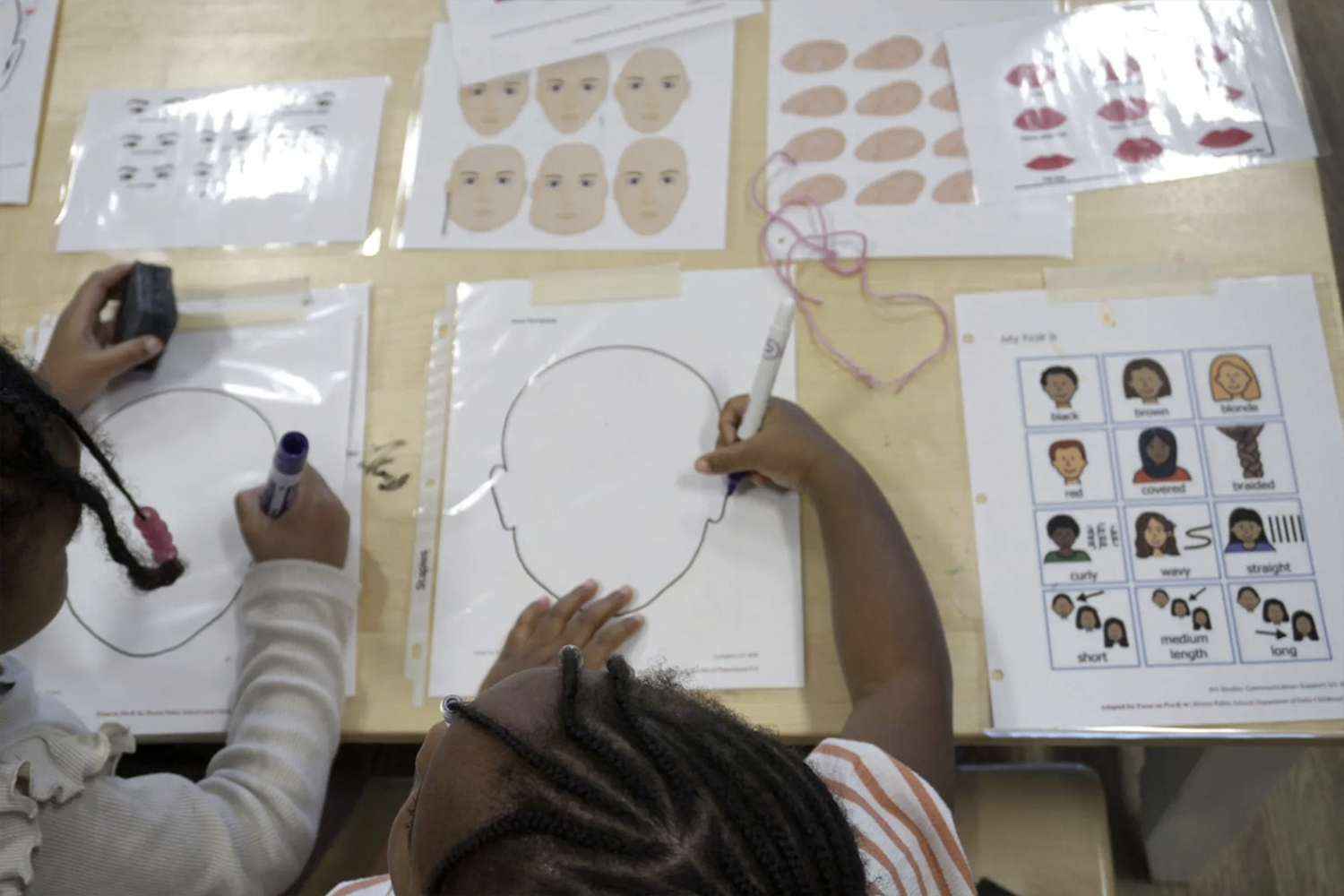
Inside Horizons’ large, light-filled building on the corner of a busy street in Boston’s Roxbury neighborhood, every detail is tailored to the needs of children who have experienced instability. Walls are painted in soothing blues and greens. Each classroom has three teachers to maintain a low child-to-staff ratio. Many of the teachers are bilingual. All educators are trained in how to build relationships with families and gently support children who have experienced trauma.
The starting salary for teachers is $54,200 a year, far more than the national median for childcare workers of $32,050 and the Massachusetts median of about $39,000. That has encouraged more teachers to stay on at the center and provide a sense of security to the children there, said Horizons CEO Barrand.
In the infant room, teacher Herb Hickey, who has worked at Horizons for 13 years, frequently sees infants who are hyperaware, struggle to fall asleep, can’t be soothed easily or cling desperately to whichever adult they attach to first. The goal for the infant teachers, he said, is to be a trusted, responsive adult who can be relied on.
Every day, the teachers in the infant room sing the same songs to the babies. “When they hear our voices constantly, they know they’re in a safe space,” Hickey said. “This is calm.”
Teachers also follow the same familiar routines. The rooms are decorated simply, organized and filled with natural light. Teachers constantly scan the infants for signs of distress.
“We have to be even more responsive,” Hickey said. “When the child starts crying, we don’t have the convenience to say, ‘I know you’re hungry, I’ll get to you.’” He said teachers want even the tiniest babies to learn that “we’re not going to leave you crying.’”
Other needs arise with Horizons’ youngest children: Infants and toddlers living in homeless shelters often lag in gross motor skills. Many spend time on beds rather than on playmats on the floor, or they are kept in car seats or in strollers to keep them safe or from wandering off. That means they’re missing out on all the skills that come from active movement.
Even the arrangement of toys at the center has a purpose. Staff want children to know they can depend on toys being in the same location every day. For many children, those are some of the only items they can play with. Families entering a shelter environment can usually only bring a few bags, with no room for toys or books. A toddler who recently entered a shelter where Horizons runs a playroom came in holding a small empty chip bag, recalled Tara Spalding, Horizons’ chief of advancement and playspace. When a shelter staff member threw it away, the boy was inconsolable. “This is the only toy my child has,” staff recalled the mother saying.
“This just shows the sheer poverty,” said Spalding.
As infant and toddler homelessness has increased, other cities and states have tried to provide more support to affected families and get a better sense of their needs. In Oklahoma, experts say, low wages, a lack of housing and eviction laws that favor landlords have led to rising homelessness rates. State officials are trying to gather better data about homeless families to determine the best use of resources, said Susan Agel, chair of Oklahoma’s Homeless Children and Youth Steering Committee. Their efforts are hampered, however, by the fact that many homeless families fear that their children will be taken away by child protective services because they are homeless.
In 2024, to fill that gap in data, the state launched a residency questionnaire given to every K-12 student that includes new questions about homelessness, including if there are younger children in the home who are not students and may not otherwise be counted in homeless populations. Officials say it isn’t a perfect solution, but it’s a start to get a sense of the severity of family homelessness. “We can’t devise a system for dealing with a problem if we don’t know what the problem is,” said Agel.
In Sioux Falls, South Dakota, city officials have ramped up efforts to coordinate city agencies to respond to an increase in homelessness among infants and toddlers.
“In general, the families we see more often have younger children. The school offers so much support, and there’s limited daycare access” to get similar support for infants and toddlers, said Tommy Fuston, Community Services and Housing Navigator at Minnehaha County’s Department of Human Services. “If a family has younger children, they’re going to struggle more.”
Each week, officials from the city, the Sioux Falls School District, local early childhood programs and shelters hold a “care meeting” to make sure any homeless families, or families at risk of homelessness, are quickly connected to the right resources and receive follow-up. “We don’t have unlimited resources, but I think it maximizes the resources that we do have,” Fuston said. “We’ve tried to create a village of supportive services to wrap around these folks.” The city relies extensively on private and faith-based donations to help. All shelters in town are privately funded, for example.
Karian heard about the child care center run by Horizons from a social worker soon after she and her daughters moved into their Boston-area shelter. In the infant room, her youngest daughter quickly settled into a routine, something Karian said didn’t happen when the baby was watched at night by family members. When staff identified speech and developmental delays, they helped connect Karian to an early intervention program where her daughter could receive therapy. Now 4 years old and in pre-K at Horizons, “she’s thriving,” Karian said. “She’s getting that nourishment.”
Karian also received support. Each family at Horizons is assigned a coach to help parents set personal goals and connect with resources. The organization offers classes in computing, financial management and English, all within the early learning building.
Two months after setting goals with a family coach, Karian earned her GED, with the help of the child care assistance. A few months later, she graduated from a culinary training program. She now works a steady job as a cafeteria manager for a local school district, where she earns a salary with benefits.
After a year in the shelter, her family was approved for subsidized housing and moved into their own apartment. Horizons allows families to stay in its programs for at least two years after they secure housing to make sure they are stable.
Now, Karian has her sights set on eventually opening a restaurant. She also has big dreams for her daughters, something that once seemed out of reach. She wants them to have ambition to “work towards something big,” she said. “I want them to have a dream and be able to achieve it.”
Experts say there are larger policy changes that could help families like Karian’s: increasing the minimum wage, expanding child care options like Head Start, which saves a portion of seats for homeless children, and offering more affordable housing to low-income families, to start.
Providing more federal money to the programs that help poor families pay for child care could also help. Those programs require states to prioritize homeless children and give them the first opportunity to access that money.
While important, experts argue, these solutions shouldn’t need to exist in the first place.
“We should be able to come to an agreement as a society that we should prioritize keeping families with infants and toddlers in their homes,” said Melissa Boteach, chief policy officer at Zero to Three. “Babies shouldn’t be homeless.”
This story was produced by The Hechinger Report, a nonprofit, nonpartisan news outlet focused on education.