



They light up the night on the darkest days of the year.
They delight small children and let the neighbors know that you have goodwill to spare.
Advertisement
And in the LED era, they’re cheaper and more energy efficient than ever before.
What could possibly be wrong with holiday lights?
Advertisement
To some extent, those brightly twinkling bulbs are a victim of their own success. The holiday-light-induced brightness has become so intense that by 2013 NASA scientists could detect it from outer space. Nighttime lights shine 20% to 50% brighter in many U.S. cities during Christmas and New Year’s when compared with light output during the rest of the year, satellite data shows.
And that’s a concern at a time when studies show that a wide range of animals are affected by artificial lighting at night: migrating birds crash into brightly lit skyscrapers, hatchling sea turtles get disoriented and fail to reach the safety of the ocean, young Atlantic salmon abandon their usual migration schedules, and least horseshoe bats delay foraging for food.
“I don’t think most people would really think that throwing up some holiday lights would have any effect,” said Scott Henke, a Regents professor in the department of rangeland and wildlife sciences at Texas A & M University in Kingsville, who drew attention to the issue with a recent study showing that his local eastern fox squirrels are more likely to forage at night — and be eaten by predators — when a lot of bright holiday lights are in use.
“Everything does have an effect,” Henke said. “And in this case, in some wildlife species, it could be negative.”
The point isn’t to refrain from all holiday lighting, according to Brett Seymoure, an assistant professor at the University of Texas at El Paso who studies the effects of light pollution on animals.
“You live in the Northern Hemisphere,” Seymoure said with a chuckle. “It’s super cold outside. You don’t have that much going on. Life is hard. If you want to have Christmas lights — do it. I’m going to put some up.”
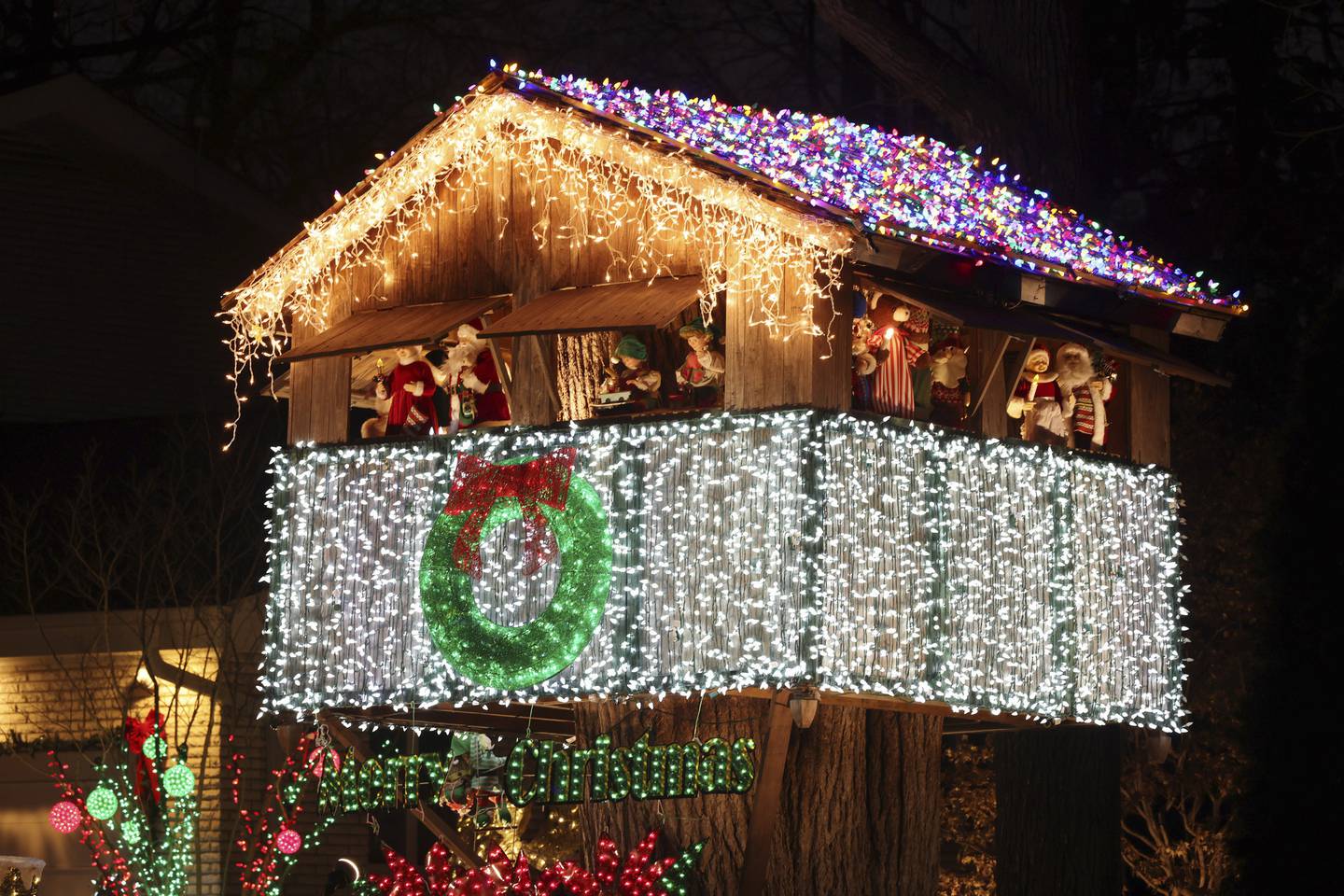
But Seymoure said you can minimize the risk to wildlife by following a few simple steps. First, he said, limit the area you illuminate and reduce any stray light going up into the sky or into natural habitats. If you use flood lights, use filters, and make sure the light beams are only hitting a building and not pointing up into the sky. In the case of string lights, avoid putting them on the roof or high up in trees. Surrounding windows and doors with string lights is a better option, as your roof will help block the light traveling upward.
Second, Seymoure said, limit the amount of time your lights are on. A modest 6 to 9 p.m. light show — aided by a timer — strikes Seymour as reasonable, with maybe an exception for Christmas Eve.
Advertisement
And finally, color counts. Stay away from blue and daylight white lights. Holiday lights with longer wavelengths are healthier for most insects and mammals, including humans. Seymour suggests reds, oranges, yellows and even greens.
The risk of directly harming animals with holiday lights is low in cold northern climates such as Chicago’s, when many creatures have already migrated or gone into hibernation or dormancy, Seymour said. But trees, which respond strongly to the length of daylight, could still be affected.
For instance, a tree could respond to the added brightness of holiday lights, combined with a warm spell in January, by starting to bud and leaf too early. A subsequent freeze would then kill the buds and leaves, potentially eliminating an entire season of pollen and nuts or berries.
That, in turn, would affect squirrels, birds and insects.
“If you disrupt the trees, you’re going to disrupt the insects, and from there, everything’s going to be messed up,” Seymoure said.
Further south, in Florida or El Paso, where Seymoure lives, wildlife is more active in winter, and holiday lights are more of a threat. His tentative plan this year is to use red lights outdoors and bring his white lights inside.
Advertisement
There have been few studies on holiday lights and wildlife, but there’s now a robust body of research showing that artificial light at night is a problem for animals, plants and ecosystems, Seymoure said.
Almost all multicellular organisms have systems for detecting night and day, including humans, who have light receptors that tell our bodies to turn on and off the hormone melatonin. Melatonin, in turn, tells our bodies when to eat, sleep, and power up our immune systems.
Afternoon Briefing
Daily
Chicago Tribune editors’ top story picks, delivered to your inbox each afternoon.
Artificial light at night can disrupt those cycles, with effects on both individuals and entire ecosystems, Seymoure said. We still don’t know how big those effects might be, he said.
In one of the few studies to address holiday lights specifically, Henke and his co-authors focused on the extensive holiday lighting program at the Kingsville campus of Texas A&M.
The trunks of campus trees are wrapped with white string lights, from the base of the tree to 13 feet above the ground. The effect is dramatic, with light intensity increasing as much as 15-fold near the trees. The lights burn nightly in December.
Henke’s team tracked eastern fox squirrels and found that the animals generally forage for food by day and retreat to their roosts before sunset. But that wasn’t the case during December, when the holiday lights were in use. The squirrels routinely foraged after sunset, and were more likely to be killed by feral cats and owls, which often hunted in twilight or darkness.
Advertisement
The study, which began as a student research project, offers a concrete example of how wild animals can be harmed by holiday lights.
“We did it as more of a public interest type of thing, just to make people aware,” Henke said.


