




DR. MAE JEMISON
1870—Congress passes the first Enforcement Act providing stiff punishment for both private citizens and public officials who conspired to deprive the recently freed slaves of either their civil rights or their right to vote. The Act was in response to the old plantation aristocracy and the defeated rebel soldiers who were taking control of Southern governments and enacting “Black Codes” aimed at the suppression of Black freedoms and voting rights. The Act was also in response to the growing power of White terrorist organizations such as the Ku Klux Klan.
1921—The infamous and bloody Tulsa (Oklahoma) Riots begin. Whites go on a violent rampage lasting several days. When the rioting was over, an estimated 21 Whites and 60 Blacks were dead. In addition, as many as 15,000 Blacks were left homeless as hundreds of homes and businesses were burned to the ground. The area bearing the brunt of the destruction was known as the “Black Wall Street” because of its large number of African American owned businesses. As recently as 2007, Detroit Congressman John Conyers was working on legislation designed to give the few remaining Black survivors of the rioting additional time to sue in order to recover some of their loses. The rioting was reportedly sparked by a false claim from a White female elevator operator of being assaulted by a Black man. But White jealousy of Black success in the Tulsa area may have also played a major role.
1835—The Fifth National Negro Convention convenes in Philadelphia, Pa. The gathering of free Blacks demonstrated how history can sometimes come full circle. One major focus of the convention was to urge Blacks to stop referring to themselves as “Africans,” “Blacks” or “Coloreds” and instead adopt the word “Negro” as the official racial designation. Gradually, the designation became popular even though all Blacks did not agree with it. Researcher Richard Benjamin Moore writes that at the time some Blacks felt word “Negro” was “a symptom of the degrading sickness of opportunism and the increasing acceptance of inferior social and political status.”
1864—Solomon George Washington Dill is murdered by angry Whites. Dill was one of those rarities in Southern society—a poor White man who supported an end to slavery and Black demands for social justice. Dill’s “crime” was giving what some Whites considered “an incendiary speech” to a group of South Carolina Blacks.
1973—Detroit’s WGPR becomes the nation’s first Black-owned television station. It was granted a license to operate on this day in 1973 but did not actually go on air until September 1975.
June 2
1863—Abolitionist and “Underground Railroad Conductor” Harriet Tubman leads a force of Union Army guerrilla soldiers into Maryland and frees more than 700 slaves. Tubman was one of the most noteworthy women in the anti-slavery struggle prior to the Civil War and became a leading voice in the call for the federal government to allow Blacks to fight in the war.
1899—African Americans observe a “National Day of Fasting” to protest lynching and other racial attacks against Blacks. The day of protest was called by the National Afro-American Council.
1975—James A. Healy becomes the first Black Roman Catholic Bishop in the United States. He was consecrated at the Roman Catholic cathedral in Portland, Maine.
June 3
1904—Dr. Charles R. Drew is born. He grows up to conduct a first of its kind research in blood transfusions and the creation of blood plasma. Drew also established Britain’s first blood bank and in the United States he fought against the segregation of blood based on race. He died on April 1, 1950 as a result of injuries received in an automobile accident while driving in North Carolina.
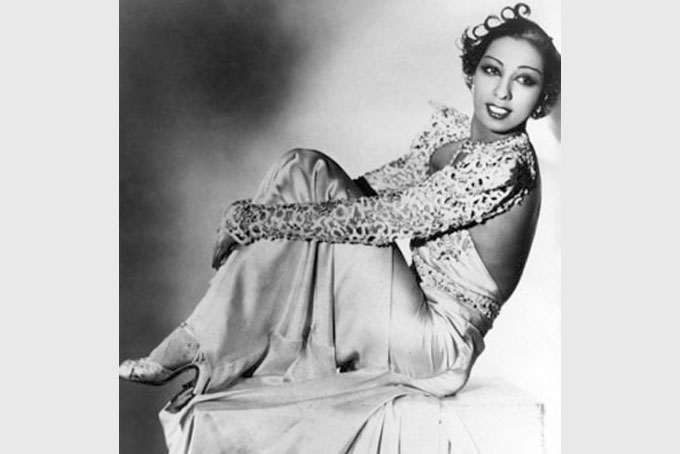
1906—Entertainer Josephine Baker is born in St. Louis, Mo. At 16, she starred in the hit and controversial musical “Shuffle Along.” However, she did not achieve fame until she left the United States and moved to Paris, France, where her exotic dancing and singing made her an international sensation. Baker was mixed race of African American and Native American parentage. She returned to the U.S. several times including in 1963 to speak at the Dr. Martin Luther King-led March on Washington for civil rights.
1922—Samuel L. Gravely is born. Gravely became the first African American admiral in the United States Navy and the first African American to command a U.S. warship. The Richmond, Va., native died in 2004 at the age of 82.

1972—College professor and activist Angela Davis is acquitted of charges that she assisted and conspired with the young men involved in a deadly 1970 shootout at the Marin County courthouse in California. The assault on the courthouse was an attempt to free imprisoned Black activist George Jackson. At least three people were killed during the escape attempt. Davis, a Birmingham, Ala., native who became a member of the Communist Party, spent 16 months in prison but on this day in 1972 she was found not guilty of all charges by an all-White San Jose, Calif., jury.
1973—Arna Bontemps dies at the age of 72 in Nashville, Tenn. Born in Louisiana, Bontemps became one of the key figures in the Black artistic and cultural movement known as the Harlem Renaissance of the 1920s and 1930s. Bontemps was a prolific writer and poet.
1872—The Republican Party National Convention takes place in Philadelphia with substantial representation from former Black slaves. At least three Blacks addressed the national political gathering. At this point in history, the Republicans were the nation’s most progressive party and attracted the allegiance of African Americans. Blacks would remain loyal to the Republicans until the 1930s. But by 1945 with the Republicans becoming increasingly conservative and attracted to the New Deal programs of Franklin D. Roosevelt, the vast majority of Blacks had switched to the Democrats.
1894—Black inventor G.W. Murray patents a fertilizer distributor, cotton chopper and a seed planter all on this day in 1894.
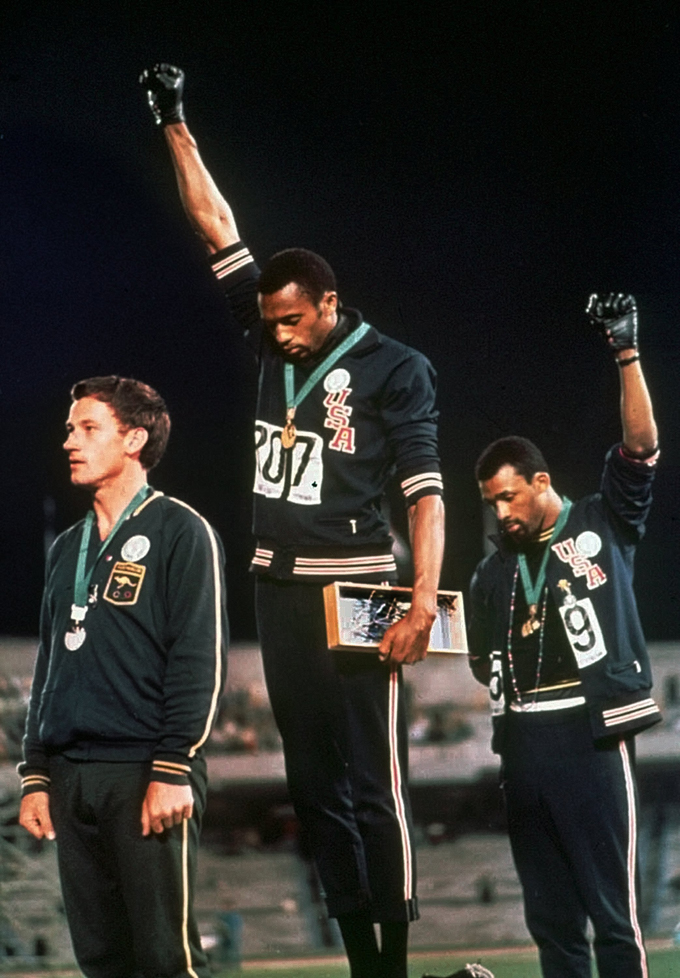
In this Oct. 16, 1968, file photo, U.S. athletes Tommie Smith, center, and John Carlos stare downward while gesturing skyward during the playing of the Star Spangled Banner after Smith received the gold and Carlos the bronze for the 200 meter run at the Summer Olympic Games in Mexico City. Australian silver medalist Peter Norman is at left. (AP Photo/File)
1945—Track star is born in Harlem, N.Y. Carlos and fellow sprinter Tommie Smith created an international sensation when they protested American racism by giving the “Black Power” clinched fist salute when accepting their medals at the 1968 Olympics.
1956—Although the actual decision may have been reached the previous day, a federal district court hands down a ruling declaring that Alabama laws requiring racial segregation in public transportation were unconstitutional. The decision, which was later confirmed by the United States Supreme Court, was the first major legal victory for the Civil Rights Movement. It grew out of the historic Montgomery Bus Boycott sparked when Rosa Parks defied the law and custom by refusing to give up her seat on a public bus to a White man. Although actually organized by Rev. E.D. Nixon, the Boycott would result in Rev. Martin Luther King Jr. becoming the nation’s most prominent civil rights leader.
1790—Jean Baptist Pointe Du Sable establishes a settlement which would eventually grow into the city of Chicago. The settlement would make the French-speaking, Santo Domingo-born Du Sable a wealthy man.
1966—Although there is some debate as to who first coined and used the phrase, this is generally recognized as the day in 1966 that Student Non-Violent Coordinating Committee President Stokely Carmichael began to popularize the term “Black Power” as a demand for greater African American control over their political and economic destiny in America.

1987—Dr. Mae Jemison is selected by NASA as the first Black woman to begin training as a space shuttle astronaut. Jemison actually become the first African American woman to travel in space on Sept. 12, 1992 aboard the Space Shuttle Endeavor.
About Post Author