


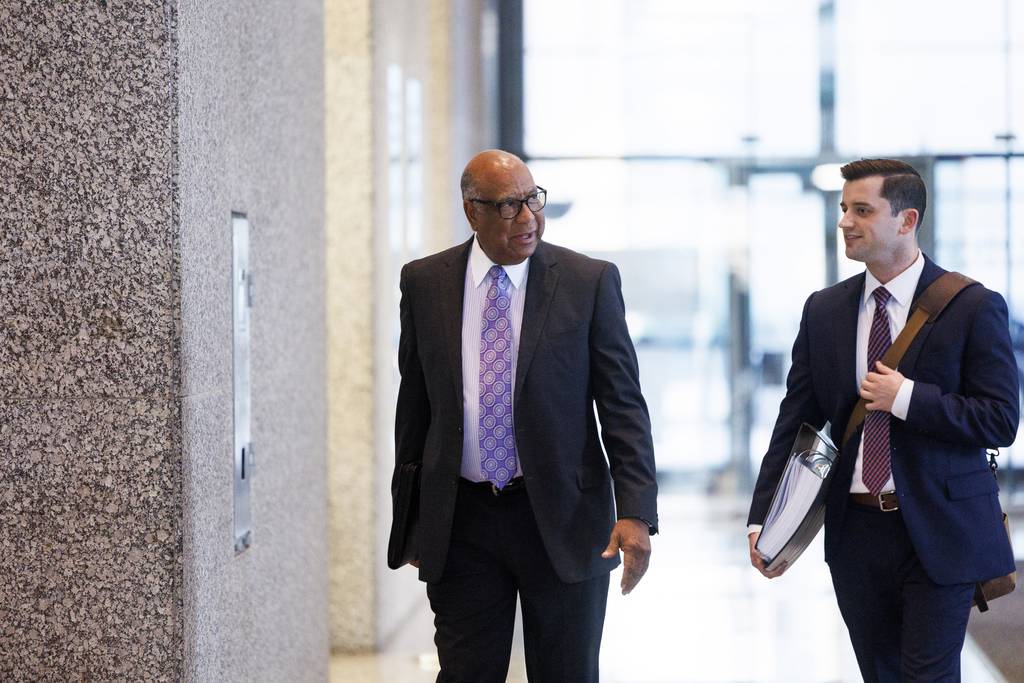
After six weeks of testimony, the “ComEd Four” bribery trial involving an alleged scheme to bribe House Speaker Michael Madigan is nearing an end.
Before the jury came in Wednesday, attorneys for the defense told U.S. District Judge Harry Leinenweber they expect to be done with witnesses later in the day. Prosecutors may have a short rebuttal, but both sides said they would be ready for what could be an extensive jury instruction conference on Thursday.
If that schedule holds, Leinenweber said he would send the jury home for a long weekend, with closing arguments in the case beginning Monday.
The pace of the defense case quickened after two of the defendants, Michael McClain and Jay Doherty, opted not to testify in their own defense. McClain’s attorney, Patrick Cotter, said he in fact plans to call no witnesses at all.
Once the trial got underway Wednesday, co-defendant John Hooker, a former ComEd executive and contract lobbyist, resumed his testimony, which began on Tuesday afternoon.
[ ‘ComEd Four’ bribery trial: What you need to know ]
Hooker’s attorney, Jacqueline Jacobson, took him line-by-line through transcripts of the wiretapped recordings at the center of the case, asking him to explain what he meant down to the word, even why he laughed at certain points in the calls.
In one of the recordings, McClain, a lobbyist and one of Madigan’s closest confidants, tells Hooker, “We had to hire these guys because Mike Madigan came to us. It’s that simple.”
Hooker testified he didn’t believe that it was true that they “had” to hire anyone.
“To me that’s just me and McClain joshing around,” he said.
In a series of final questions, Jacobson asked Hooker over and over whether he thought they were illegally influencing Madigan by hiring lobbying subcontractors he’d recommended.
“Did attempt to corruptly influence Madigan?” she repeated.
Each time, Hooker shook his head and said firmly, “No.”
In his questioning of Hooker, Cotter took it a step further, suggesting the entire premise of the prosecution — that Madigan would put his thumb on the scale for ComEd because they hired some of his people — was ludicrous.
“In all your years of experience, did you ever think for one minute that Mike Madigan would risk his speakership and his power to get a few more people some jobs at ComEd?” Cotter asked, his voice rising to a shout. “Some summer interns? Kathy Laski? Anybody?”
“No, I did not,” Hooker answered.
“It’s a crazy idea, isn’t it?” Cotter shot back.
“It’s a bad idea,” Hooker agreed.
[ ‘ComEd Four’ trial: Evidence seen and heard by the jury ]
Charged in the ComEd Four case are Hooker, McClain, former ComEd CEO Anne Pramaggiore, and Jay Doherty, another longtime lobbyist for the utility and the former head of the City Club of Chicago.
The indictment alleged the scheme included steering $1.3 million in payments from ComEd to Madigan-approved subcontractors under Doherty, appointing businessman and former McPier boss Juan Ochoa to the utility’s board of directors, hiring a clout-heavy law firm headed by political operative Victor Reyes, and stacking the utility’s summer internship program with candidates sent from the 13th Ward.
All four have pleaded not guilty. Their lawyers have contended the government is trying to turn legal lobbying and job recommendations into a crime.
Madigan and McClain face a separate racketeering indictment that is set for trial next year.
On cross-examination Wednesday, Hooker stuck to what appeared to be a script when asked about what he knew of the Doherty subcontracts, answering in the same language no matter the specific question.
Each time, Hooker said the subcontractor arrangement with Doherty had created “goodwill” with Madigan because they were able to “respond to a recommendation” from the speaker. He also made sure to say the subcontractors “added value to the company,” and that the arrangement was good for him because he “didn’t have to manage” them.
When Assistant U.S. Attorney Julia Schwartz asked about the hiring of former 13th Ward Ald. Frank Olivo in 2011, Hooker said he brought value to ComEd because of his City Hall connections, but acknowledged he never gave him a specific project to work on.
“I assumed that whatever project Jay was working on they’d give it to him,” he said.
Hooker also denied statements made in the wiretaps that he often talked to Speaker Madigan about the subcontractors.
“No I have not talked to the speaker about subcontracting,” he said.
On direct examination Tuesday afternoon, Hooker cracked jokes and sprinkled in his witty sayings dubbed “Hookerisms” as he took the jury through his remarkable life story.
Speaking in a homespun, folksy style, Hooker, 74, testified how his wife, his “high school sweetheart,” died suddenly in the late 1960s, leaving him to raise their 18-month-old daughter. At the time, he was working in the mailroom at ComEd, which he’d joined shortly after graduating from Farragut Career Academy on the city’s West Side. Eventually he took night classes at Chicago State University and earned a degree in marketing, he said.
“I had some ups and downs in life that derailed me a little bit, but I persevered,” Hooker said.
Throughout his climb at the utility, Hooker said he was constantly confronted by racist attitudes, including when he was first sent to City Hall in the 1980s as a company liaison, where some of the Black aldermen viewed him as an Uncle Tom.
Hooker says he won everyone over by playing it straight. “My job was to meet with everybody. When you see me talking to ‘X’ or ‘Y,’ that was me talking about ComEd’s business,” he said. “I became acceptable to all 50 aldermen and I was proud of that.”
As a lobbyist for a state-regulated utility, Hooker said he was friendly with Madigan but never part of his inner circle. “I was ComEd all the way,” he said. “I’ve never been to his house, and he’s never been to mine.”
Asked if he went on a trip to Turkey with Madigan and Pramaggiore that has come up in previous testimony, Hooker quipped, “No, I’m not really a world traveler. The only turkey I deal with is at Thanksgiving.”
Hooker’s direct testimony will continue on Wednesday.
In his testimony, Hooker said rising in the ranks of ComEd as an African American was “tough” because “most of the other employees felt it was affirmative action.”
“Needless to say they didn’t value that, or value me or think I was qualified to be there,” he said.
Once he got to Springfield, he said, McClain helped show him the ropes, including how to develop relationships with both Republicans and Democrats, whom Hooker referred to as “all those R’s and D’s.”
“I decided I was going to work with everybody,” he said. “I was going to meet everybody, tell ‘em who I was and where I was from and build a relationship.”
Hooker also buttressed the prior testimony of Will Cousineau, saying that the speaker told Madigan’s then-top political director to go out and rally proponents for the 2016 FEJA bill because support was waning in the last day of the fall veto session.
Along with saving the two nuclear power plants and the jobs that went with it, the legislation also gave ComEd an extension of a formula rate system that allowed the company to have more stability and predictability in revenues. Consumers paid slightly more, but clean job advocates also advanced their cause.
“I have to say it is a coalition bill,” Hooker said, a line that prompted several jurors to write in their notebooks.
He also told of how ComEd rallied a coalition to defeat the bill being pushed by the speaker’s daughter in 2018, her last full year in office. The legislation would have provided low-income assistance, which appealed to Black lawmakers because many of their constituents fell into that category.
“It was going to be her legacy bill,” Hooker said of the attorney general.
But Hooker said he helped convince lawmakers that the problem with the bill was that it was a “cost shift” because the customers who would see the assistance would be underwritten by other customers whose rates would go up.

Afternoon Briefing
Daily
Chicago Tribune editors’ top story picks, delivered to your inbox each afternoon.
Hooker said he worked on turning around enough votes “so that we would have a majority against it rather than for it.”
In his testimony, Hooker clasped his hands together and often chuckled at his own jokes. He described at length how being a good lobbyist meant developing relationships with lawmakers, reaching compromises and building coalitions.
Among the people who taught him the trade was McClain, who Hooker said could often be “pushy.” While McClain knew everyone in Springfield and was close with Madigan, he “didn’t wear it on his forehead,” Hooker testified.
“Mike was well known throughout the Capitol both with legislators and other stakeholders,” he said.
Asked by his attorney, Jacqueline Jacobson, what he meant by a “stakeholder,” Hooker said, “like the AARP.”
“That’s a senior citizen’s group,” Hooker said with a smile. “I happen to be a member.”
jmeisner@chicagotribune.com