




The spark for this investigation came from a Cook County court hearing in December 2020 that lasted just a few minutes.
The case had once been what courthouse insiders call a heater — one that got massive attention when the crime occurred. It involved an infant gunned down in her father’s arms in 2013. A suspect was soon taken into custody, but at the hearing in 2020, prosecutors were dropping the charges.
That’s not unheard of, but something else piqued the interest of longtime courts reporter Megan Crepeau: The case had lingered on the dockets for seven years. And nobody — not the judge, nor the attorneys — seemed shocked.
Crepeau wrote a deadline story but wanted to look more into why the case took so long. In the summer of 2021, she joined up with investigative reporter Joe Mahr to dig into delays in the criminal courts. The pair decided to focus on murder cases, like the one involving the baby girl. These represent a sliver of all felonies, but they have the highest stakes and the worst delays.
The first challenge was figuring out how long the courts take to complete cases. It’s a basic measurement, and many court systems use it to help assess their performance.
So the reporters turned to the office of Chief Judge Timothy Evans, elected by his peers as the top judge in Cook County. He gets to decide where judges are assigned, from handling traffic tickets to managing felony cases. Evans has a research staff to help him in his job; it works with the circuit clerk’s office to obtain and analyze data.
Unfortunately for Mahr and Crepeau, the chief judge’s office would not say whether it tracked how long cases take to complete, would not provide any reports it may have done over the years, and would not provide an interview with Evans or his researchers.
Evans did agree last year to order the circuit clerk’s office to provide the Tribune with raw court data, so the Tribune could look for answers on its own, but those hopes were also dashed. The data provided by the circuit clerk turned out to be incomplete, and the office said it was too busy to produce the full data set.
The reporters did have another source. As part of a transparency push, the office of Cook County State’s Attorney Kim Foxx has posted vast data sets online about cases it prosecuted, including when, for what, and what happened. It was a good proxy for court data, though not a perfect substitute.
Using the programming language R, Mahr wrote code that calculated the length of individual cases from arrest to the ultimate outcome, which can include conviction, acquittal, a plea agreement or a dropped case. He found delays were increasing for all types of felony cases, both before and during the COVID pandemic, and the problem was even worse for murders. Some murder cases were lasting more than a decade.
The reporting team knew court officials had in the past blamed case delays on the sheer size of the Cook County system. So they obtained data from the Cook County sheriff’s office about how long detainees were spending in jail, and compared that to data from Los Angeles County and New York City. It turned out that people accused of murder in Chicago waited notably longer, on average, for their trials than those in Los Angeles or New York, two bigger cities.
Maybe something about Illinois was behind those differences. So the reporters then used data from the state prison system on people serving time for murder to see how long their court cases took. (The prisons have to know that to figure out release dates, which are affected by the time the inmates spent in a local jail before being sent to prison.) That analysis showed Cook County was taking longer to reach murder convictions than other parts of the state, and the gap had widened in the past decade.
In other words, the data suggested that the delays had more to do with how Cook County operates than with any statewide issue.
Why were the delays occurring? What were the reasons that cases were pushed off again and again as the months and years went by? None of the available data could answer that question. So reporters started to dig into individual cases. Records from the sheriff’s office showed there were hundreds of murder cases where defendants had been detained for at least four years. Mahr used a computer program to randomly pick 30.
Because the electronic dockets in those cases provided only scant information, the reporters also asked to see the paper files for all 30 cases. Even then, the documents didn’t offer many details about why cases were delayed. Judges had to fill out a sheet for each hearing, but typically the judge merely noted that the case was being continued to a new date “by agreement.”
To get more information, reporters obtained dozens of costly transcripts of the give-and-take between lawyers and judges at court hearings. They also observed more than 1,000 hearings for themselves, showing up at the courthouse or tuning in via Zoom, as well as interviewing players in the court system and reviewing five decades’ worth of research papers.
The reporters also wanted to know who was paying the price for courtroom delays. Some costs are literal, as it is county taxpayers who foot the bill for detaining people in Cook County Jail before trial. The court system’s goal is to complete murder cases within two years of an early court hearing called an arraignment; Mahr used data from the sheriff’s office to calculate the excess costs when murder defendants are jailed for longer.
Paying a more personal price are the families of murder victims, who often wait years for justice. Reporters reached out to victims’ advocates as well as approaching some relatives directly. The reporters wanted to be as sensitive as possible, recognizing this was a painful topic that would be difficult to discuss. Some people declined to be interviewed; others agreed, typically citing the hope that sharing their story could lead to change.
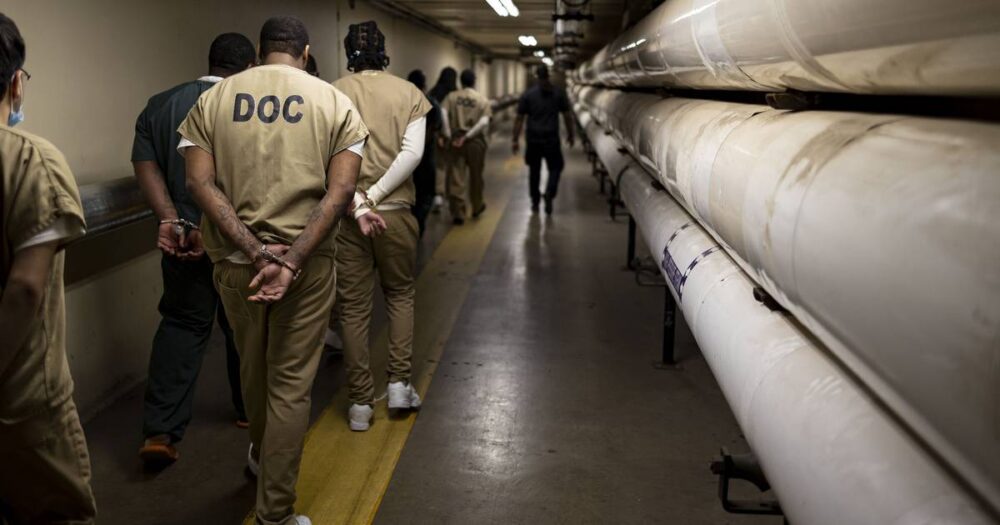
Also affected, obviously, are the people who are in detention because they were charged with crimes. These defendants, who are presumed innocent, are often stuck for years in Cook County Jail — not exactly the most pleasant place — not knowing when their case would go to trial. The reporters sent letters to a number of longtime detainees, offering them an opportunity to talk about their experience. Some accepted, speaking about how they felt trapped by a system that moved at a glacial pace.
Reporters’ conversations with some detainees sparked friction with the Cook County public defender’s office. Assistant public defenders complained to judges that the Tribune should have gotten that office’s permission before interviewing their clients. The Tribune’s position is that these detainees — all adults — could decide for themselves if they wanted to speak to reporters.
In one case, an assistant public defender falsely accused the reporters in court of tricking a defendant into being interviewed. The Tribune provided the court with video from the interview showing not only that reporters obtained informed consent but that the detainee stated he had already told his attorney he wanted to do the interview.
In another case, a judge ordered the Tribune not to publish information from an interview with a defendant. That order was rescinded after a Tribune attorney intervened. In the end, the Tribune opted not to use information from the interview, and that of another detainee, after receiving a letter from each — sent through the public defender’s office — asking the Tribune not to publish their comments.


