




Illinois will soon run its own Affordable Care Act health insurance marketplace, and have the power to stop sky-high price increases of plans sold on it.
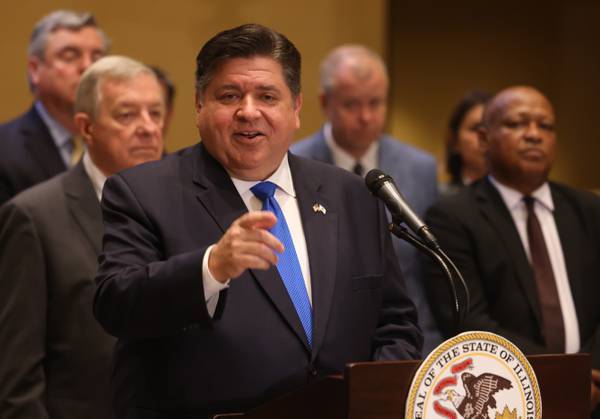
Gov. J.B. Pritzker signed a pair of bills Tuesday aimed at giving Illinois more control over health insurance prices and the Affordable Care Act marketplace, also known as the Obamacare exchange, where people can buy individual and family health insurance plans.
The bill signings Tuesday came amid criticism aimed at Pritzker for his decision to close enrollment for many people in a separate health care program for immigrants in the country without legal permission.
One of the bills signed into law Tuesday will allow Illinois to run the exchange where health insurance plans are sold, by 2025. Now, consumers must go to the federally-run healthcare.gov to buy exchange plans.
The idea behind that law is to allow Illinois to better reach consumers and protect the exchange from political shifts at the federal level. For example, former President Donald Trump made it clear during his tenure that he was not a fan of the Affordable Care Act, and he cut much of the funding for outreach and for workers who assist consumers with buying plans.
“You are less subject to changes in the political winds so if there’s a change in administration at the federal level, you’re a little bit more insulated,” said Sabrina Corlette, a research professor at the Center on Health Insurance Reforms at Georgetown University.
By running its own exchange, Illinois could also give consumers more chances to buy health insurance. Now, consumers can typically only enroll in exchange plans during an open enrollment period that runs from Nov. 1 through mid-January, or if they experience certain life changes, such as the birth of a child or job loss.
When Illinois runs its own exchange it could open additional enrollment periods if needed, such as if there’s a disaster that creates a need for health insurance, or if a big employer leaves an area of the state, said Theresa Eagleson, director of the Illinois Department of Healthcare and Family Services.
Illinois will also be able to better understand which areas of the state might need more outreach or education on the exchange, based on applications data, Eagleson said.
Illinois will join 18 other states running their own Affordable Care Act exchanges, Corlette said. Health insurance companies will pay assessments to the state, rather than the federal government, to help run the state-based exchange. The state’s budget for next fiscal year also includes $10 million to help get the exchange off the ground.
The second new law will give Illinois regulators the power to reject or modify proposed price increases for individual and small business health insurance plans, such as those sold on the exchange, starting with plans for 2026. The law will not apply to health insurance plans offered by large employers, because those plans are regulated by the federal government.
“To have the ability to go back to insurance companies now and say, ‘This does not work,’ is really an important tool in our toolbox to be able to protect consumers,” said Dana Popish Severinghaus, director of the Illinois Department of Insurance.
Each year, insurance companies selling exchange plans must make public certain proposed rate increases online before they actually increase prices. Until now, the Illinois Department of Insurance reviewed the rates, and could try to ask insurance companies to lower them if they were too high. But the department could not actually say no to price increases.
In some years, Illinois consumers have faced double digit price increases in the monthly premiums of exchange plans.
On average, prices for the lowest cost silver-level plans on the exchange increased by 11% across the state this year, according to an Illinois Department of Insurance analysis.
“We know that health care prices and costs are going up, and this is one way for the state regulatory agency to be able to push back on costs for consumers and to try to make it more affordable,” said Stephani Becker, associate director of healthcare justice at the Chicago-based Shriver Center on Poverty Law.
The bill did, however, have a handful of critics, including the National Association of Mutual Insurance Companies.
“For decades Illinois (has) had an open market in which consumers benefit from insurers competing,” said Andrew Perkins, regional vice president for the Great Lakes region for National Association of Mutual Insurance Companies, in a statement. “Although this bill doesn’t directly impact property and casualty insurance, we disagree with the concept that regulation is a better way to price products than the competitive market.”
Under the new law, Illinois regulators will be able to reject or modify a proposed rate if they deem it “excessive, unjustified or unfairly discriminatory.” They can also reject rates that are too low that endanger “the solvency of an insurer.” In 2016, Illinois insurance company Land of Lincoln collapsed, leaving nearly 50,000 Illinois residents scrambling to find new insurance mid-year. Land of Lincoln said it set its prices lower than it otherwise would have in anticipation of getting certain payments from the federal government that never fully materialized.
With the new law, Illinois will join 41 other states that also have the final word on proposed rates, according to Gov. J.B. Pritzker’s office.
In those states, there’s evidence that final prices tend to be lower than the proposed prices, on average, Corlette said. It’s relatively rare for a state to flatly reject a proposed rate, she said. It’s more common for states to have a back-and-forth with insurers when they think the rates are too high, she said.
“It’s more of a negotiation and ultimately they settle on a rate that’s agreeable to both parties,” Corlette said.
Insurance companies don’t typically pull their products from a state’s exchange over such negotiations, she said, though it may not be public knowledge when an agreement can’t be reached. In Illinois, insurance companies whose rates have been modified or rejected will have 10 days to request a hearing if they disagree.
Pritzker celebrated the bill signings Tuesday, a day after defending himself against criticism from Latino elected officials over changes to a program for immigrants in the country without legal permission. As part of a last-minute budget deal, that program is getting only about half of the money it needs for the fiscal year that begins July 1. As a result, Pritzker decided to close program enrollment July 1 for people under 65 who are currently eligible and cap enrollment for people 65 and older. Pritzker has said the changes were necessary to save the program.


