

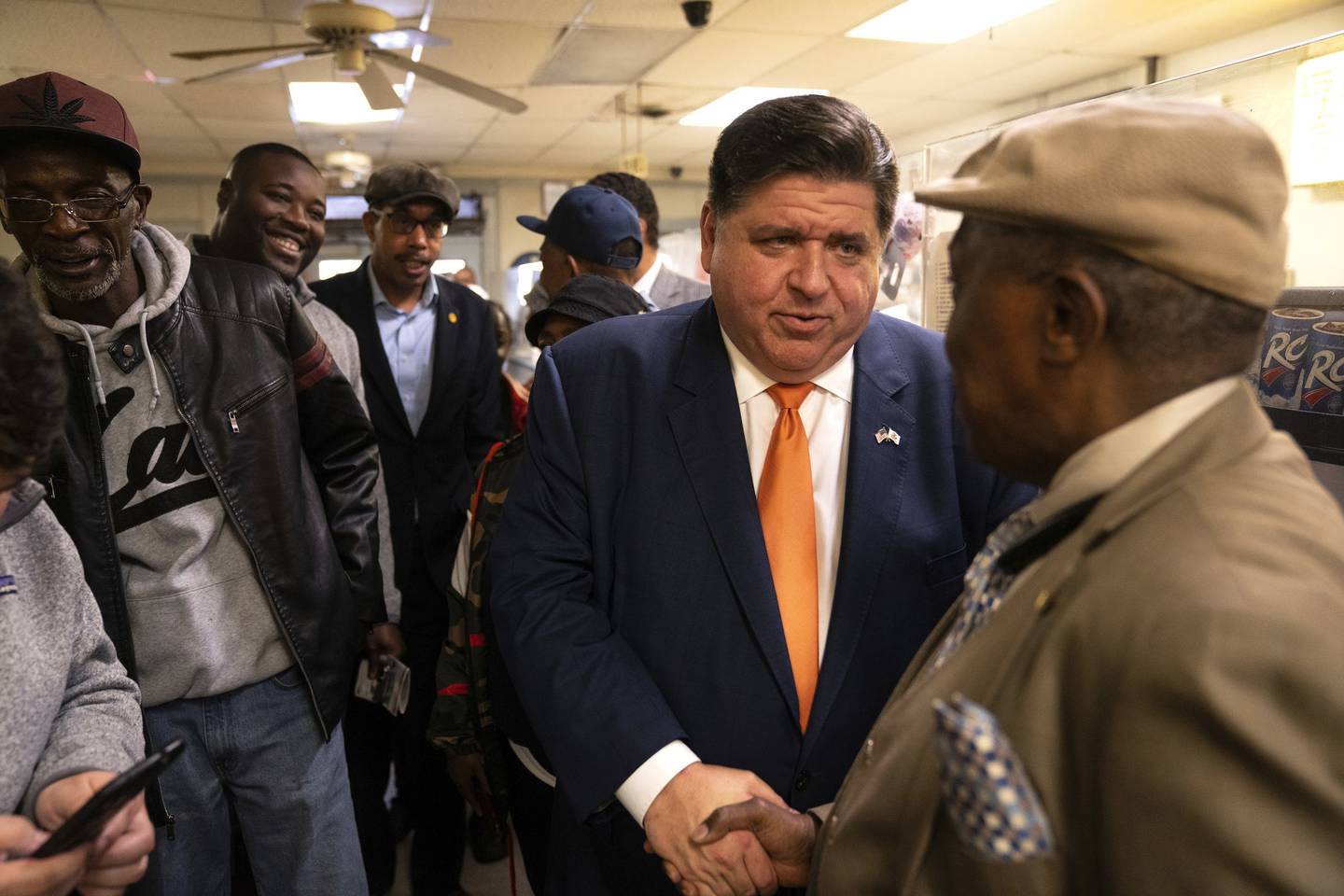
Across Illinois, polling places closed Tuesday night, ending a costly and contentious race for Illinois governor as Democrat Gov. J.B. Pritzker sought a second term and Republican state Sen. Darren Bailey looked for an upset.
The voting concluded more than a year and a half of campaigning that began with dissent over Pritzker’s handling of the deadly COVID-19 pandemic but evolved to address crime, safety, former President Donald Trump, abortion, LGBTQ and civil rights, only to return at the end to COVID-19 mitigation concerns over child vaccinations raised by Bailey, whose candidacy was launched by opposing the governor’s mandates.
Advertisement
In a contest in which each man called the other divisive and extreme, the delineation between Pritzker and Bailey was very clear.
Pritzker, an entrepreneur and a billionaire heir to the Hyatt Hotels fortune, ran on a record of enshrining abortion rights in state law as a U.S. Supreme Court ruling returned the issue to the states. He vowed to protect LGBTQ and contraceptive rights against threats from Bailey and other conservatives.
Advertisement
The governor also touted his fiscal management amid a pandemic environment, leading to six credit upgrades in contrast to the budget-less years of his one-term Republican predecessor, Bruce Rauner, and embarked on a massive public works program.
Bailey opposes abortion, except in cases where the life of the mother is in jeopardy, and has sharply attacked criminal justice changes aimed at racial justice as a threat to increased crime. Laws expanding gay rights were “wicked,” Bailey said.
In a tweet on Election Day morning, Pritzker said, “There’s too much at stake to let Darren Bailey and his extremist allies drag our hard-earned progress backward. Tomorrow, we protect our fundamental freedoms, we lift up working families, and we elect pro-labor, pro-choice, pro-civil rights candidates up and down the ballot.”
As has become his custom with his conservative evangelical Christian beliefs at the root of his campaign, Bailey said he and his wife, Cindy, fasted Tuesday “as we just count on God to deliver hope, to deliver restoration, to deliver a new day for Illinois.”
“Probably the best thing about this as Cindy and I sat and reflected this morning is we have absolutely no regrets,” Bailey said of the campaign as he delivered his nearly daily devotional on Facebook Live. “The stones have all been lifted.”
Pritzker effectively launched his reelection campaign in March of last year when he put $35 million of his own money into his campaign fund. He didn’t formally announce his bid for a second term until three months later.
At the time, Pritzker staked his reelection bid on his handling of the COVID-19 pandemic, leaning into his use of executive orders that shuttered businesses, closed schools to in-class learning and kept nonessential workers from going to the workplace. Many of the governor’s initiatives received pushback from Republicans who criticized Pritzker for operating like a “dictator.”
“I may not have gotten every decision right” in handling the pandemic, he acknowledged in a campaign announcement video. But, he said, at every step he “followed the science” to protect residents.
Advertisement
But the concept of running for reelection based on pandemic politics soon gave way to criminal issues and the governor’s signing into law of the Illinois Safety, Accountability, Fairness and Equity-Today, or SAFE-T, Act. GOP attacks on the law, especially provisions for suspected offenders to receive cashless bail unless ordered detained by a judge, put Pritzker in a defensive posture on a critical platform for many of his allies, especially Black lawmakers in Springfield.
The crime issue also overshadowed Pritzker’s efforts to portray himself as a strong fiscal steward in a state long known for its shaky finances even though he paid down a massive backlog of overdue bills to vendors providing state services that was racked up during a two-year budget impasse under Rauner.
[ After a tumultuous first term, Gov. J.B. Pritzker spends big and plays it safe in reelection bid ]
In June, shortly before the state’s primary election where Pritzker faced no real opposition, the nation’s high court overturned its 50-year-old Roe v. Wade decision formalizing the federal right to obtain an abortion and sending the issue to the states to resolve. Pritzker, as many other Democrats did locally and nationally, latched onto abortion as a women’s rights issue under threat from Republicans and warned that other rights assisting racial and ethnic groups as well as the LGBTQ community could also be threatened.
A deadly mass shooting at a July Fourth parade just days later in Highland Park provided a platform for Pritzker to promote his support for a banning on military-style assault weapons and large-capacity ammunition magazines as well as enhanced background checks. The event also became one of many gaffes for Bailey, a gun-owner rights advocate who wants to repeal the state’s firearm owners ID card law required to purchase a firearm. In a July Fourth video, Bailey acknowledged the still-developing shooting incident but urged people to “move on” and “celebrate” the holiday while the suspected gunman was at large.
Unlike when he scored his initial blowout victory over Rauner, Pritzker now has a record as governor. He touted increases in the minimum wage and legalized marijuana among his first-term successes.
But for the most part, Pritzker never outlined a comprehensive second term agenda. He acknowledged inflation by delaying a scheduled gas tax increase until January and offered property tax relief checks and said he hoped to improve the state’s revenues to the point where he could make tax relief permanent.
Advertisement
He also said he would not seek a repeat of his unsuccessful first-term signature initiative — a graduated rate income tax indexed to higher wages to replace the state’s flat rate levy — after a proposed constitutional amendment was overwhelmingly defeated by voters in 2020.
For Bailey, his candidacy represented an improbable rise for a wealthy downstate farmer and businessman whose political success had largely been confined to his home region of southeastern Illinois.
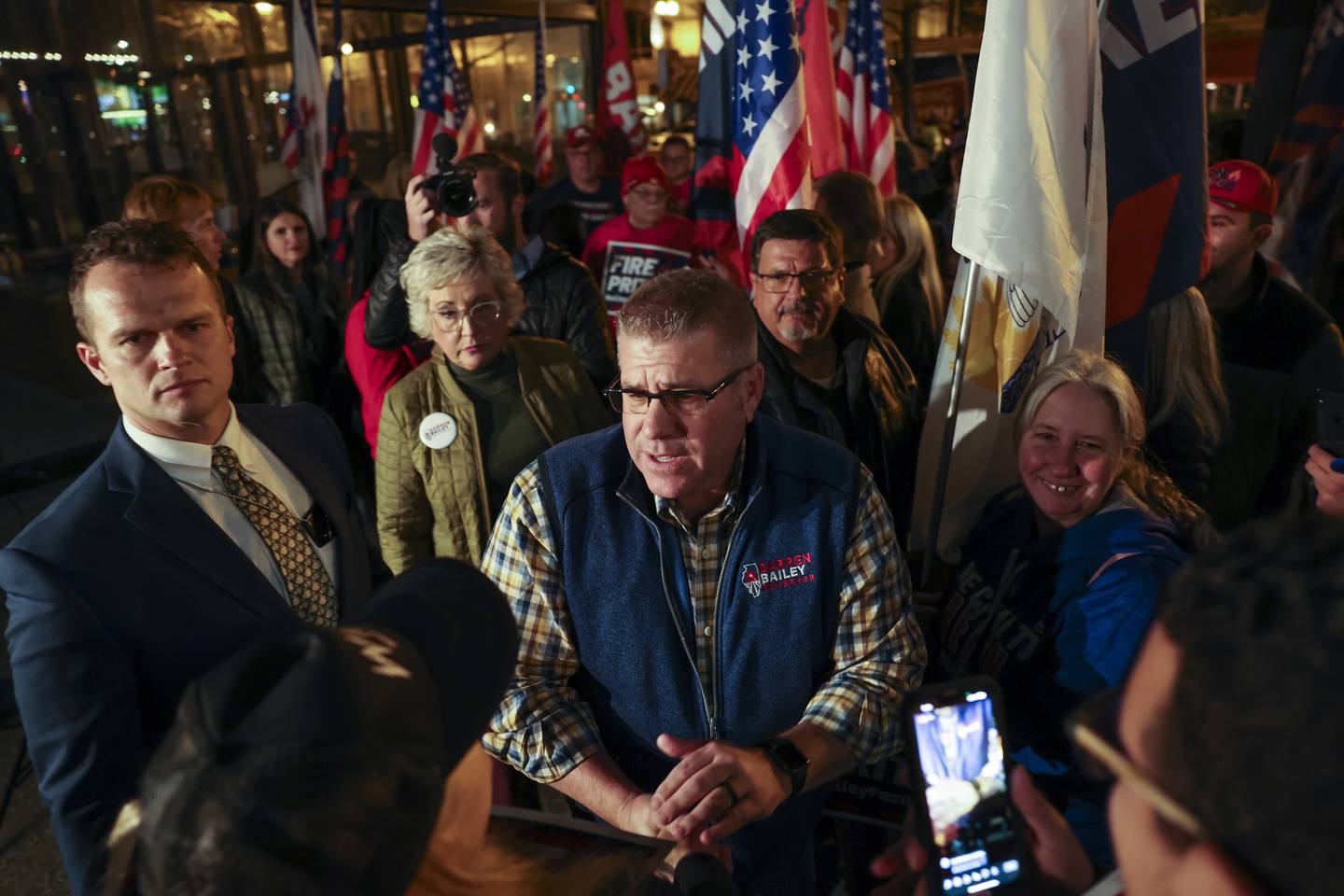
Bailey was a member of what became known as the “Eastern Bloc,” a group of ultraconservative Republicans who contended the region’s conservative values were being dismissed by progressive policies backed by Pritzker and Chicago politicians. Bailey and the group went so far as to introduce legislation that would separate Chicago from the state in favor of having its own state.
In his campaign for governor, both in the primary and general election, Bailey repeatedly referred to Chicago — the state’s largest city and Illinois’ economic engine — as a “hellhole” and an “unruly child.” And he warned that liberal polices had spurred violent crime and demoralized law enforcement in the city and that it would spread throughout Illinois with the SAFE-T Act and its provision of cashless bail that is supposed to take effect on Jan.1.
[ Darren Bailey’s uphill candidacy for Illinoisans who feel ‘pushed aside’ ]
Bailey, a state senator from Xenia, won an Illinois House seat in 2018 and was elected to the Illinois Senate two years later.
During his brief tenure, Bailey became the most activist politician battling Pritzker’s COVID-19 pandemic restrictions, including an unsuccessful court challenge to the governor’s powers to issue emergency orders. During a pandemic legislative session, Bailey was ordered removed from the makeshift House floor at the Bank of Springfield Center for refusing to wear a face mask. He returned a day later, wearing a mask.
Advertisement
Bailey’s challenge to Pritzker over pandemic mitigation became a springboard for his candidacy for the Republican nomination for governor, which he announced in February 2021, lashing out at the “political elites” and the “donor class,” while maintaining his constituency of “marginalized people have been ignored” by government.
Educational mandates for the teaching of the roles of people of different racial and ethnic backgrounds and of gays, he said, demonstrated Chicago and liberal idealism interfering with Downstate cultural values.
“Now, right in the heartland of America, Illinois has become a stronghold for this evil, wicked stuff,” he proclaimed.
Bailey entered the primary as an underdog facing Aurora Mayor Richard Irvin, who received $50 million in backing from billionaire Ken Griffin, who founded Citadel investments.
But Pritzker devoted much of his advertising to savaging Irvin and giving Bailey a backhanded leg up by labeling him as too “extreme” for Illinois to rally the core right Republican base. Pritzker also donated to the Democratic Governors Association, which echoed the governor’s Bailey ads resulting in more than $34 million to help Bailey win nomination.
In the closing days of the primary campaign, Griffin folded his cards and moved to Miami as an Irvin candidacy, overcoached to avoid controversy, lost steam. Bailey won the primary with 57% of the vote in a six-way contest while Irvin finished third.
Advertisement
Bailey also was assisted in the final days of the campaign by an endorsement from Trump, which he had actively sought. At an Adams County Fairgrounds rally with the former president, Bailey said, “I’ve made a promise to President Trump that in 2024, Illinois will roll the red carpet out for him because Illinois will be ready for President Trump.” Trump lost Illinois by 17 percentage points in 2016 and 2020.
Bailey sought to move away from Trump in the general election and instead sought to make the issue of crime his signature issue, attacking Pritzker, Chicago Mayor Lori Lightfoot and Cook County State’s Attorney Kim Foxx for failing to curb outbreaks of violence.
Though Bailey was vastly outspent by Pritzker, who pumped $150 million into his reelection campaign fund, the Republican did gain an ally in Richard Uihlein, the conservative billionaire megadonor who founded the Uline office supply and packaging firm.
Overall, Uihlein backed Bailey with $54 million, though all but $12 million went to an independent expenditure political action committee, the People Who Play By the Rules PAC, run by right-wing radio host Dan Proft of Naples, Florida.
The PAC’s most recent ads attempted to suppressturnout for Pritzker from Black voters, a core Democraic constituency.
Proft also was involved in sending political mailers disguised as newspapers to thousands of homes in Chicago, featuring distortions and misinformation about Pritzker, some stoking racial fears.
Advertisement
Bailey, in a Sept. 8 appearance on Proft’s radio show, said the faux newspapers “are full of facts and truth.”
rap30@aol.com
dpetrella@chicagotribune.com
jgorner@chicagotribune.com