



Written by Debra Hand
Something beautiful is happening here. Diverse cultural groups are gathered to celebrate Black artists. As a Black artist, I am grateful to those who have taken the time to come to witness the telling of our stories in your own artistic voices.
Our stories as artists are as diverse and multi-layered as the number of artists who’ve created them. They are as visually varied in presentation as Black musical expression — from Blues to Jazz to Hip Hop. But there is one common theme that peeps in and out of every work: and that is the unapologetic assertion of Black humanity.
Black artists are trailed by the ever-present shadow of American history. It is inseparable from our consciousness of ourselves, and therefore inseparable from us. It is ever-present, even as we draw a single straight line. We cannot “un-know” it. Even when a Black artist attempts to avoid history as the subject matter in their work, it still inhabits the most mundane objects. An innocent sugar bowl painted on a Grandmother’s table immediately inherits the ghosts and history of sugar plantations; the color blue echoes the history and horrors of the indigo trade.
There is nothing we can create that does not form a tributary to the larger American story and to that of our ancestors. Therefore our art cannot help but bear witness and to form the artifacts for how we’ve come through it; where we’ve triumphed, what we’ve endured and what has been gained, lost, or confiscated along the way.
African-American art, like no other American art, has had to serve the dual function of asserting our very humanness before the eyes and consciousness of the nation and our brushes bear the weight of that history even when we paint a rose petal. The rose petal becomes an homage to the ancestors who paid the high and horrific price for the luxury of our creative practices. Even when our painting are abstract with no apparent theme at all, they echo with something — a gratitude, or a disquiet, or a remembrance. The sacrifices and legacies of our ancestors live in those historic shadows. They flow through our DNA and into our creative expressions.
All Black art whether visual art or music, serves Black culture as a salve – a place to pour ourselves emotionally, a place to self-validate, to take refuge, to remember, heal, to resurrect. Our creativity has sustained us through all of history… from the moment our ankle-chained ancestors set foot on American soil, it has sustained us. It has fortified us through Civil Rights marches, comforted us through horrific loss, united us in common struggle, and renewed us for the struggle ahead. It is how we live, pray, fortify, commune. Indeed, it is how we survive.
That Black artists — throughout American history — have known no interruption in their ability to wrest beauty from our existence, and that we have created so many wondrous art-forms from music to dance to poetry is evidence of an extraordinary people. That our art still endures on the highest levels of excellence is in and of itself worth pondering. Still, as you look upon these wondrous works, it is important to resist comparing Black art by the yardsticks of Western or European art: to do so misses the point altogether. Black artists have known America from an entirely different perspective than any other cultural group and we are creating from our own truths. We are not behind in Western techniques or practices, we are, if anything, informed by a more broader view of America’s full landscape. We know the one that is kept away from polite view. We know America’s full and unvarnished past and present.
As you look at these works, it is important to recognize that Black art is not merely a subset of Western art. It is not an attic find to be comfortably shoe-horned into the historical art canon. It is a multifaceted reflection of the American story. One where, from the beginning, African-Americans have had to cull culture from themselves, and from the bits and pieces secretly clung onto by our ancestors; ways of the Motherland secretly smuggled along the hyphen as the word African was slammed violently and disruptively into the word American. Black culture is a collage made of the bits and pieces salvaged from the transatlantic wreckage by our ancestors – hidden, saved, and evolved by pure will into a way of survival. Through our art, Black artists by and large are still laboring to resurrect what was lost, and to -repair ourselves and our cultural group as we continue to cull culture from ourselves, and from the persistent memory of DNA.
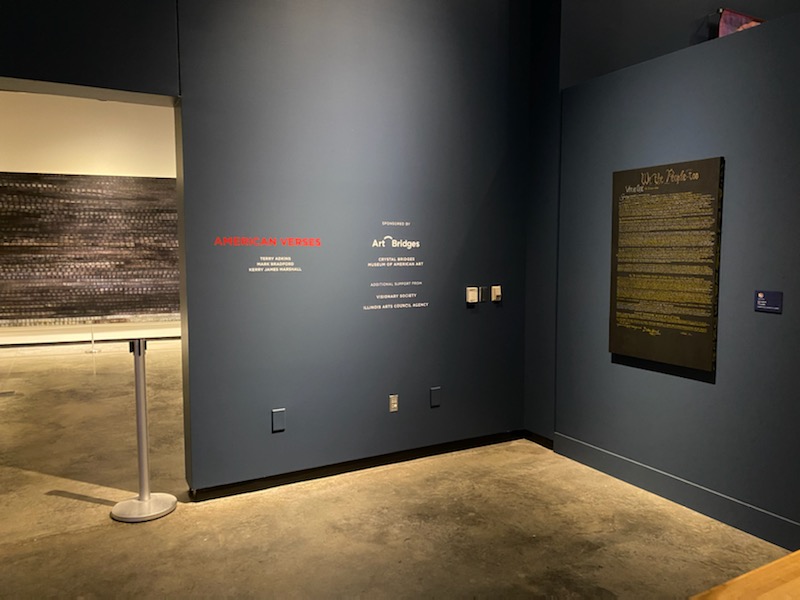
Black art emerges from a disrupted root system originating in the Motherland then severed, cross pollinated, and cultivated by the survivors. Art is how we’ve endured and negotiated that journey. In American Verses, this theme peeks in and out of every work. A theme that asserts, I am human, I am beautiful, my family is human, my cultural group is human. This is the inescapable mantra of Black. It is wrest from a history that belongs to every American.
A painting of a family by Kerry James Marshall is no less profound than Rembrandt’s “Prodical Son.” Even as techniques differ between artists of different centuries, backgrounds, journeys, and perspectives – both Rembrandt and Marshall speak eloquently and authentically regarding parables of human existence. Each has mastered the language of their chosen mediums. Mark Bradford’s multilayered constructions, slash deconstructions, are no less a social commentary on the destructive forces of class-based warfare than Picasso’s Guernica. The late Terry Adkins, having both visual art and music as part of his creative practice, used those mediums in literal concert – echoing the galvanizing force of music in Black culture. It was Blues and Jazz that first floated across American color-lines eased African-Americans into the mainstream just as quietly and istealthily as the Underground Railroad.
The hyphen in African-American can literally be seen as a symbol representing a slave ship and centuries of stolen lives and culture. Linking our lives back to our roots, however, is not as simple as jotting a dash between the words African and American. What has been lost is “un-recaptureable”, however, our art has always been the closest thing we’ve had as a means of reclaiming ourselves. And while none of us can un-live or undo the hyphen between those words, we can all work together to chisel-in a parallel dash such that the hyphen is finally wrest into an equal sign.
Today’s gathering is part of that work. And as you examine this art created by American artists who are Black, or Black artists who are American, I invite you to honor our ancestors in the process. They dreamed for such a day when we might stand as a human race, in honor of their humanity.
Indeed, something beautiful is happening here. We have come together around Black art in search of a deeper dialog and understanding. Together we are in search of the insight needed to repair ourselves as a human race. This is the height of both humanity and civilization. I am deeply honored to be a part of this profound moment. Thank you for inviting me.
Sincerely,
Debra Hand
Debra Hand is an artist and writer. Her work is in the collections of the Smithsonian Anacostia Museum and the DuSable Museum.
About Post Author