




Taking the fight where the voters are
By Danielle Bess
Las Vegas was awash in pink and green during the week of July 18, 2026, as Alpha Kappa Alpha Sorority, Incorporated, and nearly 27,000 of its members and their families arrived for the sorority’s biennial Boule.
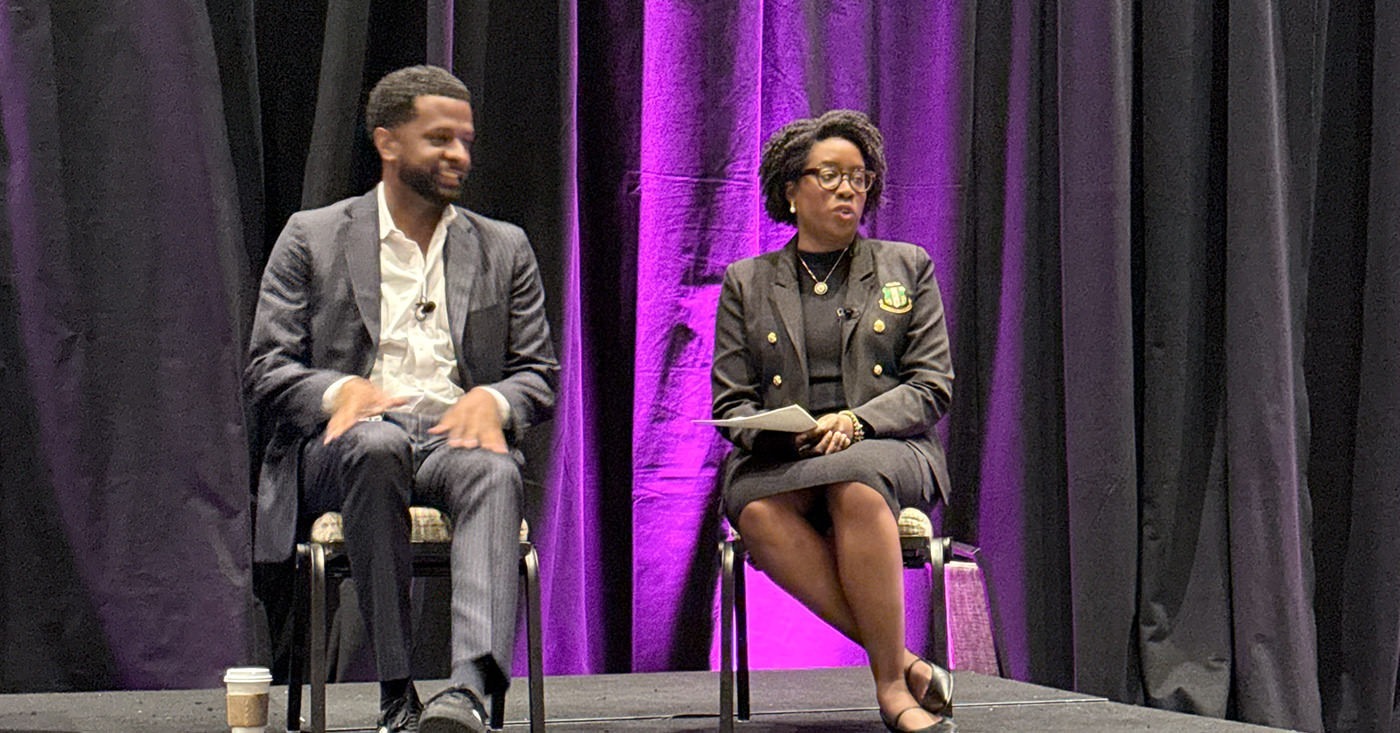
The women of Alpha Kappa Alpha were not the only notable arrivals. Black political power showed up, too. Congresswoman Lauren Underwood moderated a conversation with attorney and political commentator Bakari Sellers at a workshop titled “Soaring to the Polls: Mastering the Midterm Journey.” Aaron Ford, Nevada’s Attorney General and the Democratic nominee for Governor, addressed the workshop participants, while Congresswoman Emilia Sykes sat in the audience. And at the organization’s public meeting, Maryland Governor Wes Moore received a community award and delivered a rousing speech that sounded less like an acceptance and more like a precursor to a run for President.
Politicians go where power is. But these politicians were not mere visitors. All of the politicians are members of Divine Nine organizations. And three months after the Supreme Court neutered Section 2 of the Voting Rights Act, the power in that convention hall mattered more than it had in sixty years.
AKA, and all of the Divine Nine organizations—the historically Black Greek-letter fraternities and sororities—are a natural stop for any politician who wants to raise their profile or launch a bid for elected office. The organizations collectively have more than 4 million members who are educated and civically engaged in their communities.
While the organizations are all nonpartisan, they are able to engage in voter education, policy advocacy, and get-out-the-vote efforts. Congresswoman Underwood, an AKA herself, described the mission from the stage: “We are not telling them who to vote for, but as we soar to the polls, we have a lot of ground to cover to lay the foundation for what issues are on the ballot, who’s running, how to participate in this election.”
And for their collective 120-year history, they have done that. The NAACP was cofounded by W.E.B. Du Bois, a member of Alpha Phi Alpha fraternity. Many civil rights icons were members of the Divine Nine, including Martin Luther King, Jr., who was also an Alpha. Today, more than half the current members of the Congressional Black Caucus are members of one of the Divine Nine organizations.
With the gutting of Section 2 of the Voting Rights Act, Black political representation in Congress is at risk. Governor Moore, a member of Alpha Phi Alpha, accepting the sorority’s community award, rejected the notion that the question is whether AKA is ready. “When there’s ever a question about whether the AKAs are built for a moment like this, let’s be clear: the AKAs were built in a moment like this,” he said. “Let’s not pretend like 1908 was easy. Let’s not pretend like 1908 was simple. Let’s not forget in 1908, you had the Springfield race riot. In 1908, you had the oppressive peak of Jim Crow.”
Moore’s history was precise. Alpha Kappa Alpha was founded at Howard University in January 1908. That August, a white mob rampaged through Springfield, Illinois — the riot that spurred the founding of the NAACP the following year. The Divine Nine were not built in calm waters. They were built in the storm.
Sellers told the workshop what this storm looks like. In April, the Supreme Court ruled in Louisiana v. Callais that voting rights plaintiffs must now show a strong inference that a state intentionally discriminated — a standard Justice Elena Kagan described as rendering the VRA “all but a dead letter”. Within weeks, Southern states began dismantling majority-Black congressional districts.
“In Alabama, in Mississippi, in Georgia, in Arkansas, in Texas, and in Florida, we had Black elected officials because we could go out and vote for people who we believed shared our same lived experiences and that represented our interests,” Sellers said. “When you wake up in November, that no longer will be the case. No matter if we win, lose, or draw, no matter if Hakeem Jeffries is the Speaker of the House we will have less Black Caucus members than we’ve had before. And in two years, we’ll have even less.”
Sellers knows the cost of this fight in his bones. His father, Cleveland Sellers, was an early member of the Student Nonviolent Coordinating Committee. “When my dad and Stokely and everybody were going around yelling Black Power, they weren’t trying to shoot you,” he told the room. “They were talking about Black economic power and Black political power. So when they were in the depths of Mississippi, that’s what Black Power actually meant.”
Governor Moore offered Maryland as proof that the storm can be answered. With the support of the AKAs, he said, the state passed its own voting rights act, and he has called the legislature into special session rather than, in his words, “sit on our hands while we’re being punched in the face.” He cited more than $1.3 billion in state investments in HBCUs, “unapologetically,” and legislation confronting book bans: “You will not ban books inside the state of Maryland.”
Congresswoman Underwood was practical about what comes next. She urged the members to take the mobilization where the voters are — online — “creating content that is engaging and informative on the issues that matter: issues like the high cost of living and how we can take action in this election to lower housing costs, health care costs.” Sellers pressed the same point about the message. When Southern states refuse to expand Medicaid, he said, rural hospitals close—”and when your rural hospital closes, it’s not just the fact that you don’t have access to care. It’s your largest employer in the county.” Then came the workshop’s bluntest warning, aimed at his own party: “We cannot over the next 107 days simply believe that saying ‘I’m not Donald Trump’ is enough to win an election.”
The Divine Nine organizations were all founded before the passage of the Voting Rights Act, and they have now outlived its full protection. They were built between 1906 and 1922—the decades after Black representation had been driven out of Congress and the ballot stripped away across the South—as infrastructure for a people the law had abandoned. Their mission of racial uplift has not changed.
Sellers told the women what he believed their assignment was. “I’m talking to you all as apostles,” he said. “I’m not trying to teach you something. I’m trying to give you something to go out and share.”
Governor Moore reached for the same idea through the ancestors. “It’s not a recognition of what we’ve done already. It’s a standard for what we’re still yet to get done,” he said, closing with the words every member in the hall knew by heart, from the hymn James Weldon Johnson — himself a member of Phi Beta Sigma — gave to Black America: “Facing the rising sun of our new day begun, let us march on till victory is won.”
Nearly 27,000 women left Las Vegas at the week’s end and carried that assignment home across the country — members of an organization that predates the Voting Rights Act, now asked to repair its gutting.
The post OP-ED: Built in a Moment Like This: The Divine Nine and the Fight After Callais appeared first on BlackPressUSA.