



Close Menu
  • Home
  • News
    • Local
  • Opinion
  • Business
  • Health
  • Education
  • Sports
  • Podcast

Subscribe to Updates

Get the latest creative news from FooBar about art, design and business.

What's Hot

Prince George’s County, Maryland Advances Environmental Justice Through Urban Tree Planting Program, Installing More Than 2,000 Additional Native Trees

Prince George’s County, Maryland Advances Environmental Justice Through Urban Tree Planting Program, Installing More Than 2,000 Additional Native Trees

A Clinical Perspective on Common Health Conditions Affecting Black Women

Facebook X (Twitter) Instagram
  • Lifestyle
  • Podcast
  • Contact Us
Facebook X (Twitter) Instagram Pinterest Vimeo
The Windy City Word
  • Home
  • News
    1. Local
    2. View All

    Uncle Remus Says Similar Restaurant Name Is Diluting Its Brand and Misleading Customers

    Youth curfew vote stalled in Chicago City Council’s public safety committee

    Organizers, CBA Coalition pushback on proposed luxury hotel near Obama Presidential Center

    New petition calls for state oversight and new leadership at Roseland Community Hospital

    A Clinical Perspective on Common Health Conditions Affecting Black Women

    Health Experts: Protect Yourself but No Need to Worry Yet About “Virus Without Vaccine” Spreading in California

    After Deep Federal Cuts, California Lawmakers Push for Full Restoration of Medi-Cal Benefits 

    Grief, Advocacy, and Education: A Counselor Reflects on Black Maternal Health

  • Opinion

    Capitalize on Slower Car Dealership Sales in 2025

    The High Cost Of Wealth Worship

    What Every Black Child Needs in the World

    Changing the Game: Westside Mom Shares Bally’s Job Experience with Son

    The Subtle Signs of Emotional Abuse: 10 Common Patterns

  • Business

    Illinois Department of Innovation & Technology supplier diversity office to host procurement webinar for vendors

    Crusader Publisher host Ukrainian Tech Businessmen eyeing Gary investment

    Sims applauds $220,000 in local Back to Business grants

    New Hire360 partnership to support diversity in local trades

    Taking your small business to the next level

  • Health

    A Clinical Perspective on Common Health Conditions Affecting Black Women

    Health Experts: Protect Yourself but No Need to Worry Yet About “Virus Without Vaccine” Spreading in California

    After Deep Federal Cuts, California Lawmakers Push for Full Restoration of Medi-Cal Benefits 

    Grief, Advocacy, and Education: A Counselor Reflects on Black Maternal Health

    Food Pyramid Blind Spots: What Supermarket Civil Rights Teaches Us 

  • Education

    The Many Names, and Many Roles, of Grandparents Today

    PRESS ROOM: PMG and Cranbrook Horizons-Upward Bound Launch Journey Fellowship Cohort 2

    Poll Shows Support for Policies That Help Families Afford Child Care

    Cuts to Childcare Grants Leave Rural Students in Limbo

    Why Black Parents Should Consider Montessori

  • Sports

    NBA: Hawks’ CJ McCollum made it work during a “storm”

    Skater Emmanuel Savary Sharpens Routines for the 2026 U.S. Championships

    NFL Divisional Round: The Schedule is Set

    NFL Divisional Round: The Schedule is Set

    A Jacksonville journalist brings humanity to an NFL Press Conference

  • Podcast
The Windy City Word
News

One family’s photo album includes images of a vacation, a wedding anniversary and the lynching of a Black man in Texas

staffBy staffUpdated:No Comments6 Mins Read
Facebook Twitter Pinterest Telegram LinkedIn Tumblr Email Reddit
Share
Facebook Twitter LinkedIn Pinterest WhatsApp Email
In this photo from Aug. 20, 1922, Gene Kemp and Mary ‘Teddie’ Kemp, at left, are seen with two friends.
Jeffrey L. Littlejohn

by Jeffrey L. Littlejohn, Sam Houston State University

As a historian and director of the Lynching in Texas project, which has documented more than 600 racial terror lynchings, I receive regular emails from journalists, scholars and activists who want to discuss the history of racial violence.

My conversations with reporters and historians did not prepare me for one of the emails I received last winter. The writer, a Chicago memorabilia dealer, offered to mail me a photo album that included a picture from a Texas lynching.

I responded that I would appreciate the opportunity to review the album and to help identify the victim.

About a week later, I opened the envelope and found five photos, a small cartoon and a key labeled “Teddie’s pictures.”

Each of the photographs was numbered.

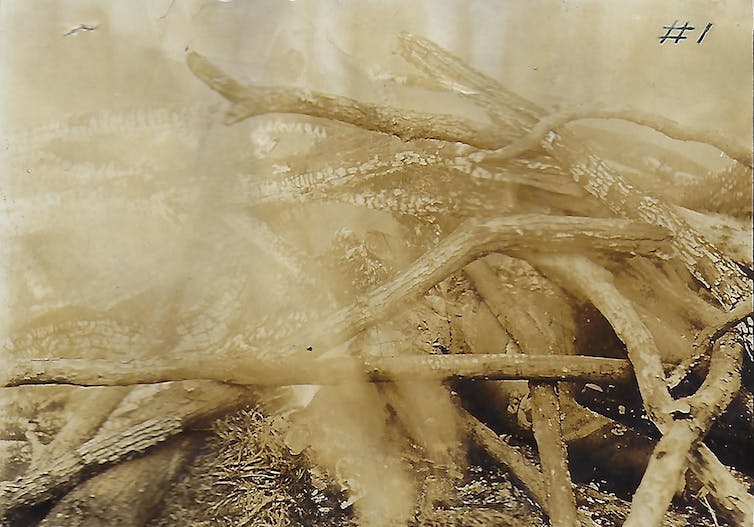
The first was a 6-by-5-inch image of what appeared to be burning wood. It proved difficult to decipher. But the description clarified matters.

In this May 27, 1922 photograph, the charred remains of Jesse Thomas are barely visible. Jeff Littlejohn

It read: “Burning of negro in front of old City Hall, Waco, Texas.”

Revealing history lessons

I immediately set out to identify the victim and to discover the story behind “Teddie’s pictures.”

As I did so, I realized that what I was doing would be controversial, if not illegal, had I been a K-12 teacher in Texas.

In fact, I was engaging in the very kind of historical analysis that Texas Gov. Greg Abbott and Republican legislators in Texas want to ban from public schools.

In 2021, for example, Texas Republicans enacted Senate Bill 3 to prohibit K-12 educators from teaching that “slavery and racism are anything other than deviations from … the authentic founding principles of the United States, which include liberty and equality.”

In other words, this official state interpretation holds that slavery, racism and racism’s deadly manifestation, lynching, did not serve as systemic forces that shaped Texas history but were instead aberrations without any fundamental meaning for Texans – or even beyond the state.
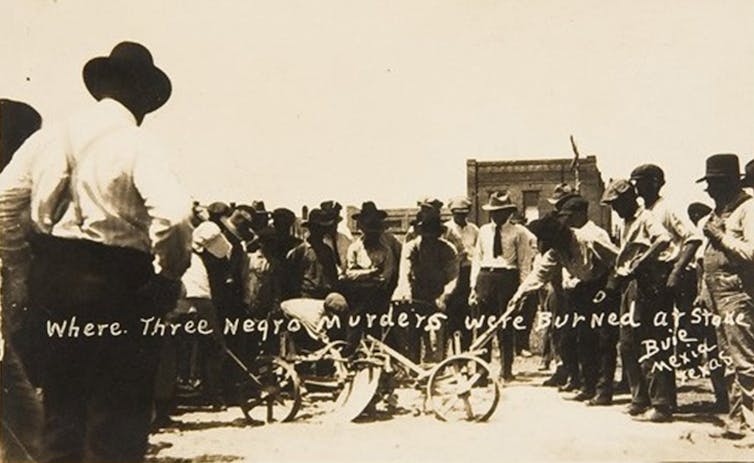
Dozens of men wearing hats have their heads down as they look at the site where three black men were burned at the stake.
Scene of the burnings of Johnny Cornish, Mose Jones and Snap Curry in Kirvin, Texas, on May 6, 1922. Jeff Littlejohn

Teddie’s photo album, which also included pictures of Teddie and her husband doing normal, everyday things like riding donkeys and going to wedding anniversary dinners, presented a direct challenge to this interpretation.

Racist mob terror

Indeed, my research soon revealed that the pictures belonged to Mary “Teddie” Kemp, a white woman from Pennsylvania who moved with her husband, Gene Kemp, to Waco, Texas, in 1922.

This date proved crucial, because it meant that the victim in Teddie’s photo album could not be Jesse Washington, the 17-year-old mentally handicapped young man who was lynched in the infamous “Waco Horror” of 1916.

In that lynching, historian Patricia Bernstein writes, Washington was “beaten, stabbed, mutilated, hanged and burned to death on the Waco town square, before an audience of 10-15,000 screaming, cheering spectators.”

In fact, the dates on the other photos in Teddie’s album made it likely that this picture showed the burning of Jesse Thomas, a 23-year-old Black man.

Thomas was wrongly accused of murdering W. Harrell Bolton and assaulting his female companion, Margaret Hays, near Waco on May 25, 1922.

When Hays identified Thomas as her likely assailant, a relative named Sam Harris shot and killed Thomas.

A white mob then dragged his body to City Hall and burned it before a crowd of several thousand people.

White supremacy in Texas

The identification of Jesse Thomas as the victim in Teddie’s photo album only led to more questions.

Why would an educated white woman from Pennsylvania include a picture of a Black lynching victim in a personal photo album?
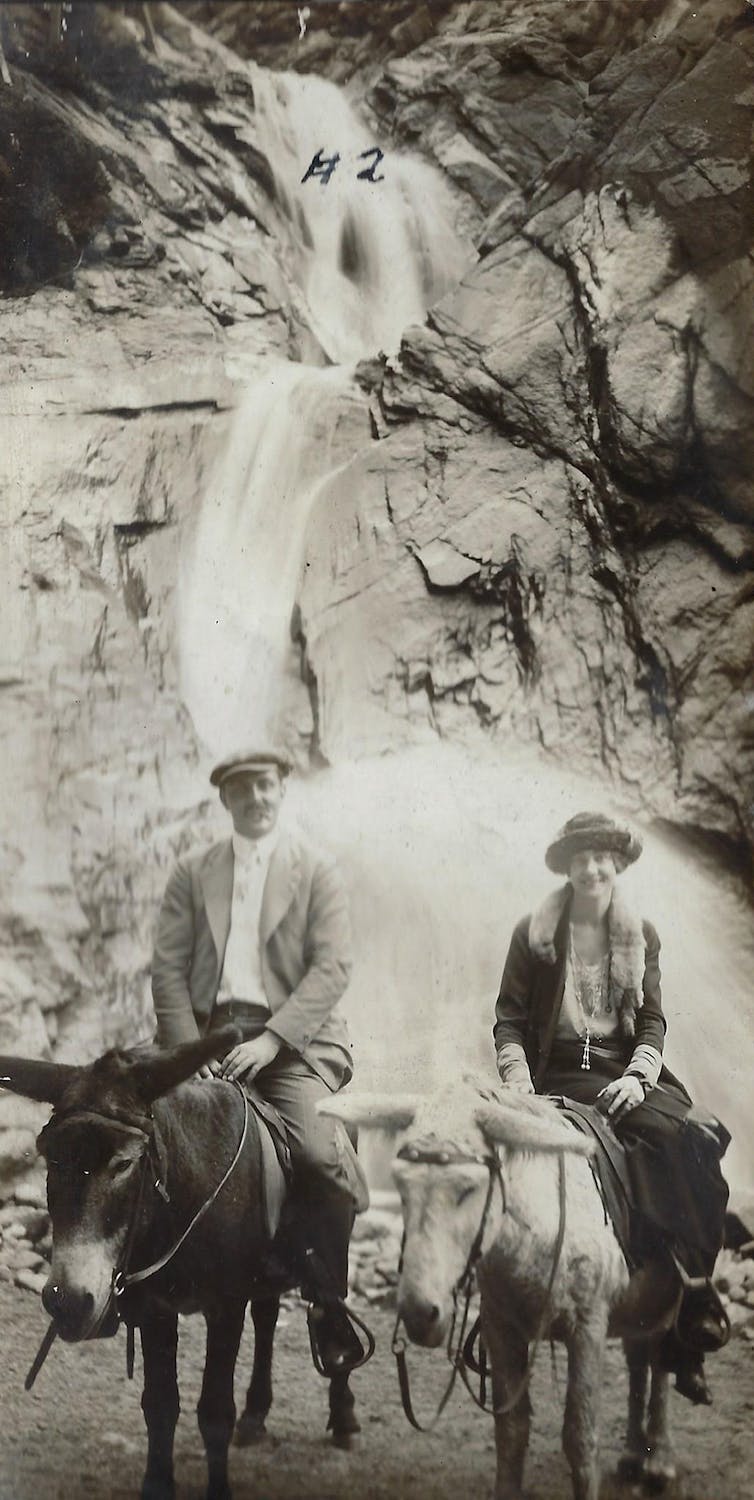
A white man and woman are seen riding on donkeys near a mountain waterfall.
In this Sept. 26, 1921, photograph, Mary ‘Teddie’ Kemp and her husband, Gene, are riding on donkeys at Seven Falls and South Cheyenne Cañon, Colo. Jeffrey Littlejohn

Why would she take her photos out of chronological sequence and place the lynching picture as the first photo in the album?

The answers to these questions reveal a great deal about Texas just 100 years ago.

In my view, the album exposes the priority that Anglo Texans – even new arrivals to the state – placed on white supremacy and Black subjugation.

Teddie likely pasted the picture of Jesse Thomas’ burning body at the beginning of her album because it featured an electrifying, adrenaline-charged event that viscerally illustrated the nature of her new Texas home.
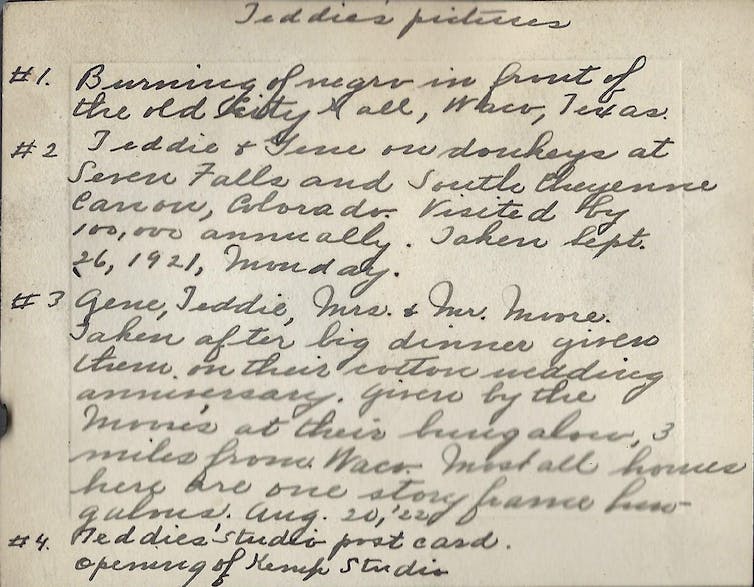
An image of handwritten descriptions.
An image of Mary Kemp’s handwritten descriptions of her photographs. Jeff Littlejohn

Indeed, as historian William Carrigan has shown, white supremacy and racial violence served as core elements of the state’s identity.

Together, they established the written and unwritten rules governing the social order – who could vote, who could marry whom, who could attend events – and the ultimate punishment for transgressing the rules.

Lynchings, like the one depicted in Teddie’s photo album, present a direct challenge to the whitewashed view of Texas history that Abbott and his Republican colleagues prefer.

Unspeakable violence

Lynchings occurred regularly in Texas – with 16 in 1922 alone – and served as the most extreme and violent embodiment of white supremacy in the state during the Jim Crow period.

When Black and Hispanic Texans dared to challenge white authority or to claim for themselves the rights of U.S. citizens, they faced violence on a scale rarely seen in other parts of the country.
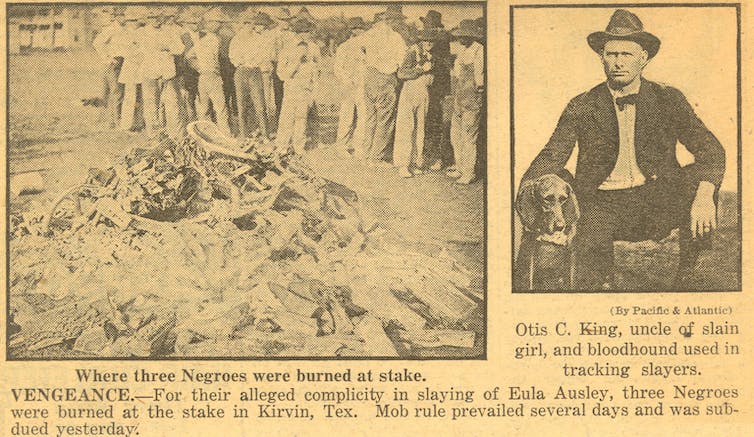
A photograph published in a newspaper shows where three black men were burned at the stake.
In this image of a May 6, 1922, newspaper, a photo caption reads ‘Where three Negroes were burned at stake’ in Kirvin, Texas.
W.E.B. Du Bois Papers

In May 1922, for example, white Texans carried out in one month at least 10 lynchings, more lynchings than in any other state but Georgia for the entire year.

Eight of the Texas victims killed in 1922 were burned at the stake in a form of torture that most people today associate with the so-called Dark Ages.

But these horrific acts happened in modern Texas, just a few generations ago. And white people caught the events on film and put the photos in their own family albums.

One hundred years ago, the lynching of Black men and women in Texas was not an aberration. It proved the rule. You could say white supremacist rule.The Conversation

Jeffrey L. Littlejohn, Professor of History, Sam Houston State University

This article is republished from The Conversation under a Creative Commons license. Read the original article.

About Post Author

Share. Facebook Twitter Pinterest LinkedIn Reddit WhatsApp Telegram Email
Previous ArticleDenver Broncos fire coach Nathaniel Hackett after a 4-11 start in his 1st season
Next Article 3 things we heard from the Chicago Bears, including whether Matt Eberflus would consider shutting down Justin Fields: ‘Absolutely not.’
staff

Related Posts

A Clinical Perspective on Common Health Conditions Affecting Black Women

Health Experts: Protect Yourself but No Need to Worry Yet About “Virus Without Vaccine” Spreading in California

After Deep Federal Cuts, California Lawmakers Push for Full Restoration of Medi-Cal Benefits 

Leave A Reply Cancel Reply

Video of the Week
https://www.youtube.com/watch?v=AxFXtgzTu4U
Advertisement
Video of the Week
https://www.youtube.com/watch?v=OjfvYnUXHuI
ABOUT US


The Windy City Word is a weekly newspaper that projects a positive image of the community it serves. It reflects life on the Greater West Side as seen by the people who live and work here.

OUR PICKS

2025 Kia Carnival 3rd Row Wins BIG Time! #shorts #carreview

Get lit with these 5 Black-owned Chicago dispensaries

@Chrysler Pacifica: Top Safety Tech in a Minivan

MOST POPULAR

A Clinical Perspective on Common Health Conditions Affecting Black Women

Health Experts: Protect Yourself but No Need to Worry Yet About “Virus Without Vaccine” Spreading in California

After Deep Federal Cuts, California Lawmakers Push for Full Restoration of Medi-Cal Benefits 

© 2026 The Windy City Word. Site Designed by No Regret Medai.
  • Home
  • Lifestyle
  • Podcast
  • Contact Us

Type above and press Enter to search. Press Esc to cancel.