



Last Friday, the news of the passing of Reverend Dr. Calvin Otis Butts, III, rocked our world here at The HistoryMakers. The news came amidst the ongoing news of the day: the war in Ukraine, continuing political acrimony, rising interest rates, the threat of a recession and this week’s upcoming midterm elections and their impact on our future…our democracy. Ford Foundation President Darren Walker, who also served previously as Abyssinian Development Corporation’s Chief Operating Officer, spoke of Reverend Butts’s significance: “Reverend Butts worked more effectively than any other leader at the intersection of power, politics and faith in New York. He understood the role of faith in our lives, especially in the Black community. But he also understood power and how to wield it and how to demand power from those who often sought to hoard it. And so he was a pragmatist, he was a realist, but he was also a dreamer.”
Reverend Butts had been an active member of our ReligionMakers Advisory Committee, helping us fill in the missing pieces of our nation’s African American religious history. He did so, taking time out of an already overcrowded calendar. His expansive knowledge and thoughtful approach lent credibility and substance to our work. The work of the committee resulted in a 150 page chronological outline of African American religious history, a list of those we still need to interview as well as a call to action to preserve the history of the black church before it is too late. In fact, this preservation work had begun in the 1980s at New York’s Schomburg Center for Research in Black Culture under the tutelage of director emeritus Howard Dodson. During the COVID pandemic, we hosted a symposium entitled Are You Saved: The History of Blacks in Religion.
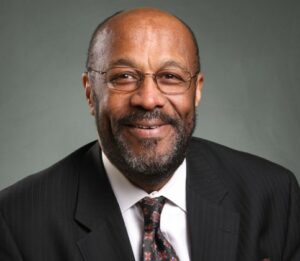
Hosted by the Dean of the School of Divinity at Wake Forest University Jonathan Lee Walton, this panel featured Assistant Professor at Yale University Divinity School The Reverend Dr. Eboni Marshall-Turman as well as Colgate Rochester Crozer Divinity School’s Reverend Dr. Marvin A. McMickle who so effectively eulogized Reverend Butts on Friday in front of a standing room only crowd at Abyssinian Baptist Church. He told of their young days as young divinity students in their twenties at Union Theological Seminary under the tutelage of Dr. Samuel DeWitt Proctor. He also spoke of the untimeliness of Butts’ death from pancreatic cancer at the age of 73: “This is a bad time to lose a prophet.”
Butts’ memorial service drew thousands that included his family, supporters, church members, religious, political, civic and business leaders and friends. His life’s work had been spent ministering to the poor and those in need, calling out the injustices in society, climbing poles to paint over billboards, serving as an university president for twenty years of SUNY Old Westbury, mentoring other young religious and civic leaders like Senator Raphael Warnock, Senior Pastor of Ebenezer Baptist Church and leading the Abyssinian congregation for decades.
Calvin Otis Butts, III was born on July 19, 1949, the son of Eloise (Edwards) Butts and Calvin O. Butts, II. In his 2005 interview with The HistoryMakers, Reverend Butts spoke very highly of his parents: “Both were very industrious people, I watched them work very hard–this is etched in my memory, in my heart–to build a life, to buy a home, to buy a second home, to take great pride in accumulating, not opulent things, but things that would provide for their comfort and for the comfort of their child, and for their child’s education, and providing the right kind of atmosphere in the home, helping to make sure that I could meet the challenges of the world.”
Of his mother, he said “I like to think that my mother is a reflection of black women…they cared for their father, their mother, their sibling in the face of great odds. They had to work and then come home and work again…” [3] He similarly praised his father, calling him “one of those black men who… would have made great progress intellectually and otherwise if it had not been for the racial situation at the time in this country…”
When asked about the sounds, sights and smells of his childhood, he responded by saying: “Well, sounds, of course, would be the sounds of New York, the subway, sirens, and the African rhythms that accompany salsa music…the different languages, Yiddish, Spanish, and the various dialects of America, English…For sights…it would be the East River and the gorgeous view we had from our apartment in the projects, the Domino Sugar plant and the boats going up and down the river at night, the view of the 59th Street bridge, the Queensboro Bridge; looking out of the window of the car and seeing Manhattan Island, a wonderful view as you approach the Midtown Tunnel–probably one of the most gorgeous sights on earth…for smells… food smells that would hit you when you came home from school or during holidays when the families would gather.”
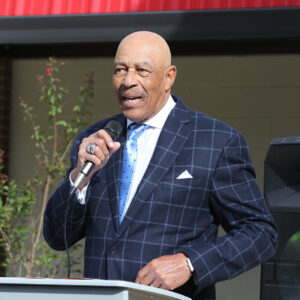
After attending Flushing High School in New York, Reverend Butts attended Morehouse College in Atlanta, Georgia where he was, like other Morehouse men of his generation, greatly influenced by the legendary Morehouse President Dr. Benjamin E. Mays. HistoryMaker and businessman Donald L. Hense who was Butts’ classmate noted: “Calvin was really smart. He had a 4.0 average, and he was really being sought after by all the fraternities to join. And Calvin challenged me to a debate. And my agreement was, if he lost the debate, he would pledge Kappa [Kappa Alpha Psi Fraternity]. He’s a Kappa…”
The assassination of Dr. Martin Luther King, Jr. served as a turning point in Butts’ thoughts about student activism: “I remember going across to Canterbury House and meeting with some fellows that I had been working within an organization called PRIDE, People Ready In Defense of Ebony…We dug up all of our preplans and we went to another location and made a bunch of Molotov cocktails….I started out with about seven of these Molotov cocktails, and I had about two left…I looked down at one of these Molotov cocktails, and I remember as we were walking, we heard this whir, and we looked around and it was an armored car, like, an Atlanta police, like a half-track truck or something….and this big shotgun and his very red neck. And all of a sudden I understood that violence was not the way (laughter); nonviolence was the way. So I remember casting off the bag with the cocktails in it and running and just running, running, running, running, running and my friend doing the same thing.”
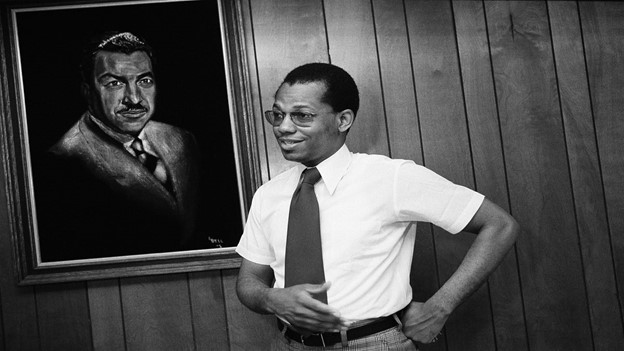
After earning his degree in philosophy from Morehouse College in 1972, Butts entered Union Theological Seminary in New York: “All of a sudden all of that talk about religion, you know, and all of their faith, and all that clicks in.’” [8] He added: My theology is shaped largely by three people in terms of reading and understanding: Howard Thurman, Benjamin Mays, James Cone. Howard Thurman’s writing– Jesus and the disinherited, the relationship of this young rabbi from a Palestinian ghetto to his people and his understanding of God as representing the power and the force that would free them from the oppression of Rome but also from the oppression of Rome’s puppet leaders like Herod.
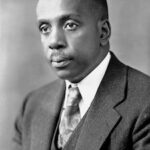
“Benjamin E. Mays, in “The Negro’s God” talked about how our religion was once a religion of compensation. And now it was evolving into something that was pressing us forward in terms of our own struggle for freedom, and liberty, and justice–and James Cone in “Black Theology & Black Power” that sort of propelled me into ministry and helped me to be about the struggles that I’m involved in against police brutality, in community development, fighting racism, and encouraging young black men and women to a sense of excellence in their studies and in their work, because God is on the side of black people in their struggle, because we have the conscience of America. We are the ones who continue to save America all the time. And, and those who agree with us are black. That’s ontological blackness.”
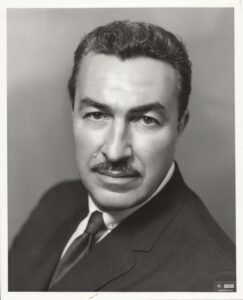
And that would be his focus for the next fifty years. He had already succeeded the legendary U.S. Congressman and Reverend Adam Clayton Powell, Jr. (1908-1972) who had assumed the role of senior pastor of Abyssinian Baptist Church in 1938 after his father Adam Clayton Powell, Sr. (1865-1953) The church, particularly Abyssinian [Baptist Church], needed to…rebuild the community, protect the poor, and not allow this very historic place to just be overrun with developers who have no interest in it other than making a dollar. We have resources in the church. We have political connections and…we have human and financial resources…So we gathered some of our more active members around the table, told them what we were witnessing, and said how do we deal with this? And out of those early efforts came the Abyssinian Development Corporation.
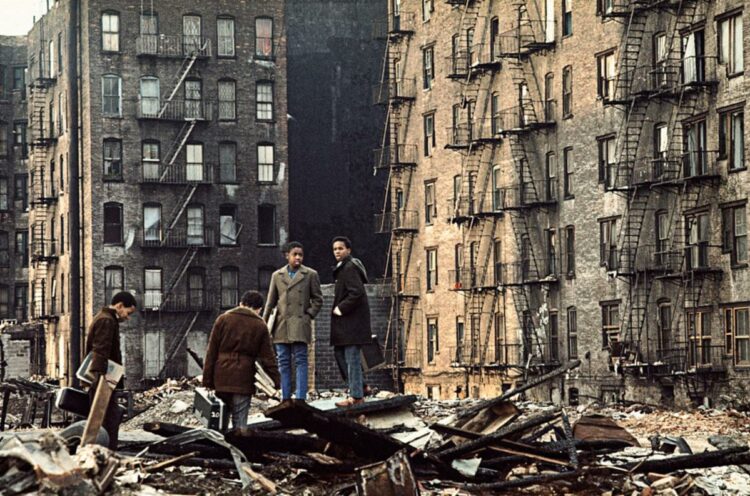
The Abyssinian Development Corporation was designed, according to Reverend Butts, to foster “residential, commercial, educational, and cultural development.” [10] Reverend Butts used his pulpit to address the myriad of issues facing the black community, and despite never holding public office, he became a political leader and change agent. When we interviewed him in the early mid-2000s, he spoke of his work to end police brutality. “Our movement had helped to get–Ben Ward made the first African-American police commissioner in the city. We saw the rates of incidents drop. We expanded the Police–Civilian Complaint Review Board so more civilians could be on it. And we actually saw the number of complaints go down and the number of incidents go down.”
Reverend Butts was particularly vocal after the police killing of Amadou Diallo in 1999, and the subsequent acquittal of the four white officers involved. “The city was racially divided. [Former New York Mayor Rudy] Giuliani was responsible for it…I watched how he baited black people. I watched how he used race…as a wedge between New Yorkers. I watched his policies and how he responded to black people. I met with him early on in his administration. He was mean-spirited. I was certainly angry with him ’cause he hadn’t done a thing…to try to help improve race relations.”
In reflections during his interview, he shared how he hoped to be remembered: “Two things…one, in the true sense of the spirit of Christ, that I’m a Christian; and two, somebody said he was a good brother, that he was a good brother, and we could talk to him, he was all right, you know, a good father, good husband, good son.”
Butts had joined our ReligionMakers Advisory Board in 2020 because he had become painfully aware of the lack of documentation of black religious life and contributions and the need to protect and digitize the collection of Abyssinian Baptist Church. In fact, he noted the disappearance of a trunk that contained the irreplaceable collection of Adam Clayton Powell: “Adam Clayton Powell Jr, when he died they said they were shipping a box of material or a couple of boxes or a trunk from Washington D.C. back to New York. We never found it and it was to have contained his papers, his notes… we’ve never found it. We don’t know what happened to those materials that he collected.” He added: I have a library that was set up by the church for me and in it are just tons and tons of boxes and papers and books. Fortunately there’s one student who is going to be working with me to try to organize them and I have never thought they were important, you know, I’m just a servant of God struggling out here trying to make it the best way I can.
“We petitioned several major foundations to help us with money to digitize the 212-year history that we know of the Abyssinian Baptist Church. The reverend Dr. Marvin A. McMickle served as an assistant minister at the Abyssinian Baptist Church. He doesn’t even remember the things he left there… James Cone lectured here many times. I have a box of tapes from John Henrick Clarke.” Then he forewarned: “People will try to take our history and change it. As they told us we had no history coming from Africa and the black church is the cultural barrier, is the repository, and we must…make sure and contribute to these organizations so that they can tell the truth about us.”
Truth telling was at the core of Dr. Butts’ theology. We will continue the work that he started to ensure the documentation and preservation of Abyssinian Baptist Church’s rich history. The black church has served as the cornerstone of black life, its contributions and accomplishments and the loss of its history is essentially the loss of black life in America.
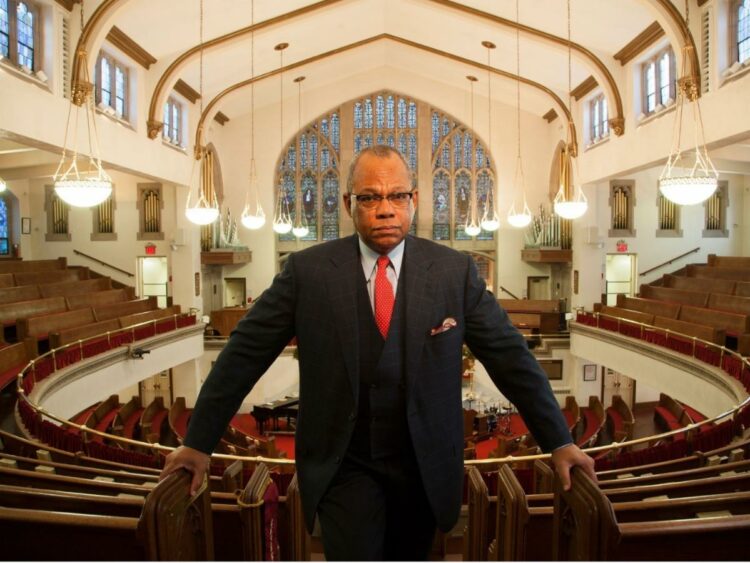
Butts’ life was spent advocating for “the least of these” as a preacher, teacher and administrator. He will be sorely missed. But let’s commit to carrying on his legacy at a time when his work is so very needed. Thank you, Reverend Dr. Calvin Otis Butts, III for your welcoming smile, your furrowed brow and your tireless dedication. You were a good father, a good husband, a good son, and a passionate advocate for black people. You labored in the vineyards and it is time for us to take up the plow.
This article originally appeared on The HistoryMakers.