




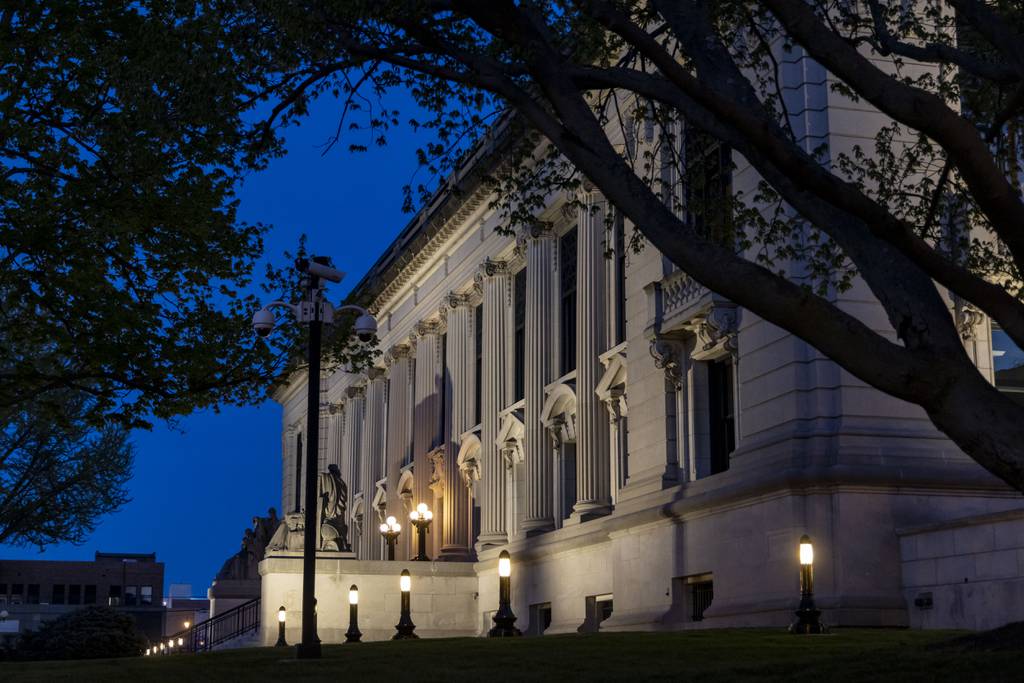
The Illinois Supreme Court on Tuesday ruled that eliminating cash bail for defendants awaiting trial does not violate the Illinois Constitution, allowing a historic change to the criminal justice system to go forward over objections from county prosecutors who challenged the law.
Tuesday’s 5-2 Supreme Court decision came more than four months after the high court heard arguments in the case in mid-March, when a coalition of state’s attorneys argued that the legislature overstepped its authority in approving the law. The court’s decisions split along party lines, with the two Republican justices, David Overstreet and Lisa Holder White, dissenting.
“The Illinois Constitution of 1970 does not mandate that monetary bail is the only means to ensure criminal defendants appear for trials or the only means to protect the public,” Chief Justice Mary Jane Theis wrote in the majority opinion. “Our constitution creates a balance between the individual rights of defendants and the individual rights of crime victims.”
The law eliminating cash bail creates a system “commensurate with that balance,” the court ruled.
The ruling means judges, prosecutors, attorneys and other court staff across the state will shift how they handle pending criminal cases. The justices gave trial courts 60 days to prepare for the new rules, with cash bail to be eliminated on Sept. 18.
The high court’s long-awaited ruling represents a victory for Democratic Gov. J.B. Pritzker, who faced fierce criticism over the policy from Republicans during his reelection campaign last year, including a barrage of misleading claims in TV ads and political mailers.
The governor made eliminating cash bail a priority during his first term and backed the Illinois Legislative Black Caucus in pushing its sweeping criminal justice overhaul in the wake of the police killing of George Floyd in Minneapolis in 2020.
“We can now move forward with historic reform to ensure pretrial detainment is determined by the danger an individual poses to the community instead of by their ability to pay their way out of jail,” Pritzker said in a statement Tuesday.
The elimination of cash bail was part of the 764-page SAFE-T Act, which was passed by the state legislature in 2021 and includes a number of criminal justice measures meant to promote police accountability and create a more equitable court system.
The law also requires all police to wear body cameras by 2025 and creates a more robust system for decertifying officers who commit wrongdoing, among other changes. Those provisions were not affected by the legal challenges.
The bail portion of the law was set to take effect Jan. 1, as lawmakers allowed counties a two-year ramp up to prepare for major procedural changes in how pretrial detention decisions are made.
The high court, though, stepped in on New Year’s Eve with an 11th-hour decision to halt implementation following a Dec. 28 ruling from a Kankakee County judge who found the measures were unconstitutional. That lower court ruling in a case that consolidated legal challenges from prosecutors in more than 60 mostly downstate counties led to confusion across the state about the decision’s impact.
The majority found that the trial court ignored the “plain language of the constitution” in multiple instances and that the prosecutors challenging the law did not meet the high legal bar for overturning a state statute.
“Statutes enjoy a strong presumption of constitutionality because the legislature is principally responsible for determining the public policy of our state,” Theis wrote.
Once the changes go into effect, monetary bail will no longer be a factor in whether someone is released from jail while they await trial. Instead, judges will weigh the circumstances and decide whether to release defendants with certain conditions or order them detained if the allegations meet certain thresholds.
Proponents of the controversial measure have said the reforms would right systemic wrongs and stop the incarceration of people for nonviolent charges because they are too poor to post bail.
Detractors argued that it would allow too many dangerous criminals back on the streets, though studies in other jurisdictions that have reformed cash bail systems have generally not found high rates of recidivism for people released while awaiting trial.
While the majority of the prosecutors challenging the law are Republicans, two Democratic state’s attorneys — Kankakee County’s Jim Rowe and Will County’s James Glasgow — led the charge last fall with separate lawsuits.
The legal challenges came during a heated campaign season in which GOP challengers to Pritzker and Democratic Attorney General Kwame Raoul unsuccessfully sought to pin the blame for pandemic-era spikes in crime on the SAFE-T Act, even though its most controversial provision, the elimination of cash bail, had yet to take effect.
Prosecutors who challenged the law argued that the measure violates the separation of powers clause of the state constitution by allowing the Illinois General Assembly to take away the judiciary’s ability to set bail. They also argued that lawmakers should have sought a voter referendum on the issue to amend the constitution.
Lawyers with the Illinois attorney general’s office countered that the constitution holds no requirement for monetary bail and that lawmakers have long legislated courtroom issues.
Pritzker and other supporters have argued that the new policy will prevent people charged with violent crimes from being able to buy their freedom before trial because they have the means to make bail.

Afternoon Briefing
Weekdays
Chicago Tribune editors’ top story picks, delivered to your inbox each afternoon.
Under the new system, defendants will appear for two hearings: an initial hearing, also known as a conditions hearing, and, if prosecutors decide to pursue detention, a hearing, designed to provide a more comprehensive look at whether someone should be released or detained pretrial.
The state Supreme Court has yet to issue a ruling on another of Pritzker’s signature legislative accomplishments: the sweeping ban on certain high-powered semi-automatic weapons and high-capacity ammunition magazines.
The court heard arguments in May in a challenge brought by Republican state Rep. Dan Caulkins of Decatur after a lower court ruled the ban, prompted by the deadly mass shooting at Highland Park’s Fourth of July parade last year, violated the state constitution’s equal protection and special legislation clauses.
More to come.
dpetrella@chicagotribune.com
jgorner@chicagotribune.com
mabuckley@chicagotribune.com


