




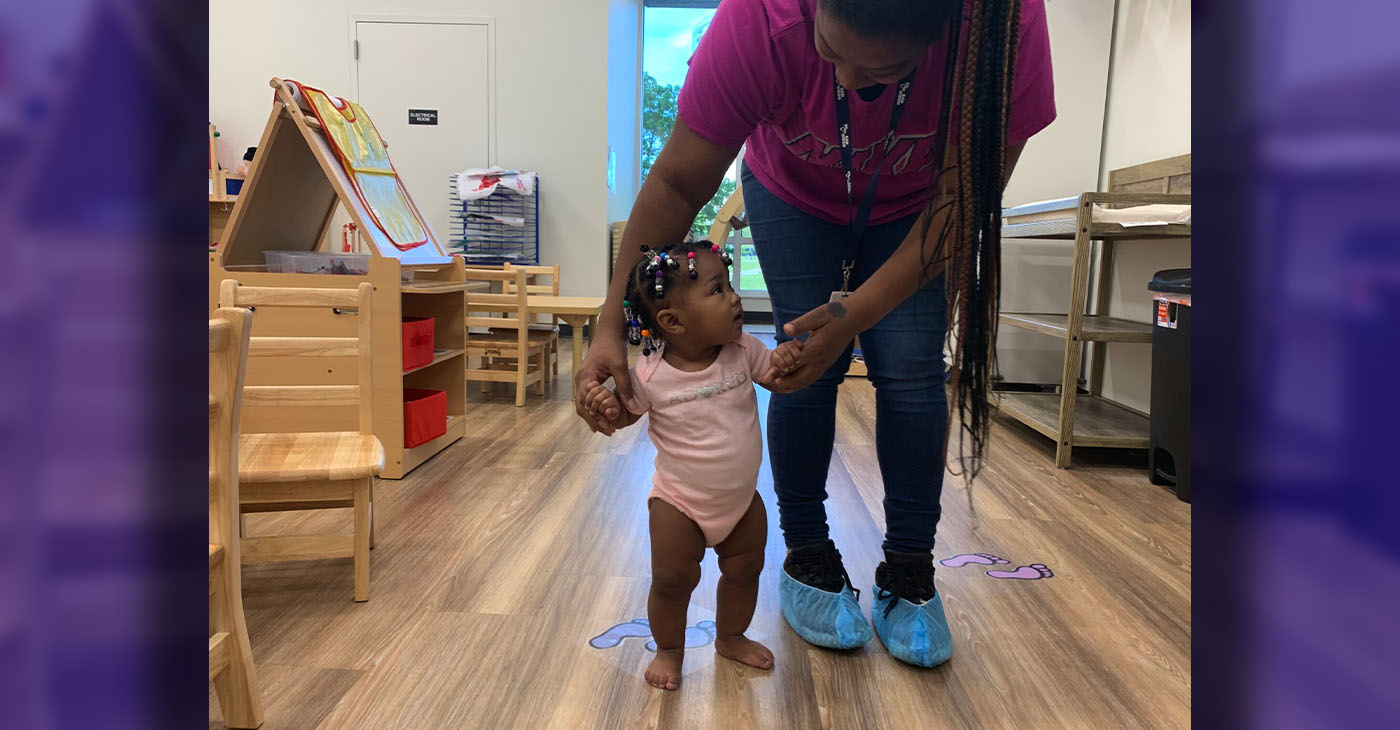
When babies are born, their brains contain billions of neurons. But how those neurons interact — and what they can do as babies grow through childhood into adulthood — is largely shaped by their experiences in the first 1,000 days of life. The architecture of the brain is built in those first three years, creating a foundation that enables thinking, learning, and adapting over time. More than 85% of adult brain volume is built during this critical period. Luckily, we know exactly what infants and toddlers need to develop healthy brains that will set them up for a lifetime of well-being.
How to support brain development
Decades of research have identified several building blocks that are essential to constructing strong foundations for the brain in the first 1,000 days. Researchers agree that the cornerstone of healthy brain development is the formation of secure attachments between babies and the trusted and caring adults in their lives. Whether these caregivers are parents, kin (including friends and neighbors), or trained early childhood professionals, they should be “knowledgeable about how to support (babies’) development and learning and responsive to their individual progress,” says a report from the National Academies of Sciences, Engineering, and Medicine. Note the connection between caring and learning. Caring adults are crucial to developing the capacity for learning in the brains of infants and toddlers. In early childhood, care and learning are inseparable.
To strengthen the brain’s capacity for learning in the first 1,000 days, the Center on the Developing Child at Harvard University has identified two key strategies that trusted adults can use — engaging in “serve and return” interactions and minimizing exposure to toxic stress. As researchers at the center explain, serve and return interactions occur when an infant or toddler “babbles, gestures, or cries, and an adult responds appropriately with eye contact, words, or a hug.” Engaging in serve and return with caregivers helps babies and very young children build and strengthen neural connections related to communication and social skills in their developing brains. The absence of consistent serve and return exchanges can release potentially harmful stress hormones into the brains of infants and toddlers. And prolonged exposure to such hormones can result in what is known as “toxic stress.” Minimizing exposure to toxic stress in the first 1,000 days is crucial for healthy brain development.
According to the Center on the Developing Child, typical causes of toxic stress during this period include “physical or emotional abuse, chronic neglect, caregiver substance abuse or mental illness, exposure to violence, and/or the accumulated burdens of family economic hardship.” But the center also points out that trusting relationships with adult caregivers can act as a buffer against these hardships. That’s why child care providers — whether they be friends, family, and neighbors, or licensed home-based or center-based caregivers and educators — can be so essential in the lives of families who may be experiencing economic hardships such as food or housing insecurity.
As Dr. Dana Suskind, a pediatric specialist and expert in early childhood brain development, writes in her book Parent Nation, “Loving (adults) do not need a PhD or expensive gadgets to do an excellent job at supporting early brain development and building our future citizens. They need easily acquired, basic knowledge about how to best foster critical neural connections.” To that end, The Basics is an initiative that uses a public health approach to educate and empower caregivers about their role in healthy brain development. In addition to a wide array of online resources (some available in multiple languages), The Basics offers a printable one-pager that can be posted in homes, classrooms, pediatrician offices, or anywhere else caregivers may find themselves. Adults — including policymakers — who embrace the basic building blocks of healthy brain development for infants and toddlers are helping build a foundation that will yield benefits well beyond the first 1,000 days.
Why support brain development
Many people, especially educators who work with children in kindergarten through third grade, can point to early learning as crucial for “school readiness,” but that term can be easily misunderstood. In EdNC’s many conversations with elementary educators, the vast majority say school readiness means young children being prepared to participate in group learning. This includes having skills such as developing relationships with trusted adults outside their homes, sitting in a circle or standing in a line with other children, communicating about their wants and needs, sharing objects with others, fine motor control, and knowing a little bit about how to regulate emotions.