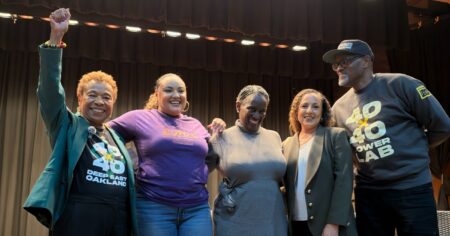
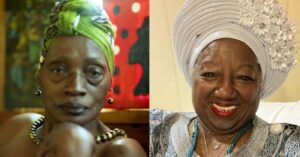
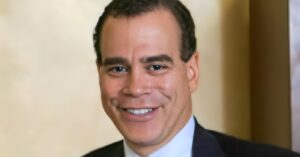




Community members gathered at the Black Panther Party Museum on Saturday, Aug. 15, in downtown Oakland for a screening of “Seeds for Liberation,” an award-winning documentary examining the Palestinian liberation movement and its connections to Black, Chicano and other movements for collective liberation.
The film reveals the face of conflict, struggle, and injustice today and yesterday. In one scene, a bleeding child pleads for help on a shell-shattered rooftop after a bombing in the Gaza Strip last year. In another scene, newly freed Nelson Mandela addresses thousands at the Oakland Coliseum in 1990, at the end of apartheid.
The screening was hosted by the East Bay Democratic Socialists of America and the Dr. Huey P. Newton Foundation. Following the film, director Matthew Solomon joined local community leaders for a discussion about solidarity, resistance, and the historical connections explored throughout the documentary.
Directed by Solomon and executive-produced by Donna Hadjikhani and Alana Hadid, “Seeds for Liberation” situates Palestinian experiences within the broader history of anti-imperialist and decolonial movements.
Through interviews with historians, legal scholars, activists and organizers, the documentary examines Palestinian resistance. It also details the role of social media in shaping the public’s understanding of the impact of Palestine’s 77-year occupation by Israeli forces, events in Gaza and the West Bank, and relationships between liberation movements across generations and geographic boundaries.
The film includes perspectives of people connected to the Black Liberation Army, La Raza Unida and the Stop Cop City movement. Those featured talk about colonialism, U.S. foreign policy, policing, racial justice and their views of what solidarity with Palestinians has meant.
Solomon developed the documentary following his previous film, “Reimagining Safety,” which explored alternatives to traditional policing.
“I use film as a medium to connect personal testimony with larger social and political questions,” said Solomon, who is currently touring the film across the nation as well as Canada and other countries.
Executive producer Hadjikhani brought a personal connection to the project. An Iranian American designer and social justice advocate, she traveled to Gaza and the West Bank as a college student in 1993 during the First Intifada. Hadid has since focused on Palestinian stories and other underrepresented voices.
The Oakland screening carried added historical significance because it was held in the Black Panther Party Museum, where the history of Black resistance and community organizing provided a backdrop for the film’s examination of interconnected struggles.
Activist and artist Cat Brooks passionately spoke about the fight for the freedom of all people. “No one is free until everyone is free,” she said.
Brooks played a key role in the struggle for justice for Oscar Grant, who was gunned down by a BART police officer in 2009 and is co-founder of the Anti Police-Terror Project (APTP), whose mission is to rapidly respond to and ultimately eradicate state violence in communities of color.
Rather than treating liberation movements as isolated chapters, “Seeds for Liberation” asks audiences to consider how movements separated by time, race and geography have influenced one another and how solidarity has continued to evolve across generations.
HASHTAGS
#PostNewsGroup #CarlaThomas #OaklandPost #SanFranciscoPost
#SeedsForLiberation #BlackPantherPartyMuseum #Oakland #Palestine #FreePalestine #BlackLiberation #ChicanoMovement #CollectiveLiberation #SocialJustice #CommunityOrganizing #Solidarity #DocumentaryFilm #IndependentFilm #OaklandEvents #EastBay #BlackHistory #LiberationMovements #MatthewSolomon #HueyPNewtonFoundation #BayAreaEvents
The post From Palestine to Oakland: Seeds for Liberation Examines Shared Struggles for Freedom appeared first on BlackPressUSA.