




New Texas Monument Highlights Overlooked Astronauts, Scientists And Leaders Just Blocks From NASA’s Johnson Space Center
A new monument in Nassau Bay, Texas, is bringing greater recognition to Black pioneers and other underrepresented figures whose work helped shape America’s space program.
The Houston Defender Network, reported that EarthRise was created to bring greater visibility to Black pioneers and other overlooked figures whose contributions helped make America’s space achievements possible.
EarthRise stands on the grounds of St. Thomas the Apostle Episcopal Church, just four blocks from NASA’s Johnson Space Center. The public art installation was dedicated on Aug. 16 and was created to preserve stories that organizers say have too often been left out of the traditional telling of America’s space history.
The monument was funded with more than $125,000 from the John and Joseph Talbot Fund of the Episcopal Diocese of Texas, part of a broader effort focused on racial reconciliation and addressing inequities within the church and surrounding communities.
EarthRise Expands The Story Of America’s Space Program
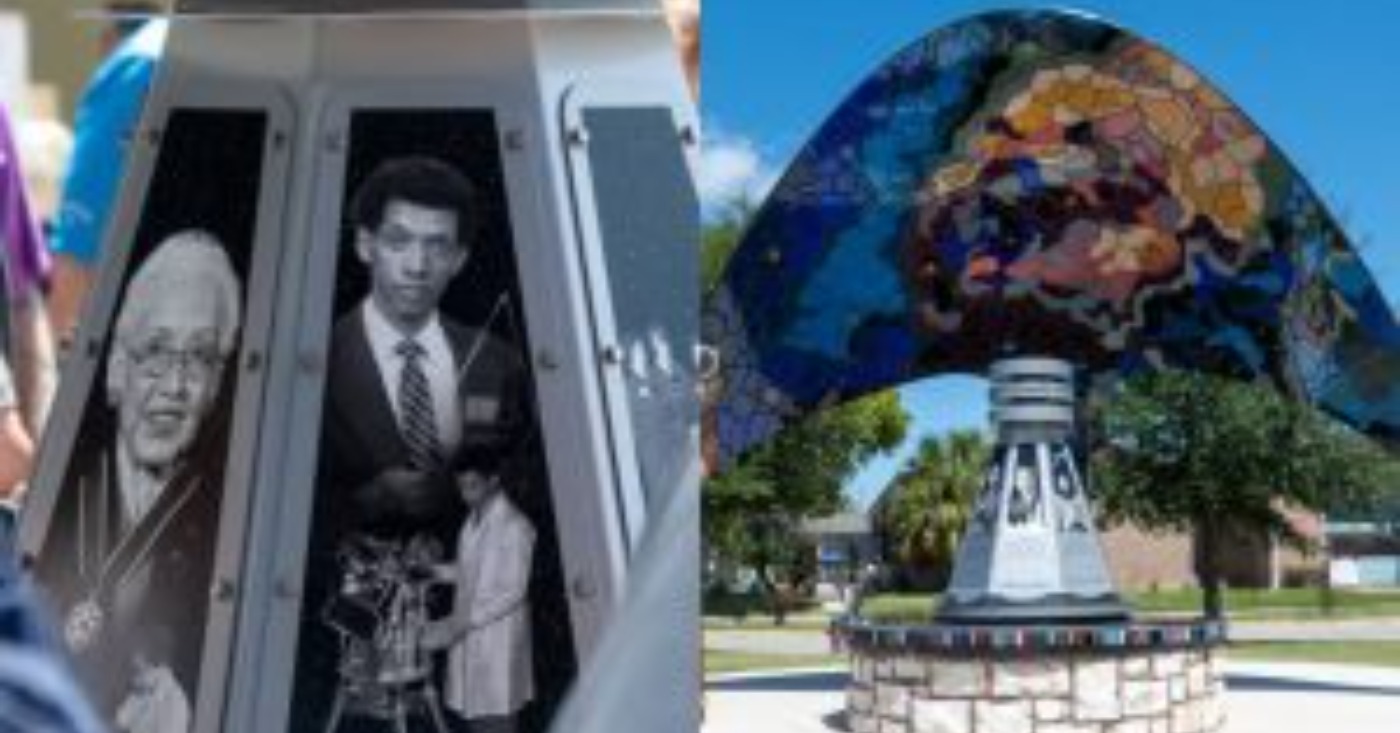
EarthRise features a space capsule-inspired sculpture beneath a stained-glass canopy modeled after the Pillars of Creation, the massive columns of gas and dust in the Eagle Nebula.
Eight panels surrounding the capsule recognize pioneers whose work spanned aviation, science, spaceflight, public service, and NASA leadership. Honorees include Ed Dwight, Robert Henry Lawrence Jr., physicist George Carruthers, Ruth Bates Harris, NASA Astronaut Group 8, Bernard Harris Jr., Sunita Williams and former NASA Administrator Charles Bolden Jr.
The monument’s official honoree list differs from some early reports that identified Katherine Johnson and Guion Bluford as individual honorees. Bluford is represented by NASA Astronaut Group 8, the historic 1978 class that included NASA’s first Black and first women astronaut candidates.
Bolden, a former astronaut and Marine Corps major general, later became NASA’s first Black administrator. He also has personal ties to St. Thomas, where he previously worshipped and served in church leadership and youth ministry.
From Ed Dwight To Robert Lawrence Jr.
Among those honored is Ed Dwight, who in 1961 became the first Black pilot selected for the Air Force’s Aerospace Research Pilot School and was positioned as a potential astronaut candidate. NASA ultimately did not select him.
More than six decades later, Dwight reached space at age 90 aboard a Blue Origin commercial flight in 2024.
Robert Henry Lawrence Jr. was selected for the Air Force’s Manned Orbiting Laboratory program in 1967, becoming the first Black person selected as an astronaut by a U.S. national space program. Lawrence died later that year in a jet training accident before he could fly in space.
Carruthers, meanwhile, developed ultraviolet imaging technology that traveled to the moon aboard Apollo 16, while Bernard Harris became the first Black astronaut to perform a spacewalk.
Together, the stories underscore the monument’s broader purpose: recognizing that America’s space achievements depended on far more people than the handful of astronauts who became household names.
“EarthRise reminds us that history is strongest when every story is told,” Bishop Andrew Doyle of the Episcopal Diocese of Texas said ahead of the dedication.
The installation is free and open to the public year-round at St. Thomas the Apostle Episcopal Church, 18300 Upper Bay Road in Nassau Bay.
Based on reporting by San Antonio Observer.
The post Earthrise Monument Honors Black Space Pioneers Who Helped Shape America’s Space Program appeared first on BlackPressUSA.