



Don’t cop out, cop in,” Chavis calls for activists to use their power at the upcoming United Nations COP30 conference.
By Siena Gleason
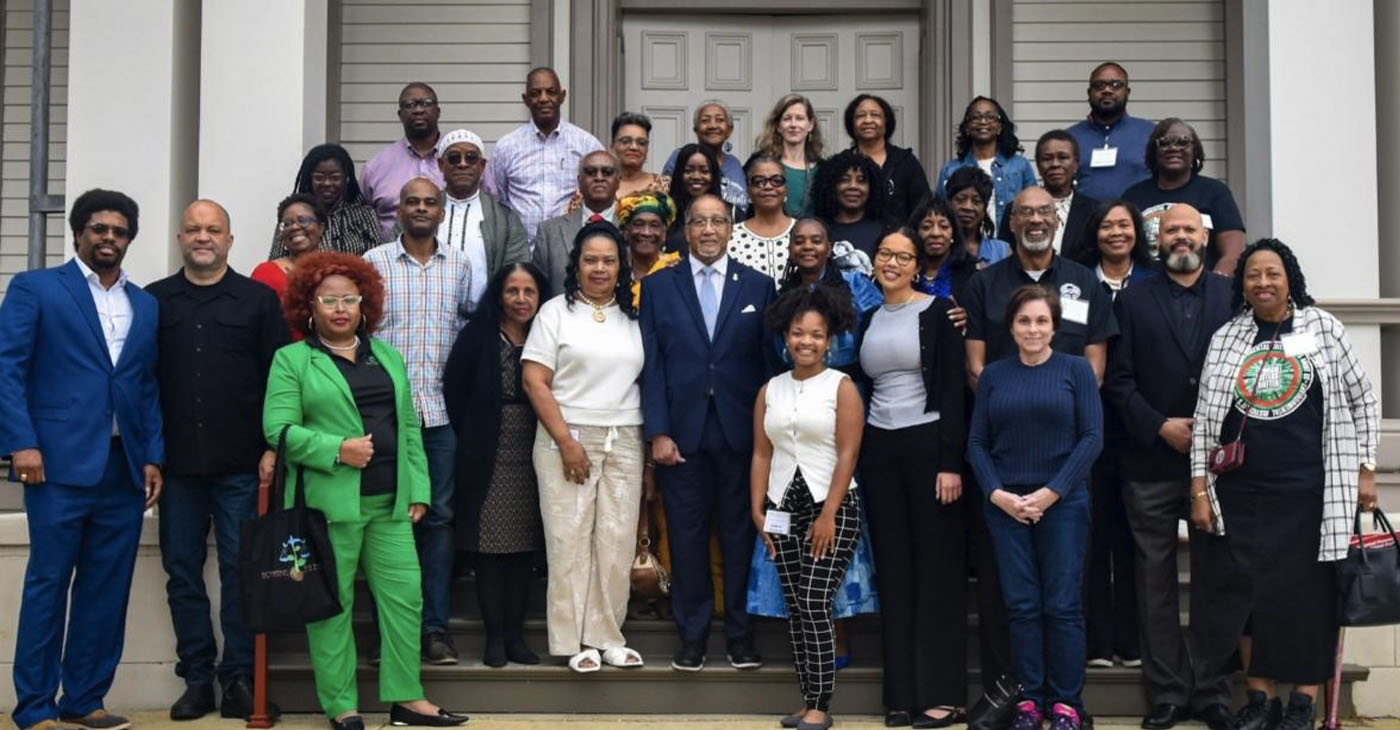
Dr. Benjamin Chavis, president/CEO of the National Newspaper Publishers Association (NNPA), was celebrated as the father of the environmental justice movement at the Mississippi Statewide Environmental Climate Justice Summit, organized by Jesus People Against Pollution (JPAP), October 24-26, 2025, headquartered at Tougaloo College.
Aaron Mair, the first African American president of the Sierra Club and an early environmental justice leader from Albany, NY, celebrated Chavis for his contribution to the movement, specifically citing his 1987 study, Toxic Waste and Race in the United States of America.
“What really gave [the environmental justice movement] force was the Toxic Waste and Race study providing a foundational, as they say, evidence-based approach which could then be replicated by frontline communities,” said Mair.
Mair described how Chavis bravely demanded that the environmental poisoning of Black and poor communities must be looked at through the lens of civil rights, creating the movement that is now known as the environmental justice movement.
“During the 1980s, you couldn’t make just an allegation of discrimination; you had to prove it. You had to statistically show that it existed,” said Chavis. “Nobody ever asked, was there a correlation between the proximity of toxic waste facilities, toxic emissions, and climate emissions to public health?”
Karenna Gore of the Center for Earth Ethics at Union Theological Seminary traced back Chavis’s founding of the environmental justice movement even further.
Gore praised Chavis for catalyzing the environmental justice movement when he organized and led a nonviolent sit-in protest in 1982 against the planned dumping of toxic polychlorinated biphenyls in Warren County, North Carolina. This sit-in is widely understood to be the launchpad for the modern-day environmental justice movement, said Gore.
During the protest, Chavis was arrested and put into the Warren County Jail. While he was in his cell, he came up with the term “environmental racism”. It quickly became widely used by activists and was later replaced with the phrase “environmental justice,” which also includes the way in which poor people of all colors are systematically poisoned by corporate and government polluters.
Gore reminded people of the courage it took Chavis to get arrested that day, given he had been a political prisoner in North Carolina just a few years before as part of a group of persecuted civil rights activists known as the Wilmington Ten.
The Wilmington Ten were arrested in February 1972 during racial unrest over school desegregation in Wilmington, North Carolina. The group – Chavis, eight Black students, and one white female – were charged with arson and conspiracy after firebombs were set downtown and firefighters received sniper fire. All ten were convicted in October 1972 and sentenced to a combined 282 years in prison, with Chavis receiving 34 years. Amnesty International designated them as political prisoners in 1978. After key witnesses recanted their testimony in 1977, admitting police pressure and bribery, their convictions were overturned in December 1980 due to prosecutorial misconduct. In 2012, they received full Pardons of Innocence.
However, his time in prison has never discouraged him from continuing his activism. Chavis has been arrested over 30 times and continues to fight for environmental justice.
The summit took place at Tougaloo College in Jackson, Mississippi, and was organized by Dr. Charlotte Keys, founder of Jesus People Against Pollution. Dr. Keys is one of Mississippi’s earliest leaders in the environmental justice movement. Like Chavis, she has never stopped. She is still fighting for change in Columbia, Mississippi, and throughout the state. Her community in Colombia became a notorious cancer cluster after a Reichold chemical plant explosion.
On Oct. 25, Chavis added meaning to a panel hosted by Gore, a discussion intended to generate recommendations for the 30th United Nations Conference of the Parties (COP30) in Brazil, focusing on the Global Ethical Stock Take initiative. He was joined on the panel by his fellow, former national president and CEO of the NAACP, Ben Jealous.
During the panel, Chavis said he believes that acknowledging the struggle against climate change is essential for uniting and creating global solutions.
“To COP30: don’t cop out, cop in,” said Chavis. “Cop in to lay the groundwork and the reaffirmation of a global struggle to prevent climate crisis, climate injustice, and to respond to the environmental injustices that are growing all over the world.”
Chavis also said that COP30 offers an opportunity for younger generations to get involved and continue fighting for environmental justice.
“It’s very important for each generation to rise to the occasion,” said Chavis. “Quite frankly, the first voices that came out against climate change and the climate injustice were young people because young people realized that they may not live to be old if we don’t solve this situation.”