




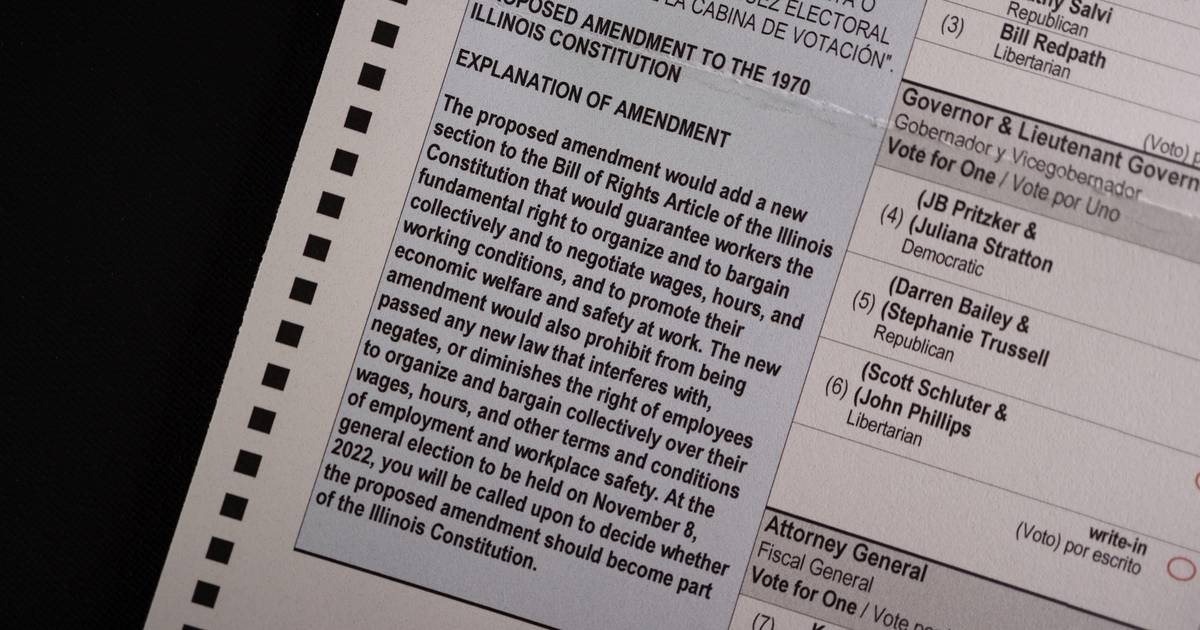
There’s little common ground between opposing sides of the recently approved amendment enshrining collective bargaining rights in the Illinois Constitution, but they do agree on one thing: The real-world effects of the change will be determined at bargaining tables and in courtrooms in the years ahead.
While the amendment granting a “fundamental right” for employees to organize and bargain won’t be added to the state’s governing document until November election results are certified on Dec. 5, The Associated Press last week determined the measure had received at least 50% of the total vote, one avenue for adoption.
Advertisement
The amendment guarantees the right of employees to bargain over “wages, hours, and working conditions, and to protect their economic welfare and safety at work.” It also prohibits the passage of any state or local law “that interferes with, that negates, or diminishes” that right, including so-called right-to-work laws, which would prohibit contracts between employers and unions that require union membership as a condition of employment.
Nearly every phrase of the 119-word amendment is likely to be parsed by labor and management attorneys as new groups of workers seek to organize and existing unions use the new language to strengthen their position at the bargaining table.
Advertisement
Among issues for potential legal disputes are who counts as an “employee” covered by the amendment, how the language comports with existing state and federal law, and what falls within the bounds of “economic welfare” and “safety at work.”
“The courts are going to put color to this thing, and they’re going to tell us” how to answer questions like those, said Marc Poulos, executive director of the Indiana, Illinois and Iowa Foundation for Fair Contracting and one of the drafters of the amendment.
“A bunch of smart lawyers are going to do good work on probably both sides and limit its application and ability through folks on the employer side, and expand its application for people that are on behalf of labor,” Poulos said.
One of the ripest areas for potential conflict is whether freelancers and gig workers, such as ride-share and delivery drivers, qualify as employees who are entitled to organizing and bargaining rights under the amendment.
Poulos and other proponents have pointed to those workers, along with agricultural workers and supervisors who likewise aren’t covered by the federal law governing collective bargaining, as potential beneficiaries of the amendment.
“We would argue that those explicitly excluded categories of employees under the National Labor Relations Act would now be covered and have a fundamental right under the state constitution if, in fact, you could deem yourself an employee under state law,” Poulos said, noting that there are several methods for determining whether someone qualifies as an employee or independent contractor.
But Aimee Delaney, a labor and employment attorney and partner at Chicago-based law firm Hinshaw & Culbertson, said any push to organize independent contractors under the new amendment could be met with skepticism in the courts.
“To me, that (amendment) language would have to change,” Delaney said. “An independent contractor is not an employee.”
Advertisement
Drafters of the amendment used the term “employees,” not “workers” or “individuals” — “two words that would have a very different impact in that regard,” she said.
“I don’t know how realistic that will be if there’s any sort of effort or focus on independent contractors,” she said.
One potential way to clarify that issue could be to pass a state law defining certain contract workers as employees for purposes of organizing and bargaining.
Taking that approach, however, could put the state in conflict with federal law governing those issues, said Michael LeRoy, a professor of labor and employment relations and law at the University of Illinois at Urbana-Champaign.
“That would be problematical because that would interfere with the National Labor Relations Act’s comprehensive design for elections and voluntary recognition of unions,” LeRoy said.
But if the state were to pass laws extending other protections, such as minimum wage or workers’ compensation coverage, to independent contractors, that likely would be on safe constitutional ground, he said.
Advertisement
Even before the amendment question was put to voters, opponents went to court in an unsuccessful effort to block it from being placed on the ballot by arguing that it would be an unconstitutional attempt to usurp powers reserved for the federal government.
The effort was led by the conservative Liberty Justice Center and Illinois Policy Institute, both based in Chicago, which sought to bring a lawsuit on behalf of taxpayers who opposed the use of public funds to place an allegedly unconstitutional amendment on the ballot.
The crux of their argument was that the amendment would violate the U.S. Constitution’s supremacy clause by creating a state-level right to collective bargaining for private-sector employees, a subject reserved for the federal government under the National Labor Relations Act.
But a Sangamon County judge found that the legislature followed the proper method for placing the question on the ballot. The judge also found that even if the amendment were preempted by federal law in regard to private-sector workers, it would make the amendment “dormant, not invalid, because it would still apply to situations not covered” by federal law and would take effect if the federal law were repealed.
A state appellate court upheld the lower court ruling, but did not weigh in on the question of the amendment’s constitutionality, finding that it was “premature until such time as it becomes effective.”
The Liberty Justice Center — best known for its victory in the U.S. Supreme Court Janus case that struck down so-called fair-share fees collected from public employees who opt out of union membership — is “still considering” how to go about taking on the amendment once it goes into effect, said Jacob Huebert, the organization’s president.
Advertisement
“We’ll have to wait and see what happens here,” he said. “We’re going to have to think about the different options for challenging this.”
In addition to questions about whether unions are trying to supersede federal labor law, Huebert argues that under the amendment, collective bargaining agreements could be used to negate state laws.
Huebert and other opponents also argue that the language regarding a right to bargain over “economic welfare” and “safety at work” will open up a host of new subjects to mandatory bargaining at the negotiating table
He pointed to a claim made by a Twitter user that the Chicago Fraternal Order of Police could use its contract negotiations to override provisions of the state’s controversial criminal justice overhaul, which the union opposes.
“I anticipate that’s the kind of argument we’re going to see,” Huebert said. “If a law currently addresses something like working conditions, well, this says you can bargain over those things. And so that would take precedence over whatever the state law says with respect to you.”
Poulos rejected both those readings of the amendment.
Advertisement
“There’s nothing in this amendment that would suggest that state law cannot stand after passage of this amendment,” Poulos said. “Nothing.”
As subjects of bargaining, Poulos said the idea is not to create “a massive expansion of all kinds of mandatory subjects of bargaining,” but rather to get employers to look at existing subjects — wages, hours and working conditions — “with a wider lens than they do today.”
The purpose of the amendment is to set a floor for workers’ rights and prevent business interests and others from coming to the General Assembly to try to roll back those rights, he said.
“The overarching objective through this amendment is to get people to go to the bargaining table and get them to stop going to Springfield,” Poulos said. “We think the best place to do this is in bargaining.”
dpetrella@chicagotribune.com


