



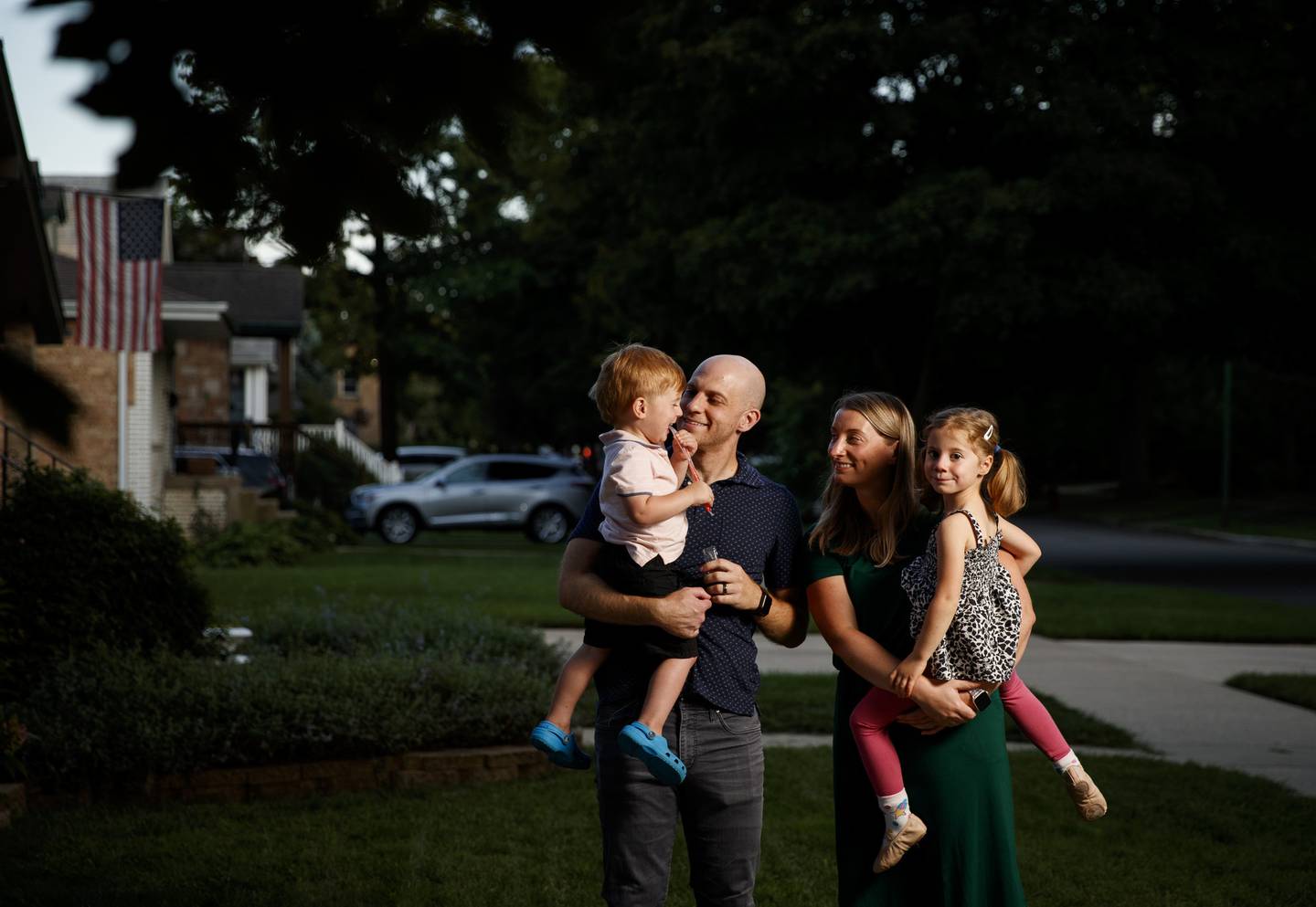
Donning protective gear. Juggling child care. Giving each other space during the exhaustion of treating patients with a lethal virus.
These were some of the challenges faced by married couples where both spouses were on the front lines caring for patients during the early stages of the COVID-19 pandemic.
Advertisement
For Meeta Shah, an emergency room doctor at Rush University Medical Center, the moment the pandemic felt real was when she saw colleagues suited up in full protective gear in the hospital’s ambulance bay.
“When I walked into work and saw all the tents up, and everybody in their gear,” she recalled, “it was very like, ‘Wow this is what we’re doing now.’ ”
Advertisement
Shah and her husband both worked with COVID-19 patients. Health care workers have faced unique challenges during the pandemic, from worrying about how to protect their families to seeing burnout as colleagues leave the industry. Hospitals have sought longer-term solutions to help exhausted workers.
Leaning on a partner can be one way couples seek support. But the shared stress can bring its own challenges.
The Tribune talked to several couples about what it was like to share pandemic health care experiences within their marriage.
Shah and her husband, Sambhav Shah, who also works in emergency medicine at the NW Indiana ER & Hospital and at Advocate’s Good Samaritan Hospital in Downers Grove, have been married for 11 years. Though each was initially skeptical about dating another emergency medicine student, they found that connection turned into a base layer of support throughout the pandemic.
“We get how we’re feeling,” she said. “I’m not saying the stress didn’t come out, like it does with every marriage, but I think you then give each other some grace.”
In spring 2020, the couple began realizing the logistical and emotional challenges of the approaching virus: child care, protecting their families, exposing their nanny to the elevated risk they now carried.
“It was really, really stressful,” Meeta Shah said. “You’re trying to figure out, what does it mean for my job? What does it mean for how I work, when I work, how much I work?”
At the beginning of the pandemic, she was seeing as many as 100 patients a day virtually through the Rush On Demand platform, as well as seeing patients in person in the emergency department. Person after person feared they had the virus.
Advertisement
The couple quickly reorganized their shifts to patch together child care for their daughters, 6 and 3 at the time; the older one was trying to understand remote learning and the younger one needed hands-on attention almost all day.
“It felt like having a newborn again,” Meeta Shah said. Their nanny eventually transitioned back and was an “essential part of (our) lives,” she added, “one of many essential workers I don’t think we give enough credit to.”
When day care closed in 2020 for their then 6-month-old and 3-year-old, Jonathan Martin, an infectious disease doctor at Cook County Health, and Erin Martin, a physician assistant at Northwestern Memorial Hospital, lined up a nanny share with her sister. But one night, after they arrived home from the hospital, their daughter was coughing.
Erin Martin felt the exposure they carried while working at the hospital was too much to share. “We can’t do this anymore,” she told her sister of the nanny-share arrangement. “In my mind, it wasn’t if, it was when, we get sick.”
Mac Walter is a pulmonary and critical care physician who helps intensive care unit patients at Northwestern Memorial Hospital as well as medical students adjusting to remote learning; his wife, Marion Stanley, is a hospitalist there. They were expecting their second daughter when the pandemic hit.
The experience changed a lot for them, from where they lived — they moved from Lakeview to a suburb so their toddler could run outside — to experiencing shared guilt when they were working fewer shifts with COVID-19 patients than their colleagues while trying to protect Stanley’s pregnancy. Eventually, research showed that pregnant women were more at risk should they get COVID-19.
Advertisement
When their younger daughter was born in July 2020, they adjusted to the reconfiguration of their family and found balance in their marriage.
Neither remembers huge fights, in part because even during something like a squabble over who would watch the kids, they tried to remember the stress the other was under.
“You can hold that frustration,” Stanley said, but “I think there was a respect for what each of us had going on.”
For many couples, the challenges yielded extra communication, even though it was under duress.
As an infectious disease doctor, Jonathan Martin joked — but isn’t really joking — that he did everything during the pandemic. His responsibilities at Cook County Health included writing guidelines for diagnosis and treatment, coordinating with state officials, and working with patients in the ICU and setting up monoclonal antibody treatment for those patients, which began in fall 2020 and was one of the first in the county to provide those infusions.
His wife reminded him to take time off to care for his mental health. She planned weekend getaways so they could drive away from the city.
Advertisement
“My personality is to put my head down and just kind of be consumed by my work,” he said. “There were times when I needed Erin to pull me out of it.”
Meanwhile, her department asked for volunteers for the intensive care unit, treating COVID-19 patients, and she did volunteer, spending weeks with the sickest patients. When they both worked in the ICU with COVID-19 patients, they would send their girls to their grandparents for the week.
“I always knew Erin was strong, but I didn’t realize how strong,” Jonathan Martin said. “Her endurance and her always putting our family first, trying to protect our kids, trying to make sure that our kids have everything that they need.”
Couples found new things to appreciate about each other, from individual support to parenting expertise.
As neonatologists, Bree Andrews and Patrick Myers, who work at University of Chicago Medicine’s Comer Children’s Hospital and Lurie Children’s Hospital, respectively, already worked in intense environments. The neonatal intensive care units became more fraught as families weren’t able to visit babies as often due to COVID-19 restrictions.
The pandemic highlighted their distinct parenting strengths, Myers said. His wife excelled at emotional support, and he mastered the homework needs of their two kids, now ages 11 and 16.
Advertisement
“Better understanding those strengths has helped us as we have emerged from the pandemic,” he said.
His wife added that she realized her husband was a “phenomenal math tutor and makes a great grilled-cheese sandwich.”
Many hospital workers had family members and friends who doubted the vaccine or eschewed protections; others simply could not understand what they were seeing daily. And people they typically would count on sometimes could no longer fill that support role.
“It made us rely on each other more,” Erin Martin said. “I think we became closer.”
She added, “Weekend cocktails helped.” The Martins tried to garden more and became amateur mixologists. For her husband, their relationship was an anchor.
“It makes you realize how lucky you are to have a family that you could go back to at the end of the day,” he said.
Advertisement