



Close Menu
  • Home
  • News
    • Local
  • Opinion
  • Business
  • Health
  • Education
  • Sports
  • Podcast

Subscribe to Updates

Get the latest creative news from FooBar about art, design and business.

What's Hot

My Head Start Success Story

More Than a Biopic: “Michael” and the Power of a Global Icon

Epstein Pressure Mounts As Trump Turns To Nigeria Strikes

Facebook X (Twitter) Instagram
  • Lifestyle
  • Podcast
  • Contact Us
Facebook X (Twitter) Instagram Pinterest Vimeo
The Windy City Word
  • Home
  • News
    1. Local
    2. View All

    Uncle Remus Says Similar Restaurant Name Is Diluting Its Brand and Misleading Customers

    Youth curfew vote stalled in Chicago City Council’s public safety committee

    Organizers, CBA Coalition pushback on proposed luxury hotel near Obama Presidential Center

    New petition calls for state oversight and new leadership at Roseland Community Hospital

    NFL Week 17: The Playoff Picture Comes into Sharper Focus

    NFL Week 16: The Playoff Picture and Clinching Scenarios

    Dying From a Name: Racism, Resentment, and Politics in Health Care Are Even More Unaffordable

    In Photos: South Carolina State overcomes 21-point deficit to win 3rd HBCU National Championship

  • Opinion

    Capitalize on Slower Car Dealership Sales in 2025

    The High Cost Of Wealth Worship

    What Every Black Child Needs in the World

    Changing the Game: Westside Mom Shares Bally’s Job Experience with Son

    The Subtle Signs of Emotional Abuse: 10 Common Patterns

  • Business

    Illinois Department of Innovation & Technology supplier diversity office to host procurement webinar for vendors

    Crusader Publisher host Ukrainian Tech Businessmen eyeing Gary investment

    Sims applauds $220,000 in local Back to Business grants

    New Hire360 partnership to support diversity in local trades

    Taking your small business to the next level

  • Health

    Dying From a Name: Racism, Resentment, and Politics in Health Care Are Even More Unaffordable

    Rural America Faces the First Cut as ACA Support Hits a High

    A World Pulled Backward: Child Deaths Rise as Global Health Collapses Under Funding Cuts

    Breaking the Silence: Black Veterans Speak Out on PTSD and the Path to Recovery

    Plant Based Diets Reduce High Blood Pressure, Prostate Cancer, Heart Disease, and More

  • Education

    Educating the Early Childhood Educators

    School Choice Is a Path Forward for Our Communities

    42nd Annual UNCF Mayor’s Masked Ball To Raise Funds & Awareness For HBCU Students

    It’s Time to Dream Bigger About What School Could Be

    Seven Steps to Help Your Child Build Meaningful Connections

  • Sports

    NFL Week 17: The Playoff Picture Comes into Sharper Focus

    NFL Week 16: The Playoff Picture and Clinching Scenarios

    In Photos: South Carolina State overcomes 21-point deficit to win 3rd HBCU National Championship

    College Football Playoff bracket is set: Indiana on top, Notre Dame left out

    Prairie View SHOCKS Jackson State; wins the SWAC Championship

  • Podcast
The Windy City Word
Local

Chicago’s new weapon against climate change: A requirement that new homes be ready for easy installation of electric appliances

staffBy staffUpdated:No Comments4 Mins Read
Facebook Twitter Pinterest Telegram LinkedIn Tumblr Email Reddit
Share
Facebook Twitter LinkedIn Pinterest WhatsApp Email

City Council has made life easier — and less expensive — for Chicagoans who want to reduce their carbon footprints by installing electric stoves, clothes dryers and water heaters.

Under the new 2022 Energy Transformation Code, passed Wednesday, newly constructed residences will have to be wired and ready for large electric appliances, sparing homeowners, tenants and landlords the headache of running additional wires and adding outlets.

Advertisement

The ordinance also requires that some low-lying commercial buildings — many of them warehouses — be built with roofs capable of supporting solar panels.

“It’s really exciting,” said Grant Ullrich, managing deputy commissioner of the Buildings Department, who noted that 70% of the city’s greenhouse gas emissions are related to buildings and industry.

Advertisement

“In Chicago, a big part of our solution to global climate change has to do with our building stock,” Ullrich said.

Buildings, including homes and businesses but not factories, are responsible for 29% of greenhouse gas emissions in the United States, according to the U.S. Environmental Protection Agency, and experts say that building electrification can play an important role in reducing greenhouse gas emissions and staving off the worst effects of climate change.

[ Some Chicagoans are going all-electric at home: ‘Hopefully, this will be the future’ ]

New York has banned natural gas heating and stoves in new buildings, and Los Angeles has passed a ban on most gas appliances in new construction.

Chicago’s new ordinance doesn’t go that far, but it, too, encourages a move from natural gas to electricity.

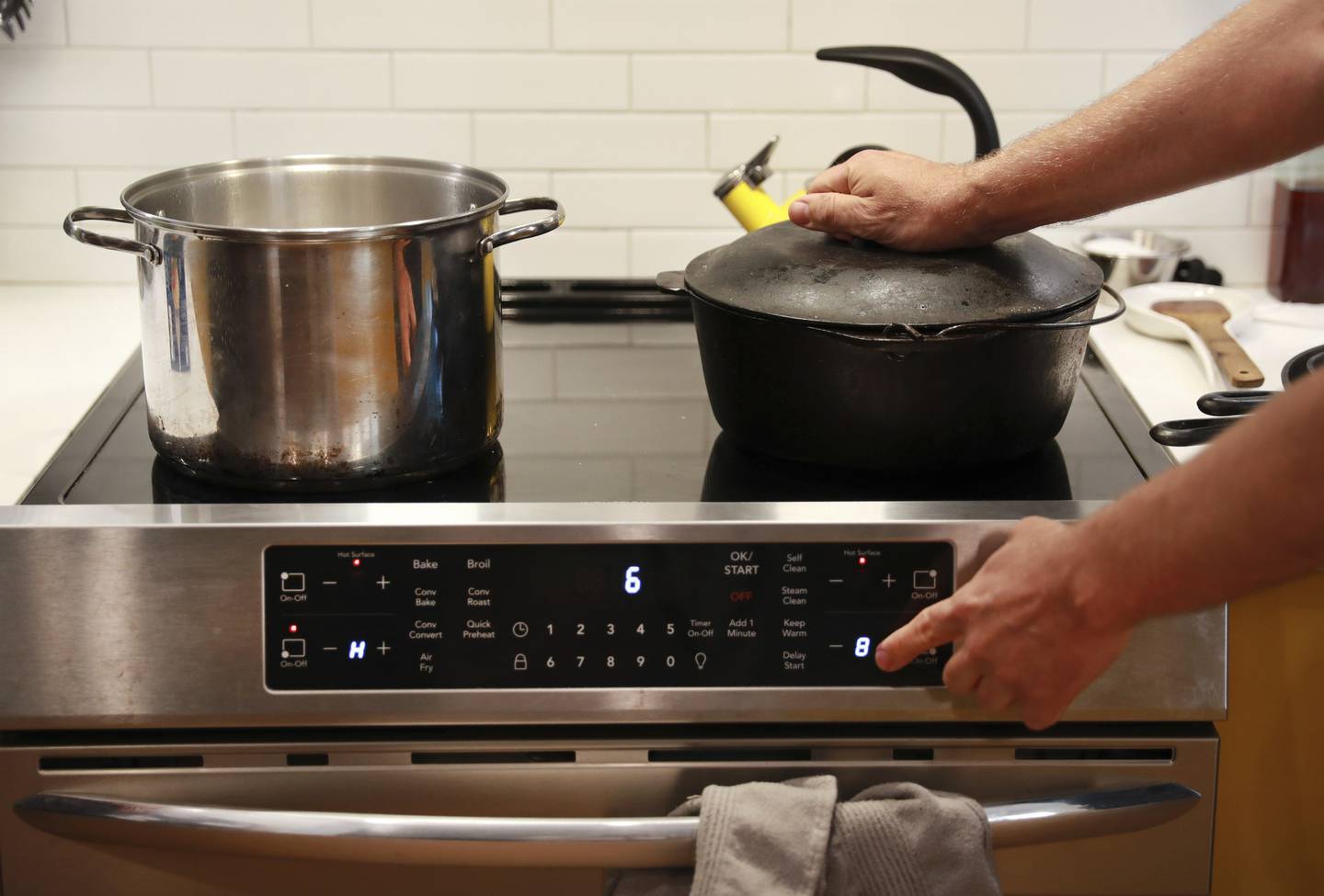
Scott Kroll makes an adjustment on his electric induction stove while making sauce at home in Chicago’s Logan Square neighborhood on June 29, 2022. (Chris Sweda / Chicago Tribune)

Ullrich said Chicago’s new ordinance will bring an added benefit.

The federal Inflation Reduction Act, passed in August after many political observers had given up on comprehensive climate change legislation, includes $1 billion in funding for technical assistance in areas such as improving the building permitting process. But cities won’t be eligible to apply for that money until they pass a code update that’s at least as strict as the 2021 International Energy Conservation Code, Ullrich said.

“We’re going to be among the first to do that, so we’re going to be at the front of the line in applying for that money,” he said.

Afternoon Briefing

Afternoon Briefing

Daily

Chicago Tribune editors’ top story picks, delivered to your inbox each afternoon.

In June, Katie Kaluzny of the Illinois Green Alliance told the Tribune that the new ordinance “sets us on a really good path for what’s minimum for Chicago.”

Advertisement

“While all-electric isn’t required, it makes a builder give a second thought to that. It makes you assess whether you want to build both infrastructures. In some cases, gas will still make sense, and that transition can happen later, but at least that resident — or that homeowner, or that tenant — would be ready to do that if and when that time came,” said Kaluzny, associate director of Illinois Green Alliance, a nonprofit that promotes green buildings and sustainability.

[ Lawmaker pushes for Chicago to join the race for 1st offshore wind farm on the Great Lakes ]

Mike Cwienkala, president of the board of directors of the Chicagoland Associated General Contractors, told the Tribune in June that the ordinance contains “clear steps the building industry can and should be taking to further a sustainable building infrastructure.”

He said that the ordinance will increase construction costs, but added that the higher costs “should be viewed as investments into these projects, because they will help reduce the life cycle costs of buildings and add value to the properties.”

The ordinance, an update of the city’s energy-efficient construction code, also includes the adoption of the 2021 International Energy Conservation Code. The 2021 code represents an 8.7% reduction in carbon emissions for residential buildings compared with the 2018 code, according to the U.S. Department of Energy.

Updated by the International Code Council every three years, the international code establishes minimum requirements for energy-efficient buildings. It addresses cost, energy usage, use of natural resources and the environmental effects of energy usage.


nschoenberg@chicagotribune.com

Share. Facebook Twitter Pinterest LinkedIn Reddit WhatsApp Telegram Email
Previous ArticleAfter McDonald’s CEO says Chicago needs to ‘face facts’ about its ‘crisis,’ Mayor Lightfoot says he should ‘educate himself’ before speaking
Next Article School of the Art Institute’s nontenured faculty calls on museum to recognize new union
staff

Related Posts

Uncle Remus Says Similar Restaurant Name Is Diluting Its Brand and Misleading Customers

Youth curfew vote stalled in Chicago City Council’s public safety committee

Organizers, CBA Coalition pushback on proposed luxury hotel near Obama Presidential Center

Leave A Reply Cancel Reply

Video of the Week
https://www.youtube.com/watch?v=AxFXtgzTu4U
Advertisement
Video of the Week
https://www.youtube.com/watch?v=OjfvYnUXHuI
ABOUT US


The Windy City Word is a weekly newspaper that projects a positive image of the community it serves. It reflects life on the Greater West Side as seen by the people who live and work here.

OUR PICKS

(REBROADCAST) The Healing Circle: Self-Advocacy

LIVE! HE SAID, HE SAID, HE SAID: “DATING DIALOG: Do’s & Don’ts” w/ Lamont White — FRI. 10.11.24 7PM

Interior 2024 Chrysler Pacifica Hybrid Pinnacle PHEV 360 Video

MOST POPULAR

Dying From a Name: Racism, Resentment, and Politics in Health Care Are Even More Unaffordable

Rural America Faces the First Cut as ACA Support Hits a High

A World Pulled Backward: Child Deaths Rise as Global Health Collapses Under Funding Cuts

© 2026 The Windy City Word. Site Designed by No Regret Medai.
  • Home
  • Lifestyle
  • Podcast
  • Contact Us

Type above and press Enter to search. Press Esc to cancel.