
Close Menu
  • Home
  • News
    • Local
  • Opinion
  • Business
  • Health
  • Education
  • Sports
  • Podcast

Subscribe to Updates

Get the latest creative news from FooBar about art, design and business.

What's Hot

How Resilient Black Women Turn Job Loss into New Ventures

How Resilient Black Women Turn Job Loss into New Ventures

Black Engineers’ Annual Convention Highlights Baltimore as Hub for Black STEM Professionals

Facebook X (Twitter) Instagram
  • Lifestyle
  • Podcast
  • Contact Us
Facebook X (Twitter) Instagram Pinterest Vimeo
The Windy City Word
  • Home
  • News
    1. Local
    2. View All

    Uncle Remus Says Similar Restaurant Name Is Diluting Its Brand and Misleading Customers

    Youth curfew vote stalled in Chicago City Council’s public safety committee

    Organizers, CBA Coalition pushback on proposed luxury hotel near Obama Presidential Center

    New petition calls for state oversight and new leadership at Roseland Community Hospital

    Food Pyramid Blind Spots: What Supermarket Civil Rights Teaches Us 

    NBA: Hawks’ CJ McCollum made it work during a “storm”

    Birmingham-Partnered Warming Station Will Open Sunday and Monday Nights

    Skater Emmanuel Savary Sharpens Routines for the 2026 U.S. Championships

  • Opinion

    Capitalize on Slower Car Dealership Sales in 2025

    The High Cost Of Wealth Worship

    What Every Black Child Needs in the World

    Changing the Game: Westside Mom Shares Bally’s Job Experience with Son

    The Subtle Signs of Emotional Abuse: 10 Common Patterns

  • Business

    Illinois Department of Innovation & Technology supplier diversity office to host procurement webinar for vendors

    Crusader Publisher host Ukrainian Tech Businessmen eyeing Gary investment

    Sims applauds $220,000 in local Back to Business grants

    New Hire360 partnership to support diversity in local trades

    Taking your small business to the next level

  • Health

    Food Pyramid Blind Spots: What Supermarket Civil Rights Teaches Us 

    Birmingham-Partnered Warming Station Will Open Sunday and Monday Nights

    Empowering Black Parenting: Tips and Insights That Matter

    Why Tracking Racial Disparities in Special Education Still Matters 

    Dying From a Name: Racism, Resentment, and Politics in Health Care Are Even More Unaffordable

  • Education

    The Many Names, and Many Roles, of Grandparents Today

    PRESS ROOM: PMG and Cranbrook Horizons-Upward Bound Launch Journey Fellowship Cohort 2

    Poll Shows Support for Policies That Help Families Afford Child Care

    Cuts to Childcare Grants Leave Rural Students in Limbo

    Why Black Parents Should Consider Montessori

  • Sports

    NBA: Hawks’ CJ McCollum made it work during a “storm”

    Skater Emmanuel Savary Sharpens Routines for the 2026 U.S. Championships

    NFL Divisional Round: The Schedule is Set

    NFL Divisional Round: The Schedule is Set

    A Jacksonville journalist brings humanity to an NFL Press Conference

  • Podcast
The Windy City Word
News

Chicago Race Riot of 1919 Tour Happens this Saturday in Bronzeville

staffBy staffUpdated:No Comments5 Mins Read
Facebook Twitter Pinterest Telegram LinkedIn Tumblr Email Reddit
Share
Facebook Twitter LinkedIn Pinterest WhatsApp Email

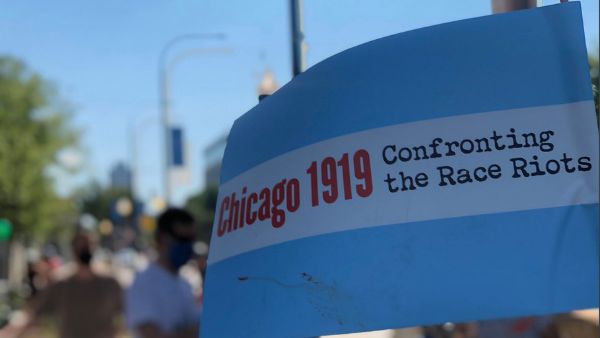
This Saturday, a group of participants will go on a tour that revisits the Chicago Race Riot of 1919, the single worst incident of racial violence in the city’s history.

This two-hour bike and trolley tour, hosted by the Chicago Race Riot of 1919 Commemoration Project, will commence through the historic Bronzeville and Bridgeport neighborhoods on the Southside. 

Yet, this tour is more than just an exercise in historical recollection. 

Instead, it’s an exploration of how the riot, which claimed 38 lives, left 537 people injured and thousands homeless, led to the creation of structures that intentionally isolated Black Chicagoans. 

“For us initially, it began as a way to uplift this history that we consider the origin story for segregation in Chicago,” said Franklin N. Cosey-Gay. 

Peter Cole and Cosey-Gay, co-directors of The CRR19 Commemoration Project, designed the nine-stop bike and trolley tour. The event is part of a public art project where CRR19 commissioned Firebird Community Arts to develop 38 permanent glass markers around Chicago to memorialize the lives lost to the riots. 

Cole got the idea for the markers from visiting Germany, where he saw stumbling stones placed at sites to honor Holocaust victims. He founded CRR19 in 2019, the year that marked the 100th anniversary of the Chicago Race Riot of 1919.  

In the same vein, Cole and Cosey-Gay aim to help the public become more aware of the race riot and its impact on local history.

“We commemorate this anniversary because it’s important in its own right,” said Cole, “But, through the tour, educate people about 1919.”  

How the Chicago Race Riot of 1919 Began

The most racially violent series of events occurred in Chicago when a 17-year-old young Black male named Eugene Williams got on a raft with friends in Lake Michigan to escape the searing Summer heat.

But the raft they were on ventured past an invisible line, near the White part of the water near 29th Street beach. That’s when, according to witnesses, a 24-year-old White man named George Stauber hurled stones at them, causing Williams to fall out of that raft and drown.

The first police officer refused to arrest Stauber over the incident. 

Subsequently, Williams’ death triggered a full-scale race riot that began on July 27 and ended on August 3, 1919. It was one of 25 racial conflicts that occurred nationwide, dubbed the Red Summer of 1919.  

Whites perpetrated these acts of racial violence to enforce dominance and control over Blacks, especially those who came to Chicago to escape the racism of the South.

While the legacy of the Chicago Race Riots is residential segregation, the violence once used to enforce racial boundaries between communities became policies and institutions. 

“Restrictive covenants were implemented instead by the real estate industry in the 30s, reinforced through redlining in the 50s, reinforced through white flight and housing and suburbanization,” Cole said. 

The vacant lots and empty buildings, says Cosey-Gay, are also legacies of the Chicago race Riots. 

“When you’re on the south and west sides of Chicago, you don’t have to go very far to see empty lots, to see homes in disrepair,” Cosey-Gay said.

“They’re emblematic of the wealth gap between Black and White Chicago,” he said. “The story of the race riots is an origin story connected to that.”

A Tour of Resistance and Resilience

The CRR19 bike and trolley tour isn’t “simply a tour of places where harm happened,” said Cosey-Gay. 

The tour will highlight the people and sites connected to the riots. Yet, it will also feature the institutions linked to Black resistance and resilience that sprung up after that tragic incident. Tour stops include The Light of Truth Ida B. Wells National Monument and the Victory Monument landmarks.

“I want to highlight the word resistance too,” said Cosey-Gay, about one of the tour’s themes.

“Resilience is great,” he said, “But yeah, resistance is about, ‘No, I’m not gonna allow you to beat me down from the beginning.’” 

“So we want to highlight both of those,” he said.

For More Information

What: The 5th Annual CRR19 Historic Bike Tour (A Trolley will also be provided for non-bike riders)

When: Saturday, July 22, from 10 a.m. to 1 p.m. (Check-in starts at 9:15 a.m.)

Where:  Parking lot on 35th and State Street

More Info: The event is free with an option for donations. All donations of $30 or more will receive a Chicago Race Riot 1919 shirt at the check-in table. After the tour, there will be free lunch, music and an opportunity to engage with local organizations and resource tables.

For more information on The 5th Annual CRR19 Historic Bike Tour, visit chicagoraceriot.org. To register for Saturday’s tour, see this link. 

About Post Author

Tacuma Roeback, Managing Editor

Tacuma R. Roeback is the Managing Editor for the Chicago Defender.

His journalism, non-fiction, and fiction have appeared in the Smithsonian Magazine, San Francisco Chronicle, Atlanta Journal-Constitution, The Tennessean, South Florida Sun-Sentinel, Phoenix New Times, HipHopDX.com, Okayplayer.com, The Shadow League, SAGE: The Encyclopedia of Identity, Downstate Story, Tidal Basin Review, and Reverie: Midwest African American Literature.

He is an alumnus of the Medill School of Journalism at Northwestern University, Chicago State University, and Florida A&M University.

Share. Facebook Twitter Pinterest LinkedIn Reddit WhatsApp Telegram Email
Previous ArticleCarlee Russell’s Search History Prior To Disappearance Revealed
Next Article Barack Obama appears in Kankakee library TikTok video to put focus on book bans
staff

Related Posts

Food Pyramid Blind Spots: What Supermarket Civil Rights Teaches Us 

NBA: Hawks’ CJ McCollum made it work during a “storm”

Birmingham-Partnered Warming Station Will Open Sunday and Monday Nights

Leave A Reply Cancel Reply

Video of the Week
https://www.youtube.com/watch?v=AxFXtgzTu4U
Advertisement
Video of the Week
https://www.youtube.com/watch?v=OjfvYnUXHuI
ABOUT US


The Windy City Word is a weekly newspaper that projects a positive image of the community it serves. It reflects life on the Greater West Side as seen by the people who live and work here.

OUR PICKS

LIVE! HE SAID, HE SAID, HE SAID: “Money Matters Mental Health” w/ Randy Jones — FRI. 3.21.25 7PM EST

Best Walk Through theToyota Lexus Museum 360 Video

Election Night on The Yard at Howard University

MOST POPULAR

Food Pyramid Blind Spots: What Supermarket Civil Rights Teaches Us 

Birmingham-Partnered Warming Station Will Open Sunday and Monday Nights

Empowering Black Parenting: Tips and Insights That Matter

© 2026 The Windy City Word. Site Designed by No Regret Medai.
  • Home
  • Lifestyle
  • Podcast
  • Contact Us

Type above and press Enter to search. Press Esc to cancel.