



Browsing: Sports

The news of a possible defection by Pac-12 stalwarts USC and UCLA to the Big Ten Thursday sent shock waves throughout the college landscape. It’s the latest realignment move that could drastically change the look of college football in the future and it’s most likely not the last. Here are how several of the conferences stand after the latest round of realignment news:AdvertisementThe Big Ten could make the next move in conference realignment with the reported addition of USC and UCLA in 2024. What could be the ripple effect of that move? (Charlie Neibergall/AP)USC and UCLA could join the Big Ten by 2024, expanding the conference to 16 members and creating a footprint that extends from New Jersey to California. It includes lucrative television markets in New York, Chicago, Pittsburgh and Los Angeles. But some don’t believe the league is finished.With a new media rights deal in the works, now may be the time for the Big Ten to look to expand to 20 members. If so, there are a few choices, perhaps other Pac-12 schools like Oregon, Washington and Stanford or maybe the ultimate piece in Notre Dame. The school has relished its independence but could forgo it and join a conference.AdvertisementWhen Thursday’s news broke, the ink hadn’t even dried on new Big 12 commissioner Brett Yormark’s contract. Yormark won’t have long to get settled in before he faces more concerns over realignment. The DNA of the league is changing with the addition of four new schools in BYU, Cincinnati, Houston and UCF in 2023, even as the league is about to lose blue blood programs in Texas and Oklahoma in 2025. With a new media rights deal on the horizon, perhaps now is the time to get aggressive. The Pac-12 is on shaky ground at best and the Big 12 could provide more value to television partners by adding schools like Arizona and Arizona State. Or Yormark could shoot higher and propose a merger with the remaining Pac-12 members, forming a super conference with 20 or 22 members. When the SEC decided to invite Texas and Oklahoma to join the league, it started the first wave of conference realignment moves that have led to the Big Ten reportedly adding USC and UCLA. (Mike Ehrmann/Getty Images North America/TNS)The SEC started this process by inviting Texas and Oklahoma to join the league in 2025. It’s a move projected to pay each league member $117 million of revenue by 2029. That would be most in the Power Five conferences, ahead of the Big Ten’s projected $100 million. If the SEC wanted to continue to grow, it could look toward the ACC, where schools like Clemson, Florida State, Miami and North Carolina would fit its southern footprint. The only catch would be the ACC’s Grant of Rights, which runs through 2036. Although if eager to leave, the schools could try their luck through legal challenges. Realignment hasn’t been as real as it is now for the ACC. The league has several attractive member schools (See SEC) and if its Grant of Rights is nullified through the courts, it’s anybody’s guess what could happen. Chicago Tribune SportsWeekdaysA daily sports newsletter delivered to your inbox for your morning commute.That doesn’t mean the ACC could choose to stay pat. The league could pursue Notre Dame, trying to convince the school to join as a full-fledged member instead of just a partial member. The addition of the Fighting Irish football program could go far in solidifying the conference. If the ACC chooses to expand, it runs the risk of nullifying its Grant of Rights deal, which would open the door for schools to leave without penalty. AdvertisementPac-12 commissioner George Kliavkoff thought forming the Alliance between the Big Ten and ACC would help solidify his conference standing. That’s clearly out the window with Thursday’s news. Barring a last-second Hail Mary by Kliavkoff to convince USC and UCLA to have a change of heart, the league’s standing is tenuous at best. Even with the two L.A. schools, the league was only projected to see its revenue per school grow to $62 million by 2029, and without them, that figure would surely be much less. The Pac-12 could stay put with its remaining 10 member schools, or it can add new schools like Boise State, Fresno State or San Diego State. But those wouldn’t provide enough cache to convince the other schools not to look elsewhere. If schools like Oregon, Washington and Stanford are convinced to join a league like the Big Ten, then all bets are off. It’s safe to say that the five non-autonomous conferences are playing the waiting game. What inevitably happens to the Pac-12 would have a ripple effect that could stretch into the G5 landscape. This article first appeared on OrlandoSentinel.com. Email Matt Murschel at mmurschel@orlandosentinel.com or follow him on Twitter at @osmattmurschel.

Chicago Bears general manager Ryan Poles and his wife, Katie, on June 16 sold their five-bedroom, 3,182-square-foot house in Overland Park, Kansas, for its $685,000 asking price.In January, the Bears hired Poles, 36, to be the team’s general manager after Ryan Pace was fired. Poles had been with the Kansas City Chiefs from 2009 until 2021, rising to become executive director of player personnel.AdvertisementIn Overland Park, which is a large suburb of Kansas City, Poles and his wife bought the nine-room home in 2018 for $575,281, according to public records. Built in 2017, the house has 4½ bathrooms, two fireplaces, a kitchen with a custom island, a great room with built-ins and hardwood flooring, a formal dining room and a primary bedroom suite with a walk-in closet and a makeup vanity.Other features include a screened porch with a floor-to-ceiling stone fireplace and TV area.AdvertisementThe couple listed the house on March 11.Listing agent Erin Peel previously declined to comment in detail on the listing, although she did acknowledge that the house had numerous offers.The house had a $7,822 property tax bill in the 2020 tax year.It’s not known yet where Poles and his wife have settled in the Chicago area.Bob Goldsborough is a freelance writer.Join our Chicago Dream Homes Facebook group for more luxury listings and real estate news.

UCLA and Southern California are planning to leave the Pac-12 for the Big Ten Conference in a seismic change that could lead to another major realignment of college sports.A person who has been briefed on the discussions between USC, UCLA and the Big Ten said the schools have taken steps to request an invitation to join the conference. The person spoke to The Associated Press on Thursday on condition of anonymity because the schools’ talks with the Big Ten have not been made public.AdvertisementThe move would come as soon as 2024, after the Pac-12′s current media rights contracts with Fox and ESPN expire, and increase the size of the Big Ten to 16 schools.The decision by the Los Angeles schools — two of the NCAA’s most decorated athletic programs — comes almost a year after Oklahoma and Texas formally accepted invitations to join the Southeastern Conference in July 2025.AdvertisementThe Big Ten would become the first conference to stretch from the Atlantic to the Pacific and would build on previous expansion into the nation’s largest media markets.Big Ten leadership, including the council of presidents and chancellors, would still have to sign off on extending an invitation to the two schools.The Big Ten has expanded twice in recent years, with Nebraska joining in 2011 and Maryland and Rutgers in 2014.USC and UCLA fit the Big Ten’s academic profile. Both schools are among the 65 members of the Association of American Universities, which is made up of top research universities. All Big Ten schools except Nebraska are members.
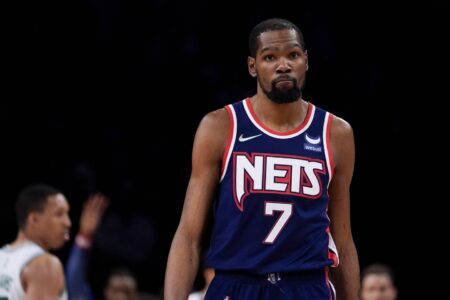
The Seven-Eleven Era has come to an end.Superstar forward Kevin Durant has requested a trade from the Brooklyn Nets, the Daily News has confirmed. It means Brooklyn’s championship window has come to a close. The Nets are also continuing to work to trade Kyrie Irving, The News can also confirm, which means the Durant-Irving era will end with one playoff victory and one first-round sweep in their three seasons in Brooklyn.AdvertisementDurant’s official trade request was first reported Thursday by ESPN.The News was first to report of this potential eventuality — Durant requesting a trade from Brooklyn — if the Nets chose not to give his co-star Irving a long-term deal. The Nets were “outright unwilling” to do so, as The News reported in May, and Irving ultimately opted into the final year of his contract extension worth $37 million. Durant requested a trade on Thursday after Irving and the Nets failed to reach an amicable solution.AdvertisementThe Nets will be able to recoup draft assets and young players in deals for Irving and Durant and will be able to re-tool in the coming years. But make no mistake: the Nets being unable to retain the two biggest stars in Brooklyn’s history is a massive failure for team owner Joe Tsai and general manager Sean Marks.Kevin Durant wants out of Brooklyn. (John Minchillo/AP)Developing story, check back for details.

It is an empire built piece by piece, but reaching expansively across the Baltimore area and beyond — through real estate that includes a downtown landmark and a renowned horse farm, to an aggressive law firm that won billions of dollars for workers harmed by asbestos and smokers sickened by tobacco, and of course, wrapping in the Orioles, whose glories and struggles define their proud and scrappy hometown.But now, in the twilight of his life, Peter G. Angelos’ vast portfolio of assets could be broken up amid a family feud over who will control them.AdvertisementAccording to a recently filed lawsuit, his wife wants to sell the team and his older son wants to “dissolve and dismantle” his law firm, the signature holdings that propelled the son of a Highlandtown tavern owner into one the most prominent and powerful figures in the state.The suit, filed June 9 by his younger son, Louis F. Angelos, 52, details a family feud that allegedly has been brewing since the health of the family patriarch began declining and he could no longer manage his businesses. Peter Angelos’ 93rd birthday is on the Fourth of July.AdvertisementLouis Angelos sued in Baltimore County Circuit Court, claiming his brother John P. Angelos, 54, has sought to seize control of their father’s assets, intimidating and confusing their mother, Georgia Kousouris Angelos, into acquiescence. The 80-year-old matriarch issued a statement in response to the suit, however, saying she alone has the authority to manage the family assets and fully supports John.Whether any asset is sold remains to be seen and, indeed, family holdings often don’t remain intact through the generations for any number of reasons. Disputes such as the one splitting the Angelos family are so familiar, they’ve inspired everything from Shakespeare’s “King Lear” to HBO’s “Succession.”ExpandAutoplayImage 1 of 11One Charles Center at 100 N. Charles St., one of a number of properties owned by Peter Angelos, on June 17, 2022. (Karl Merton Ferron/The Baltimore Sun)The Angelos empire has had but one emperor, observers say, making it hard to envision the passing down of the crown.“With Peter’s personality, being such a dominant leader, the Angelos law firm was just him. He ran the Orioles the same way,” said Aris Melissaratos, a former Maryland secretary of business and economic development who now is vice president for leadership development for St. John Properties.“He was kind of dominant everywhere, and dominant over his two sons,” he said. “For decisions, it was always, ‘You have to see Mr. Angelos.’”The Law Offices of Peter Angelos, as the much-advertised firm is called, employed a fluctuating stable of attorneys over the years — but none were made partners, although it’s currently managed by Louis Angelos. And while Peter Angelos organized a group of buyers to purchase the Orioles in 1993, including the late novelist Tom Clancy and tennis-star-turned-broadcaster Pam Shriver, Angelos was the major investor and managing partner.As his health faltered, he granted power of attorney to his wife “to act in my place in all matters,” according to a document signed Oct. 31, 2017, and which was included in the filing of Louis Angelos’ lawsuit.Should she not be able to act in that capacity, the document went on to say, he designated his sons “acting jointly or separately” to replace her as his “attorney-in-fact.” Angelos also created a trust for his holdings, and on Aug. 9, 2019, he discontinued his role as its trustee while his wife and two sons took over as co-trustees.AdvertisementIn October 2020, Georgia Angelos placed her husband’s interest in the Orioles into his trust, according to the lawsuit.One Charles Center, one of a number of properties owned by Peter Angelos, is shown June 17, 2022, in Baltimore. (Karl Merton Ferron/The Baltimore Sun)Peter Angelos last went to his law office, in the gleaming One Charles Center downtown, in February 2018. Angelos bought the building, designed by modernist giant Ludwig Mies van der Rowe, in 1996 for $6 million.The law firm specializes in personal injury cases, most notably illnesses and deaths by steel and shipyard workers from inhaling asbestos. The firm also handled the state’s litigation against the tobacco industry to recover costs related to caring for smokers.Attorneys in town say the law firm is smaller than during the height of the asbestos litigation and, according to Louis Angelos’ suit, John Angelos considered it unsustainable and thought it needed to be dissolved or spun off. Louis Angelos refused, the suit said, noting their father considered his firm his “most significant achievement” and his role with the Orioles “strictly secondary.”From a working-class background — his parents immigrated from Greece, and he went to law school at night — he rose in status and wealth. He served as a City Council member and ran unsuccessfully for mayor, and became a major philanthropic and Democratic political donor. He has given millions to his alma mater, the University of Baltimore Law School, where a building bears the names of his parents, John and Frances Angelos.Angelos has owned various downtown buildings over the years, and sought to protect the office-leasing market from moving to other parts of town. He sued to halt development plans outside the central business district, such as the westside Superblock project and the State Center revamp.AdvertisementLouis Angelos’ lawsuit accuses his brother of transferring what he estimates as more than $90 million of their father’s real estate holdings into an LLC owned by a trust that John Angelos largely controls.The former home of Boccaccio Restaurant in Baltimore’s Little Italy, one of a number of properties owned by Peter Angelos, is shown on June 17, 2022. (Karl Merton Ferron/The Baltimore Sun)The list includes city and county properties, including 925 Eastern Ave. in Little Italy, which housed Boccaccio Restaurant until shortly after its owner’s death in 2008. Peter Angelos had been a regular, hosting everyone from Os pitching great Jim Palmer, who said the team owner was trying to woo him as manager, to then-Gov. Martin O’Malley, in a reported attempt to warm a chilly relationship with the Democrat.Angelos previously bought the legendary Maison Marconi on West Saratoga Street, saying he would relocate the restaurant to one of his Charles Street properties. Instead, he closed it five years later and sold the building in 2019.Angelos’ business interests tend to overlap. He owned thoroughbred horses before the Orioles, racing them under the name Marathon Farm. In 1998, he bought a 237-acre horse farm in Baltimore County for $2.6 million. He has named horses after then-Os manager Buck Showalter and right fielder Nick Markakis.The value of Peter Angelos’ fortune is unclear, although Melissaratos estimates it’s in excess of $2 billion. The Orioles are valued by Forbes at $1.375 billion.For many a family, experts say, the transition from founder to the next generation can be fraught.Advertisement“You’re not just dealing with business issues. You’re dealing with family issues, as well,” said Maurice Offit, a Baltimore-based attorney who specializes in estate planning, but noted he has no independent knowledge of the Angelos family’s situation. “Many times it’s hard.”And when the crown jewel of the family business is particularly high-profile, with much of the town invested in its every move, the challenges are that much greater, Melissaratos said.“The Os and Baltimore are synonymous,” he said.“Succession planning is always difficult to achieve, especially in a family with such a visible asset like the Orioles,” Melissaratos said.John A. Pica Jr., a former Democratic state legislator, agreed. Pica, who previously worked for the Angelos law firm and now is a lobbyist, said he hopes the family settles its differences.“Mr. Angelos built an empire through hard work. He kept the Orioles in Baltimore,” he said. “It’s very sad to see a battle like this going on, but I’m sure it will all work out.”AdvertisementExpandAutoplayImage 1 of 55Baltimore Orioles owner Peter Angelos (Algerina Perna, Baltimore Sun)In his lawsuit, Louis Angelos said his father brought both sons into the Orioles operations starting around 1995, two years after he and other investors bought the team for $173 million, then the most ever paid for a sports team.Frank Wren, the Orioles general manager for a single year, 1999, said the brothers were feeling their way in a still-unfamiliar field for them, and it was not always clear what their role was.“Both of the kids were new to the business, trying to figure out how to lead,” he said. “They were figuring out what was their place, where they really fit in, ‘What will Dad let us do?’ ‘Will the role have meat to it — or is it just a title and Dad’s running everything?’”Wren said Louis Angelos “had a decent feel for the game” and “was more interested in baseball stuff” than his brother at the time.Peter Angelos fired Wren at the end of the season, in part because he refused to hold a plane for a West Coast road trip for star Cal Ripken Jr., who was caught in traffic.“Peter’s very demanding. I don’t think saying that takes anyone by surprise,” Wren said. “He has a view of what should be done, and how.”AdvertisementThe lawsuit said the brothers initially worked together collaboratively, but a “rift” developed between John Angelos and his father over such matters as where the team should locate its spring training facility. The acrimony led to John Angelos allegedly walking away from the Orioles for long periods of time, during which Louis Angelos’ role on the team grew, the lawsuit said.John Angelos returned to the team in 2017 at his father’s request, according to the lawsuit, and began trying to seize control, unilaterally getting rid of those loyal to Peter Angelos and installing his own people. He now holds the title of chairman and CEO of the team.Louis Angelos said in his suit that his brother worked to consolidate his control over the team and could sell it or move it to Tennessee, where he lives in Nashville. John Angelos has denied he would move the team, and in the lawsuit, he is accused of stalling and thwarting his mother’s desire for a sale.The turmoil has many fans watching not just what’s happening on the field, where a yearslong rebuilding process seems to be bearing some fruit in exciting young players, but off it as well.“It’s unfortunate this rift comes as the team is about to turn around,” Melissaratos said.“It’s got to be resolved peacefully, not by having family laundry aired in public,” he said. “Someone needs to come in and calm things down. I would offer to do it.”

Charlotte Hornets forward Miles Bridges was arrested Wednesday in Los Angeles after a warrant was issued, according to the Los Angeles Police Department.LAPD spokeswoman Lizeth Lomeli confirmed Bridges was arrested, but did not release details on the charges. TMZ reported that Bridges is facing felony domestic violence charges.AdvertisementThe Hornets have not responded to news of Bridges’ arrest.Bridges, the Hornets’ leading scorer last season, is set to become a restricted free agent and could command a max contract in the coming weeks. The news comes on the eve of NBA free agency, which begins Thursday night with teams able to speak with free agents.AdvertisementThe 24-year-old Bridges averaged career highs with 20.2 points and seven rebounds last season in what amounted to a breakout season for the four-year NBA veteran while playing alongside All-Star point guard LaMelo Ball.Bridges, who played at Michigan State, is also a rapper who goes by the name RTB MB.The Hornets extended Bridges a qualifying offer on Tuesday, which allows them to a chance to match any offer sheet made by another team.“As an organization we love Miles,” Hornets general manager Mitch Kupchak said Tuesday. “We are going to bring him back. He has been great for the franchise and I believe, with his work ethic, he’s only going to get better.”The 6-foot-7, 225-pound Bridges said after the season he wanted to return to the Hornets, but he recently changed his Twitter bio from “forward for the Charlotte Hornets” to “It’s me,” adding some intrigue to the situation.

Will Zach LaVine remain in Chicago next season? After weeks of wondering and worrying, Bulls fans finally are close to receiving an answer as NBA free agency officially opens Thursday evening.Teams may begin negotiating with players and their agents at 5 p.m. CDT, though free agents cannot sign new deals until July 7. AdvertisementThis is LaVine’s first offseason as an unrestricted free agent, which allows the two-time All-Star shooting guard to pursue a deal with any team. It’s also his first opportunity to seek a five-year maximum contract from the Bulls, which could top out at $215 million according to an ESPN report of a 10% salary-cap increase for next season.LaVine declined during his exit interview with media in April to make a hard commitment to re-signing with the Bulls, deferring all questions about his future to his agent. But he made it clear at the end of the season that he knows his worth — and won’t compromise to receive it.Advertisement“You get paid what you’re valued at and I see myself as a top guy in this league,” Lavine said after the Bulls were eliminated by the Milwaukee Bucks in the opening round of the playoffs.His teammates echoed the sentiment, calling for LaVine to receive a maximum contract from the Bulls.“Max player, max talent, max everything,” DeMar DeRozan said after the Game 5 loss to the Bucks. “He’s one of those players in this league that you don’t see too often. I tell him all the time how envious I am of the things he’s able to do. He deserves everything that’s coming to him.”Bulls forward DeMar DeRozan (11) talks with teammate Zach LaVine (8) during a game against the Clippers at the United Center on March 31, 2022. (Chris Sweda / Chicago Tribune)The front office hasn’t publicly balked at these statements, and re-signing LaVine remains the clear offseason priority. The Bulls have a solid upper hand in their pursuit — they can offer LaVine more money than other team, and he openly enjoyed playing alongside DeRozan and other new teammates last season. After the NBA draft last week, general manager Marc Eversley said the Bulls have “every intention” to keep LaVine in Chicago, and executive vice president of basketball operations Artūras Karnišovas said Monday that the front office feels “confident” in its ability to reach a deal.June 28: Center Tony Bradley exercised his $2 million player option for the 2022-23 season, according to ESPN’s Adrian Wojnarowski.Free agents: Zach LaVine (unrestricted), Derrick Jones Jr. (unrestricted), Tristan Thompson (unrestricted), Troy Brown Jr. (restricted), Matt Thomas (restricted), Tyler Cook (restricted, two-way), Malcolm Hill (restricted, two-way)Under contract: Nikola Vučević (expires 2023), Coby White (2023), Javonte Green (2023), Ayo Dosunmu (2023), Tony Bradley (2023), DeMar DeRozan (2024), Patrick Williams (2024), Marko Simonović (2024), Lonzo Ball (2025), Alex Caruso (2025)AdvertisementChicago Tribune SportsWeekdaysA daily sports newsletter delivered to your inbox for your morning commute.Eligible for extension: Vučević, White.June 30: Free-agency negotiations open at 5 p.m. CDT July 1: Signing moratorium begins, but teams can sign players to rookie, minimum and two-way contractsJuly 7: Signing moratorium ends and teams can begin making trades and signing playersJuly 7-17: NBA Summer League, Las VegasJuly 13: Last day to withdraw qualifying offers to free agentsAdvertisementAug. 31: Last day to waive players

The Chicago Bears are making progress toward completing their purchase of Arlington International Racecourse in Arlington Heights, officials say, with the clock ticking toward a deadline to seal the deal in 2023.Village documents obtained by the Tribune show the highest levels of the team’s administration, including Chairman George McCaskey, have been involved in meetings to make the purchase and subsequent construction of a new football stadium happen. The documents showed that the team deposited $125,000 with the village for studies of the stadium proposal, and they also included a former baseball executive’s proposal to add a minor league baseball complex to the site.AdvertisementIn September 2021, the team announced it had signed a purchase agreement to buy the property from Churchill Downs Inc. for $197 million, pending final approvals by both parties. Churchill Downs Inc. subsequently closed the famed racetrack. The Bears would have to break their lease at Soldier Field to build a new stadium at Arlington.[ [Don’t miss] The Arlington Heights Bears? Here’s what to know about the team’s possible move from Chicago’s Soldier Field. ]The new baseball fields were proposed by William Larsen, former general manager of the Kane County Cougars minor league team. In an email in February to Mayor Tom Hayes, Larsen wrote that the baseball fields would host four to six teams of undrafted college players.AdvertisementLarsen said he had no financial or other formal backing for the proposal, and hadn’t heard back from the Bears, but was told by scouts and others in professional baseball that there is a need for undrafted players to chase their dreams of playing professionally.“I might as well find out if they’re interested,” he said. “I knew it had a lot of potential.”He estimated 10 to 15 acres would be needed for the project on the 326-acre site, but did not cite any financing or backing for the deal.He guessed that the games could draw about 450,000 fans a year.The village forwarded the email to the Bears. Village officials would encourage the team to consider the idea, Hayes said, but it’s up to team officials to decide what to do with the site, within the village’s parameters. Meanwhile, village and team officials have continued meeting to discuss plans for the site, he said.Brandon Faber, Bears vice president of communications, didn’t comment on the baseball proposal, but said the team is still trying to see if the site will work for a football stadium.ExpandAutoplayImage 1 of 16Soldier Field, home of the Chicago Bears, in Chicago on Sept. 29, 2021. The Chicago Bears have signed a purchase agreement for Arlington International Racecourse, a move that takes the team a step closer toward securing property for a new stadium and leaving their longtime home at Soldier Field. (Jose M. Osorio / Chicago Tribune)“We continue to work through the due diligence process on the Arlington Park property with our accomplished team of land use experts,” Faber said. “While significant progress has been made, we still must do extensive work and analysis to determine the viability of developing the site. Our expectation for a decision on whether we can purchase the property remains late 2022 or early 2023.”The village’s first recorded meeting with Bears representatives was Aug. 26, 2021, followed by meetings in October, February, March, April and June. Bears officials also agreed to attend training sessions this year on stadium security.AdvertisementThe October meeting at the village included McCaskey, Bears President and CEO Ted Phillips, and team attorney Cliff Stein, among others, village emails showed. Mayor Hayes, Village Manager Randy Recklaus and Director of Planning and Development Charles Perkins, among others, attended for the village.[ [Don’t miss] ‘One step at a time’: Chicago Bears remain in a waiting game for a potential new stadium in Arlington Heights ]Afternoon BriefingDailyChicago Tribune editors’ top story picks, delivered to your inbox each afternoon.Hayes wouldn’t talk about specifics of the discussions, but said progress was speeding up due to the Bears’ deadline to finalize the deal by mid-2023.He confirmed that due to the size of the site, its plan likely would include mixed-use development featuring residential, commercial, retail and entertainment.“Things are moving quicker than they had been, as a result of the timeline the Bears are working under,” Hayes said. ”We have been working together with the team to meet their needs and our needs, and things are progressing. We’re doing all we can to make this a reality.”The Bears also deposited $125,000 with the village to pay for necessary consultant studies that the village would conduct regarding the proposal, Recklaus said.Such payments are not uncommon for projects that may require the hiring of a consultant for studies of traffic, security, crowd control or other issues, Recklaus said. A similar arrangement took place when studies were conducted before the former Sheraton Hotel near Arlington Park became apartments known as Arlington Downs. The village hasn’t conducted any such studies for the Bears yet.AdvertisementIn March, the team announced it had hired Manica Architecture, which designed the Las Vegas Raiders’ new stadium. The team also hired stadium development manager CAA Icon and real estate investment firm Jones Lang LaSalle to work on the proposal.rmccoppin@chicagotribune.com

ANAHEIM, Calif. — Tim Anderson and José Abreu singled in the first inning for the Chicago White Sox against Shohei Ohtani.Anderson reached third and Abreu second on a wild pitch. But the Los Angeles Angels two-way star struck out Gavin Sheets to end the threat.AdvertisementThe Sox had another big opportunity in the fourth, loading the bases. But Ohtani struck out Josh Harrison for the third out.The Sox made Ohtani work but they couldn’t cash in Wednesday, falling 4-1 in front of 27,612 at Angel Stadium.Advertisement“We didn’t put the ball in play enough,” Sox manager Tony La Russa said. “That’s to their credit. Their pitching was good.”The Sox struck out 15 times as they dropped the rubber match of the three-game series.“We got it going, just key times they made a pitch and we didn’t put it in play,” La Russa said.Wednesday was billed as a showcase pitching matchup between Sox starter Michael Kopech and Ohtani. And both had numbers good enough to win.[ [Don’t miss] Andrew Vaughn, back at the site of his big-league debut, is putting up All-Star-caliber numbers for the White Sox ]“Obviously he’s a superstar,” Kopech said of Ohtani. “We have to be prepared coming into that on both sides of the ball with a guy like that. And for the most part, I was able to stay in control of that and work counts with him (Ohtani went 0-for-3 with a walk). I might not have been as efficient as I would have liked, but I was able to stay in the driver’s seat with him there.“He did a great job on the mound tonight. Kind of answered all of his own problems or his team’s own problems that they may have struggled with offensively, and they had a couple of big hits and came through for him. It’s quite a matchup like that, but I would like to see my best stuff on a day like that.”Kopech allowed four runs, three earned, on five hits with six strikeouts and two walks in 5⅓ innings.White Sox starter Michael Kopech pitches in the first inning Wednesday, June 29, 2022, in Anaheim, Calif. (Jae C. Hong/AP)“It was kind of a grind,” he said. “I started off making a few mistakes that got taken advantage of. And then toward the end where I really needed to bear down and make some tough pitches, didn’t make those pitches and I got taken advantage of. I’ve got to do a better job of putting us in control and being in the driver’s seat a little bit.Advertisement“I’ve been putting the team in a position where we have to fight all night long, and I can’t continue to do that.”Ohtani gave up five hits, struck out 11 and walked one in 5⅔ scoreless innings.“I thought we worked the at-bats,” La Russa said. “And then we did a better job of making the at-bats go longer. But he’s got weapons. He’s for real.”The first two Angels batters scored in the first. Taylor Ward singled and Mike Trout drove him in with a double.[ [Don’t miss] Rockford Peaches — 30 years after ‘A League of Their Own’ — live on in a new series: ‘We didn’t know we were part of something bigger’ ]With runners on first and second, Jared Walsh hit a grounder to Abreu. The first baseman threw to second to get an out, but the return throw got past Kopech as he tried to time getting the ball and the bag. Trout scored on the sequence, making it 2-0.Luis Robert and Abreu singled to begin the fourth. Sheets hit the ball hard, but Trout made a running catch in center for the first out. Ohtani struck out AJ Pollock but walked Leury García to load the bases.AdvertisementOhtani then struck out Harrison on five pitches.Abreu collected his third of four hits, a one-out single, in the sixth. Ohtani struck out Sheets and exited, having thrown 108 pitches. Pollock singled against reliever José Quijada, but Leury García hit a comebacker to the mound to end the inning.The Angels extended the lead with a two-run homer by Luis Rengifo in the bottom of the sixth. Kopech exited after 99 pitches.“I was talking to Lance (Lynn) a little after my outing and he said it best: The days you don’t have your best stuff and you’re able to grind through five or six and limit damage, that’s what pitching is about,” Kopech said. “Not when you do have your best stuff, things are going easy. You would like to have that every time, but it’s a difficult time and we face really good players.”The Sox scored on a wild pitch in the eighth, but that would be all for the offense. They went 0-for-7 with runners in scoring position.“Sometimes you strike out that many times and you didn’t do a good job,” La Russa said. “But we did a good job of prolonging at-bats, we had opportunities and they made the pitch to get the outs. Tip your cap to the other side.”

The Orlando Magic didn’t tender a qualifying offer to Mo Bamba by Wednesday, which will make him an unrestricted free agent when free agency officially opens at 12:01 a.m. Friday, a person with knowledge of the situation told the Orlando Sentinel.The Magic not extending the qualifying offer doesn’t mean Bamba won’t return. They still have an interest in bringing him back and are expected to work on negotiating a new deal when the period opens.AdvertisementBamba, the No. 6 pick in the 2018 draft, finished the final season of his 4-year, $24.1 million rookie scale contract in 2021-22.He averaged career-highs across the board, including minutes (25.7), points (10.6), rebounds (8.1), blocks (1.7) and assists (1.2) in 71 games (69 starts).AdvertisementThe Magic had until the close of business Wednesday to tender a 1-year, $10.1 million qualifying offer to Bamba to make him a restricted free agent.The move didn’t come as a surprise. Early Wednesday, it was clear that the Magic were “unlikely” to make the qualifier, a person with knowledge of the situation told the Sentinel.Orlando would have risked diminishing the value of Bamba’s contract on the trade market if it extended the qualifying offer and he opted into it. Players who return to a team on the qualifying offer are no longer extension eligible and become unrestricted free agents the following season. They also have a no-trade clause for that season they’re on the qualifying offer, meaning the team would need the player’s consent for a trade.If the Magic and Bamba agree to a new deal, it’d allow Orlando to retain his Bird rights and have more contract flexibility.Restricted free agents can sign an offer sheet with any team, but the player’s original team can retain him by matching the terms of that offer. As an unrestricted free agent, Bamba can sign with any team.There’s also the possibility the Magic sign and trade Bamba.Chicago Tribune SportsWeekdaysA daily sports newsletter delivered to your inbox for your morning commute.The Toronto Raptors, New York Knicks, Los Angeles Lakers, Chicago Bulls, Houston Rockets, Miami Heat and Minnesota Timberwolves are expected to be interested in Bamba, a person told the Sentinel.AdvertisementTeams may communicate with free agents starting at 6 p.m. Thursday before agreeing to terms six hours later.The free agency moratorium is a negotiation period from Friday through July 6 in which teams can come to terms on contracts and other deals while the new salary cap numbers are adjusted after an audit of league finances. Those deals can become official at 12:01 p.m. on July 6.The Magic had three other players who were eligible for 1-year qualifying offers — Bol Bol ($2.7 million) and two-way players Ignas Brazdeikis ($50,000) and Admiral Schofield ($50,000).The Magic extended a two-way qualifying offer to Schofield, a person with knowledge of the situation told the Orlando Sentinel, making him a restricted free agent.The Magic didn’t publicly comment on any of these players.This article first appeared on OrlandoSentinel.com. Email Khobi Price at khprice@orlandosentinel.com or follow him on Twitter at @khobi_price.