



Author: staff

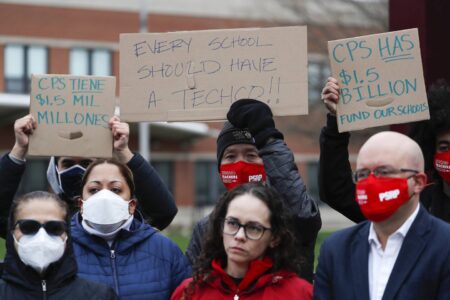
Emiliano Zapata Academy teachers and elected officials gathered Tuesday outside the Little Village elementary school to protest a proposed $894,000 cut to the school’s budget for the upcoming year.Last month Chicago Public Schools presented preliminary individual school budgets for the 2022-23 school year. If those figures hold, Zapata’s budget would be $5.9 million, down from $6.8 million this school year. On Tuesday school community members called on the district to spend federal COVID-19 funds to ensure no school would have to experience cuts, but especially those in Little Village, which was hit hard by the pandemic.Advertisement“We here at Zapata are projected to lose eight or nine teachers, which will most definitely dramatically increase class sizes. In my own classroom, I am projected to have 30 distinctly unique little human beings in front of me instead of the 20 that I have this year,” Zapata fourth grade bilingual teacher Jaquelina Salgado said. “There is no good reason why my future students should be crammed into a classroom where I will have great difficulty meeting their academic, their social, their emotional needs. They deserve so much more.”In a conversation with news reporters last month, CPS CEO Pedro Martinez said school enrollment was a major factor in the creation of the individual budgets. District enrollment declined from 340,000 students the last school year to 330,000 students this year. Zapata counted 554 students, down from 621, according to CPS data.AdvertisementPeople rally outside Zapata Academy in Chicago’s Little Village neighborhood on April 26, 2022, as they protest a proposed $894,000 cut to the school’s budget for the upcoming year. (Jose M. Osorio / Chicago Tribune)Martinez emphasized lower-enrollment schools and schools with the greatest needs would have enough resources for the fall, and more support from the central office would be provided to all schools.Local School Councils at CPS schools were directed to approve school budgets by April 19. It’s unclear if the figures the district released last month are the final numbers or if any schools were able to negotiate more money. CPS did not immediately provide comment.In all, about 200 of CPS’ 500-plus district-run schools were on track to receive less money, based on figures provided last month by CPS.Troy LaRaviere, president of the Chicago Principals and Administrators Association, said at last month’s Chicago Board of Education meeting that the raw numbers don’t tell the whole story.LaRaviere said they fail to account for a 5.5% to 6% increase in staffing costs when you factor in raises and “step” increases, which automatically boost an employee’s salary for adding a year of experience.“It is a fact that some schools receive roughly the same amounts they received last year. However, the CEO used that fact to imply these budgets would create stability. That was false,” LaRaviere said.“Handing (out) the same amount of money provides zero stability for students if that money doesn’t secure the same staff and services. If expenses go up and your budget remains the same, you create instability.”Outside Zapata on Tuesday, eighth grade civics teacher and parent Juan Sanchez was among those calling for the use of COVID-19 funding to stabilize school budgets.Advertisement“CPS has received over $2 billion in federal funds during the dawn of the pandemic, the majority of which has not made its way to our classrooms, and many of which remains unspent,” Sanchez said. “CPS has chosen — it’s a choice — to undercut, to underfund and to undermine schools like Zapata’s ability to adequately educate our children.”CPS is expected to receive $2.8 billion in direct emergency pandemic relief funding over five fiscal years. The district recently admitted it’s been slow to spend this money, but it also said it doesn’t want to create positions it can’t afford when the pandemic money runs out.Ald. Michael Rodriguez, 22nd, said he will work with teachers, parents and advocates to restore funding to Zapata and other Little Village schools. CPS is still formulating its overall budget plan for the next school year, which includes capital spending on construction projects. This year’s budget was $9.3 billion.A “Free the Funds” protest over proposed budget cuts is scheduled for 9:30 a.m. outside CPS headquarters in the Loop before Wednesday’s monthly board meeting.tswartz@tribpub.com

ZURICH — Russia was removed Tuesday as host of the 2023 world championship in men’s ice hockey that was to be played in Vladimir Putin’s home city St. Petersburg.Citing “concern for the safety and well-being of all participating players, officials, media, and fans,” the International Ice Hockey Federation announced the decision after its ruling council met.AdvertisementThe latest blow to Russia in its favored winter sports follows one day after its signature annual international figure skating competition was pulled by the International Skating Union in the fallout from the country’s war on Ukraine.The IIHF said its officials “expressed significant concerns over the safe freedom of movement of players and officials to, from, and within Russia.”AdvertisementSimilar reasons were given last month for stripping the 2023 world juniors event from Russia. That championship was to be played in Omsk and Novosibirsk.Russia had committed to build a new 23,000-seat arena for the men’s worlds that was scheduled for May 2023.A new host will be picked during the men’s world championships which starts next month in Finland, the governing body said.

Information about homicides is released daily by the city of Chicago. The release of homicide victims’ names is delayed by two weeks to allow time for the victims’ families to be notified of a death by Chicago police.[ City reached at least 800 homicides in 2021, a level not seen in 25 years ]The homicide figures do not include killings that occurred in self-defense or in other circumstances not measured in Chicago police statistics. Homicide data from Illinois State Police, which patrols the city’s expressways, also is not included here.AdvertisementIn Chicago, 797 people were slain in 2021 — 25 more than in 2020.Data, which is updated on this page weekly, is through April 24, 2022.Advertisement[ In 2021, violence spread into Chicago neighborhoods that normally enjoy a sense of security, rattling nerves and putting city leaders on the defensive ]
Where each homicide has occurred so far in 2022
Through April 24, 2022
Sources: City of Chicago, Tribune reporting

Chicago Reader co-owner Len Goodman and three board members stepped down Tuesday amid protests from employees, freeing the embattled alternative newspaper to transition to a nonprofit organization.The Reader has been stuck in limbo since December, when a planned transition to a nonprofit model was delayed over concerns about alleged censorship of an opinion piece written by Goodman, who pushed for an investigation into the matter and more representation on the successor board.AdvertisementGoodman announced Tuesday he was stepping away from the Reader immediately over “an unresolvable impasse” with fellow co-owner, Chicago real estate developer Elzie Higginbottom, who wanted to move forward with the planned transition to a nonprofit newspaper.“We cannot continue the fight without destroying the Reader,” Goodman said in a statement. “I am stepping aside. I will sign off on the sale so that the Reader can transition immediately to NFP status.”AdvertisementBoard members Dorothy Leavell, Sladjana Vuckovic and Carol Bell, who were aligned with Goodman’s concerns, announced they were also stepping down immediatelyFrustrated Reader editorial employees organized a rally last week in front of Goodman’s Lakeview East home and planned another one for Thursday morning in an effort to get the Chicago criminal defense attorney to relinquish control and let the newspaper move forward as a nonprofit. Goodman blamed Reader management for not addressing his concerns.In 2018, Goodman and Higginbottom bought the Reader from the Chicago Sun-Times for $1 and the assumption of debt. Since then, they have invested more than $1 million each to keep it afloat, weathering the pandemic and supporting the money-losing publication as it planned to transition to a more sustainable nonprofit model.That plan was delayed after editors pushed back on a November opinion piece by Goodman expressing concerns about vaccinating his 6-year-old daughter against COVID-19, which created backlash on social media for some disputed scientific claims.More to come.rchannick@chicagotribune.com

Chicago Reader co-owner Len Goodman and three board members stepped down Tuesday amid protests from employees, freeing the embattled alternative newspaper to transition to a nonprofit organization.The Reader has been stuck in limbo since December, when a planned transition to a nonprofit model was delayed over concerns about alleged censorship of an opinion piece written by Goodman, who pushed for an investigation into the matter and more representation on the successor board.AdvertisementGoodman announced Tuesday he was stepping away from the Reader immediately over “an unresolvable impasse” with fellow co-owner, Chicago real estate developer Elzie Higginbottom, who wanted to move forward with the planned transition to a nonprofit newspaper.“We cannot continue the fight without destroying the Reader,” Goodman said in a statement. “I am stepping aside. I will sign off on the sale so that the Reader can transition immediately to NFP status.”AdvertisementBoard members Dorothy Leavell, Sladjana Vuckovic and Carol Bell, who were aligned with Goodman’s concerns, announced they were also stepping down immediatelyFrustrated Reader editorial employees organized a rally last week in front of Goodman’s Lakeview East home and planned another one for Thursday morning in an effort to get the Chicago criminal defense attorney to relinquish control and let the newspaper move forward as a nonprofit. Goodman blamed Reader management for not addressing his concerns.In 2018, Goodman and Higginbottom bought the Reader from the Chicago Sun-Times for $1 and the assumption of debt. Since then, they have invested more than $1 million each to keep it afloat, weathering the pandemic and supporting the money-losing publication as it planned to transition to a more sustainable nonprofit model.That plan was delayed after editors pushed back on a November opinion piece by Goodman expressing concerns about vaccinating his 6-year-old daughter against COVID-19, which created backlash on social media for some disputed scientific claims.More to come.rchannick@chicagotribune.com

You’d think more than 20 years into a chosen career, not many things can surprise.That’s not the case with Kim Peavler, an anesthesiology nurse at Northwestern Medicine Central DuPage Hospital. It was while she was regularly visiting her mother at Marianjoy Rehabilitation Hospital in Wheaton that Peavler noticed the site had a meditation room.Advertisement“I was like, ‘Wow,’ because you don’t see the two mix,” Peavler said. “That’s more of an alternative form of health care to people who do medicine. Shortly after that, I learned that our hospital also had resiliency rooms.”Kim Peavler, a regional block nurse at Northwestern Medicine Central DuPage Hospital, is working on a video project for a mindfulness program that is culturally appropriate for Black women. (Brian OMahoney / Chicago Tribune)Seeing how her hospital was moving in the space, Peavler wanted to know how she could be a part of it, and pivoted. She found an accredited master’s program in mindfulness studies at Lesley University in Cambridge, Massachusetts, and enrolled. That was in 2020 after George Floyd’s murder, Peavler recalls.Advertisement“When I got to school, I was able to put a language to so many things that I didn’t know anything about,” she said. “And then I wondered how many other people didn’t know about internalized oppression and how that presents itself.”During her educational deep dive (Peavler will graduate in 2023), Peavler has learned things like: It’s not what we eat, it’s why we eat; and addressing any issues of comorbidity/mortality rates of Black women cannot happen without speaking about racism and what that looks like for the population.“That is happening. But what is happening inside of you, as well — that internalized oppression, the things that you don’t talk about? Black women, we are about grinding, we’re about the work let’s get this work done. ‘I don’t have no time for feelings’ and ‘Who’s gonna do this if I don’t do it?’ Attention is not paid to our emotional health.”Kim Peavler, a regional block nurse at Northwestern Medicine Central DuPage Hospital, is working on a video project for a mindfulness program that is culturally appropriate for Black women. (Brian OMahoney / Chicago Tribune)Peavler, also a holistic registered nurse, certified life coach and mindfulness meditation facilitator/practitioner, started Melan Mind, a company wherein she teaches Black women the art of being present as an antidote to stress — stress that Peavler says many Black women deny.“If you survey most Black women, and ask them are they stressed, they’re going to tell you no. Unless it’s an acute thing like I lost my job, I can’t pay the bills,” Peavler said. “They can admit it in those acute situations … but mortality and morbidity rates of Black women is linked to chronic stress, hypertension, diabetes, and heart disease. Hypertension means there’s pressure in your body, your body is not at ease, and it’s tense. Anything that is tense and tight, after a while it’s going to pop.”Peavler doesn’t want that pop to come. That’s why she’s been teaching a weekslong course called the MIND program. It was created for Black women, bringing mindfulness and collective cultural aspects from Black ancestry together.“The M stands for mindfulness and movement and there are the four I’s, which are intimacy, integration, imagination, and inspiration. And the N is nurture and nourishment. Then the D is design,” Peavler said.Mindfulness activities are done, with focus on breathing, listening, and hand washing, as a way to be present through everyday tasks. Less looking for the big things in life to happen, in favor of seeing joy in the little things — everything from eating with intention, the art of crocheting, mirror exercises and making a deeper connection with your hair and scalp.Advertisement“The design is taking these aspects of what you’ve learned about mindfulness and the practices and then how are you going to create a life that is more intentional and more on purpose?” Peavler said. “We don’t necessarily know how to appreciate ourselves outside of what we do. Because we do this in a community with other Black women, it’s about finding that space in you that is OK with who you are without any work attached to it.”Kim Peavler, a regional block nurse at Northwestern Medicine Central DuPage Hospital is working on a video project for a mindfulness program that is culturally appropriate for Black women. (Brian OMahoney / Chicago Tribune)Peavler is a peer leader and coach in the Central DuPage Hospital Resiliency Coach Program, which enables her to use mindfulness in her everyday work. She also introduces mindfulness to communities through Melan Mind workshops where she also incorporates West African dance and kemetic yoga, yoga that has roots in Africa. All are done in effort to support and empower Black women on their path to transforming pain into healing. For those who want to go deeper with mindfulness, they can join the Melan Mind community and/or partake in one-on-one sessions with Peavler for mindfulness coaching. Her goal is to have a retreat center in the area.“Most people don’t like to get quiet and be still … it has a lot to do with emotions,” Peavler said. “If you’re a Black American, if you trace this back to slavery, there was no time for emotion — it was survival. You needed to do these things to be here, to not become extinct. I contribute a lot of what we’re feeling is emotional irregularity. We don’t necessarily know how to regulate our emotions because we don’t have an experience of feeling the emotions.”After two years in the pandemic, Peavler says she’s seen people wanting to get back to a sense of connection after being isolated. More people are willing to be a bit more vulnerable, to find that connection with self and others. In addition to her in-person work, Peavler is creating a 90-minute documentary, “Culture Meets Presence,” related to her work. She started a GoFundMe to help raise funds for it. She hopes to shop the finished product around to Black-owned networks like OWN and BET.“We’re starving to be heard and to be seen, and the only way you can do that is you have to show up, and you have to speak, but at the same time, we still need these spaces of healing — spaces where you feel comfortable enough to speak and to show up and know that someone’s going to hold space for you for that,” Peavler said. “None of that is necessarily easy, but I believe that people want that and this is what I would like to create.”Cassie Smith, 36, of Aurora, is one such person. As a middle school social worker in Oswego she’s familiar with mindfulness and self-care, as things she teaches others. She had tried meditation apps before, but in-person meditation with Peavler was more of a reminder for maintaining self-care.Advertisement“it reminds me it’s OK for me to not be OK; not to have it all on my shoulders and do it all by myself,” she said. “I can take a break and I don’t have to judge myself for taking that break or worry about what other people may think because I am taking that break.”She’s always telling her friends about Peavler’s work. Smith is participating in the documentary.“I find myself when I try to take time to do yoga or meditate, my brain is constantly: ‘You should be cleaning up, or doing this, or you have this coming up,’” Smith said. “It’s time to change our thoughts and how we handle things … to take that time out of what you feel you have to do to do the things that are good for you to keep you going.”drockett@chicagotribune.com

Novak Djokovic will be allowed to defend his title at Wimbledon, despite not being vaccinated against COVID-19, because the shots are not required to enter Britain, All England Club chief executive Sally Bolton said Tuesday.Djokovic, a 34-year-old Serb who is ranked No. 1, missed the Australian Open in January after being deported from that country because he was not vaccinated against the illness caused by the coronavirus that has led to the deaths of millions during the pandemic that began in 2020.AdvertisementDuring the annual spring briefing ahead of Wimbledon, which starts on June 27, Bolton said that “whilst, of course, it is encouraged” that all players get vaccinated, “it will not be a condition of entry to compete” at the grass-court Grand Slam tournament this year.Djokovic, in addition to being unable to defend his championship at Melbourne Park after an 11-day legal saga over whether he could remain in Australia, had to sit out tournaments at Indian Wells and Miami because he couldn’t travel to the United States as a foreigner who is unvaccinated.AdvertisementThe U.S. Tennis Association has said that it will follow whatever governmental rules are in place regarding COVID-19 vaccination status when the U.S. Open is held starting in late August.Djokovic — who has said he got COVID-19 twice, once each in 2020 and 2021 — owns 20 Grand Slam singles titles, tied with Roger Federer for the second-most for a man. They trail Rafael Nadal, who won his 21st at the Australian Open.Six of Djokovic’s trophies came at Wimbledon, including victories each of the past three times the tournament was held — in 2018, 2019 and 2021. It was not held in 2020 because of the pandemic.After what happened in Australia, Djokovic said he would be willing to sit out other Grand Slam tournaments if getting vaccinated were a requirement to compete. The next major event is the French Open, which begins on May 22, and tournament director Amelie Mauresmo said last month there was nothing preventing Djokovic from defending his 2021 title in Paris.The Italian Open, a clay-court tune-up for Roland Garros, also has said Djokovic can play there next month.

United Airlines is adding new flights between Chicago and two European cities, as the carrier eyes the return of international travel.AdvertisementThe two Chicago routes are part of a major trans-Atlantic expansion by United, which plans this spring to begin new or expanded service to multiple international cities and vacation destinations. That includes new service to Amman, Jordan; Bergen, Norway; the Azores and the Canary Islands, among others. Destinations that will get expanded service include Dublin and Frankfurt.In Chicago, daily flights began this week to Zurich. The route was initially set to begin in March 2020, but was put on hold because of the pandemic.AdvertisementThe Boeing 767-300 aircraft that are flying the 9-hour route have extra space devoted to business class seats. The flight is intended to cater to both business travelers trying to reach the European financial center and leisure travelers, United executives said in a news release.On May 6, United will also begin daily flights between Chicago and Milan. The airline currently flies between Milan and New York.The new flights, announced in October, come as United anticipates the further return of international travel as pandemic restrictions ease. Along with business flights, international travel was especially hard hit during the pandemic.A person walks past United Airlines signage at O’Hare International Airport in Chicago on Feb. 23, 2022. (Jose M. Osorio / Chicago Tribune)United Airlines said last week it was “seeing indications that business travel is rapidly returning” and expects more upticks in international travel.“This is really kind of the coming-out party for the real return of business travel and international travel in this quarter,” CEO Scott Kirby told analysts during an earnings call. “We are in the first inning of that recovery.”The comments came as the carrier reported it expected to return to profitability in the current quarter, after a first quarter loss of $1.38 billion. United is still running fewer flights than pre-pandemic, but said it has reopened lounges, resumed more than a dozen international routes and restarted service to six cities that hadn’t been served since before the pandemic. United executives also said they were pleased mask requirements had ended for airports, domestic flights and some international flights, depending on the arrival country’s mask rules. They called for an end to preflight COVID-19 test requirements, and said the elimination of those rules could make travel easier.“While travel demand is surging, we believe eliminating these requirements will ease the travel experience for our customers,” United President Brett Hart said.AdvertisementInternational business travel was increasing, and the airline expected good trans-Atlantic business travel levels compared with 2019, Chief Commercial Officer Andrew Nocella said. It hasn’t seen meaningful recovery in business travel to Asia.While many of the new and expanded routes set to begin in the coming weeks are geared toward vacationers, some of the routes are targeted specifically toward business travelers, said Patrick Quayle, United’s vice president of international network. That includes the new Chicago-Zurich flight, and a route between Denver and Munich, he said.“We are seeing strong demand and strong pickup for those flights,” he said.The Associated Press contributedsfreishtat@chicagotribune.com

The Chicago Cubs don’t boast the same star power as they did a year ago. Yet despite subtracting three star hitters last July, the Cubs offense has become more functional and successful.The typical early season disclaimers apply, but even so, the Cubs offensive profile has made games more engaging for fans and players because of the pace of play. Even when they put up a football score in a 21-0 win Saturday against the Pittsburgh Pirates, the game lasted 2 hours, 47 minutes — 19 minutes shorter than the average nine-inning MLB game this season.AdvertisementThe Cubs (7-9) look to get back to .500 during a three-game series in Atlanta that begins Tuesday. While they try to get on a roll, at the very least the offense is more viable than during the first half of 2021 with what was supposed to be a playoff-caliber roster.The strength of the Cubs offense will be tested soon. In their next 14 games, the Cubs face the reigning World Series champion Atlanta Braves, Milwaukee Brewers, Chicago White Sox, Los Angeles Dodgers and San Diego Padres.AdvertisementIs the Cubs offense legit? Five numbers highlight the good and bad.ExpandAutoplayImage 1 of 28Cubs right fielder Seiya Suzuki (27) slides into second on a double during the ninth inning, April 24, 2022, at Wrigley Field. (Erin Hooley / Chicago Tribune)The Cubs are finding ways to score that don’t require home runs, and it’s making a difference in how the offense functions. Weighted on-base average (wOBA) helps quantify the value of a plate appearance’s outcome rather than evaluate all hits equally.The Cubs’ .347 wOBA ranked first in the majors through Sunday, which isn’t surprising since they also had the best average, on-base percentage and OPS. Their 125 weighted runs created plus (wRC+) ranked second. The Cubs have a well-rounded offense and a lineup that generally is balanced, even on days manager David Ross opts to rest a regular.A strong offensive profile hasn’t converted to as many wins as it seems the Cubs should have, and their record includes a 2-4 mark versus the Pirates. But their wOBA suggests the lineup will be a strength in the long run, even if the Cubs don’t remain at the top of key offensive categories.Ian Happ reacts after striking out to end the fifth inning against the Pirates on Thursday, April 21, 2022, at Wrigley Field. (Chris Sweda / Chicago Tribune)When the Cubs scored 21 runs Saturday, another statistic was nearly as impressive. They struck out only three times in 52 plate appearances and no Cub had more than one.The Cubs were almost unwatchable at times last season, especially in the first half, with an offense that featured too many swings and misses and not enough contact hitters to offset that. Injuries to Matt Duffy and Nico Hoerner played a role in the Cubs falling apart in late May and into June, which was problematic on many levels.This year, though, the Cubs aren’t relying on the long ball to score. Saturday’s outburst epitomized what this offense has shown through 16 games: The Cubs hit only one home run en route to 21 runs.[ [Don’t miss] 3 takeaways from the Cubs-Pirates series, including an emphasis on placement over power ]Cutting down on strikeouts while still drawing walks has been a key to the offense’s success. The Cubs’ 21.2% strikeout rate was sixth-best in the majors through Sunday, while their 10.1% walk rate was tied for eighth. Combined with their big-league-leading .273 average, their offensive production has found a balance between swing-and-miss bats and contact hitters — with both profiles showing an ability to draw walks and get on base.AdvertisementThe Cubs will need to keep this up to make up for being slightly below the league average in home runs. Their four-game series against the Pirates showed what can happen if the hits aren’t consistently falling. They can’t count on a home run to bail them out.Cubs left fielder Rafael Ortega rounds third and heads for home during the first inning against the Pirates on Sunday, April 24, 2022, at Wrigley Field. (Erin Hooley / Chicago Tribune)The offense’s profile includes one area in which the Cubs haven’t graded out as well nearly three weeks into the season.FanGraphs’ baserunning metric (BsR) is all-encompassing in evaluating stolen bases, caught stealing and other baserunning plays and converting them into runs above and below average. The statistic can be volatile this early in the season, but the Cubs ranked 23rd through Sunday with a minus-1.5 BsR. They haven’t stolen many bases (four) and have been caught stealing three times.The Cubs have been above the league average in advancing an extra base, which is helpful for a team putting the ball in play as much as they have.Chicago Tribune SportsWeekdaysA daily sports newsletter delivered to your inbox for your morning commute.The Cubs don’t have many obvious base stealers in the lineup, though Seiya Suzuki likely will be on the move more as the season progresses. Manager David Ross wants him to feel comfortable at the plate and on the basepaths before incorporating more steal attempts in Suzuki’s style of play. Suzuki’s speed and instincts would add another dynamic to the Cubs offense.Cubs catcher Willson Contreras runs to the dugout after grounding into a double play during the sixth inning against the Rays on Monday, April 18, 2022, at Wrigley Field. (Armando L. Sanchez / Chicago Tribune)After finishing with the worst contact rate in the majors in 2021, the Cubs are showing improvement, sitting 12th at 76.2%.Advertisement“I do think that’s a pretty sustainable trait,” president of baseball operations Jed Hoyer said last week. “It’ll probably vacillate from time to time with different matchups and different handedness. But I do think that we should be a fairly high contact team — but with that we’re not going to hit as many three-run homers as we once did.”Notably, the Cubs’ contact rate includes the highest ground-ball rate (51.8%) in baseball. All other teams were below 48% through Sunday, with the Seattle Mariners the lowest at 37.7%. One side effect the Cubs are encountering to putting the ball in play more — and specifically hitting the ball on the ground so much — is the double-play balls they are racking up.[ [Don’t miss] How Cubs first baseman Frank Schwindel’s experience at catcher helps him defensively: ‘He’s hungry’ ]The Cubs have hit into 18 double plays, which led the majors entering Monday’s games. Willson Contreras (five) and Nick Madrigal (four) were tied for first and fourth in the big leagues.Conversely, only three teams have a lower line-drive percentage than the Cubs (18.4%). The Cubs know they must elevate the ball more. It sounds simple to fix, but looking for balls to drive within an at-bat can require adjusting an approach.Hoyer sounded optimistic the ground-ball rate and double-play issue will even out over the season. Still, it’s worth keeping an eye on.

It’s no surprise if you’ve been suffering from a bad case of whiplash over the last week.One day you’re cranking up the heat. The next day you’re turning on the air conditioner. And then it’s back to winter again.AdvertisementOne day it’s OK to take off your mask. The next day it’s time to mask up again. And who knows what tomorrow will bring?And if you’ve been following the Chicago White Sox, the whiplash has occurred at a fast and furious pace. The Sox were 6-3 and looking unstoppable in the American League Central on Wednesday morning, only to be swept in a doubleheader in Cleveland that day to begin an 0-6 road trip that ended with a walk-off loss Sunday in Minnesota.AdvertisementAnother brutal injury, putting Eloy Jiménez out of action for up to two months, combined with shoddy defense and a lack of hitting helped void the collective optimism Sox fans accumulated during the opening homestand.It’s enough to make a grown man cry — or at least cover his eyes.But just as our one day of spring Saturday eventually will morph into a real summer, the real White Sox are likely to show up sooner or later.ExpandAutoplayImage 1 of 90White Sox’s Eloy Jimenez leaves the field on a cart after falling to the turf on a groundout to the Minnesota in the second inning on April 23, 2022. (Bruce Kluckhohn / AP)Sooner would be preferable, and a homestand this week against the Kansas City Royals and Los Angeles Angels should help bring them out of their doldrums.But if not, it’s still a long way to October and the division is occupied by three rebuilding teams and the Sox and Twins. One aggravating week in April won’t mean much if the Sox can limit the damage.The most concerning part is the unforced mistakes, particularly the league-worst six errors committed by shortstop Tim Anderson. While Anderson is no Gold Glove shortstop, he never has looked so out of sync in the field. Last year he made 10 errors in 122 games, so you have to believe this is just a blip.It’s reminiscent of a similar fielding slump former Sox third baseman Robin Ventura experienced at the start of the 1995 season, when the Sox also were coming out of a shortened spring training after the end of the strike. Ventura, who had won three Gold Gloves at that point, made six errors in the first five games and had a one-word response when asked about his fielding woes:“Disgusting.”AdvertisementThe ‘95 Sox, who were prohibitive favorites to win the division, committed 21 errors in their first six games, which obviously affected the pitching. Ventura’s fielding slump continued, and the Sox had the worst record in the majors after 31 games when manager Gene Lamont was abruptly fired. It was only the second time in 15 seasons Chairman Jerry Reinsdorf had given his general manager the OK to fire a Sox manager. The other one was Tony La Russa, who is now back at the helm and getting the same kind of questions from Sox fans on Twitter that Lamont heard on talk radio during the team’s underachieving start in ‘95.White Sox manager Tony La Russa stands in the dugout before the first inning against the Mariners at Guaranteed Rate Field on April 13, 2022. (Armando L. Sanchez / Chicago Tribune)La Russa doesn’t have to worry about suffering the same fate as Lamont, no matter where he bats struggling Leury García in the lineup or if he lets Byron Buxton beat the Sox instead of walking the Twins slugger with the game on the line in the 10th inning.This is La Russa’s team, like it or not.And Anderson won’t take any extended time off to clear his head after an awful week. The Sox can’t afford to take his bat out of the lineup, and he will get another day off when he serves his one-game suspension for flipping off a fan in Cleveland, assuming he loses his appeal. He’ll just have to play his way out of this.Defense was an issue last year, when the Sox committed 97 errors — fourth-worst in the AL — and they did nothing to improve it in the offseason. So it shouldn’t be a big shock to anyone that the Sox entered Monday tied with the Arizona Diamondbacks with 18 errors, five more than any other team. Other than outfielders Luis Robert and Adam Engel, no position players stand out defensively.AdvertisementThe Sox got by last year with designated hitters and first basemen playing in the outfield, and it wouldn’t be a major concern now if their pitching and hitting had lived up to expectations.With Lucas Giolito’s return Sunday, the Sox still have a formidable threesome of Giolito, Dylan Cease and Michael Kopech leading the rotation. They can hold down the fort until Lance Lynn’s return. But Dallas Keuchel and Vince Velasquez need to step up, and Johnny Cueto didn’t fare well in his debut at Triple-A Charlotte, serving up two home runs in 2⅔ innings.The Sox declined to spend on a top-line starter in the offseason after losing Carlos Rodón to free agency. That decision could come back to haunt them.Jiménez’s hamstring injury, of course, is deflating. His injuries always are tough to deal with because we keep waiting on him to get through a full season. Now that won’t happen until 2023 at the earliest. I’ve always thought the Sox should make him the regular DH to limit the injury risk.Giolito told reporters after the Sox’s seventh straight loss Sunday that it was a “(bleep) week.” Those things happen over the course of a season, even for the best teams. Even without Lynn, Jiménez and Yoán Moncada for an extended stretch, this team should dominate the AL Central rebuilds and hang with the Twins.La Russa was hired because he has seen it all, so this is nothing new to him. What will he do to make sure last week is a blip and not a trend?AdvertisementWe’re all anxious to find out.