

Author: staff

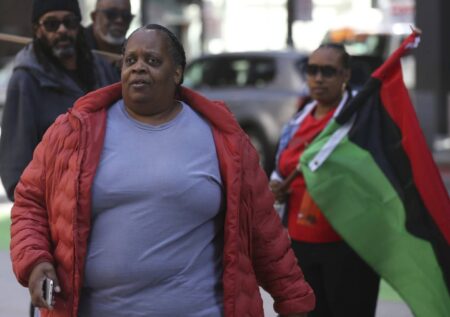
The maternal grandmother of slain teen Laquan McDonald said she still wants federal charges to be pressed against his shooter, former Officer Jason Van Dyke, despite U.S. Attorney John Lausch’s office’s statement earlier this week saying federal prosecutors will not bring a case against the one-time cop.Tracey Hunter, 55, McDonald’s grandmother, appeared Thursday morning at Federal Plaza in the Loop with about a dozen other activists to urge the public to still fight for federal charges against Van Dyke.Advertisement“I want justice. I want justice for my grandson, and I want justice now,” Hunter said. “I want federal charges. John Lausch, if you’re not going to do your job, you need to step down.”Activists at the gathering called for the public to call Lausch’s office and other federal representatives to ask for federal charges.AdvertisementLaquan McDonald’s maternal grandmother Tracey Hunter, family members and supporters are attend a news conference demanding a federal civil rights prosecution of Jason Van Dyke on April 21, 2022. (Antonio Perez / Chicago Tribune)Jason Van Dyke has already been tried and convicted in Cook County court for McDonald’s death, and federal law sets an extraordinarily high bar to prove criminal civil-rights violations in such a case — “more stringent than the state charges on which Mr. Van Dyke was convicted,” according to a statement from Lausch’s office.“Federal prosecutors would need to prove to a jury beyond a reasonable doubt that Mr. Van Dyke willfully deprived Mr. McDonald of a constitutional right,” the statement read. “To do that, prosecutors would have to prove not only that Mr. Van Dyke acted with the deliberate and specific intent to do something the law forbids, but also that his actions were not the result of mistake, fear, negligence, or bad judgment.”The decision not to bring federal charges was made in consultation with McDonald’s family, according to the statement Monday.When asked who was part of that consultation, Tracey Hunter said she and her daughter, McDonald’s mother, were not included and believed it was Laquan’s great uncle, Rev. Marvin Hunter, who she said should no longer be the spokesperson for the family.Rev. Hunter did not immediately respond to a request for comment.Tracey Hunter said she did not know about the U.S. attorney’s office’s decision until she received phone calls from reporters asking about it.“We did not get no phone calls (from the U.S. attorney’s office) about nothing,” she said. “ … When it all boils down to it, my grandson ain’t coming back. I got to live with this for the rest of my life. My daughter has to live with this for the rest of her life.”Hunter said when she talked to her daughter on the phone after learning of the U.S. attorney’s decision to not pursue federal charges, her daughter was silent.Advertisement“She couldn’t even talk. That’s all she could say, ‘What? What?’” she said.Lausch’s office declined to comment on the situation Thursday.It is rare for federal authorities to announce that they have declined to charge someone. But in the wake of Van Dyke’s release from prison after a relatively short sentence, high-profile figures such as the Rev. Jesse Jackson and the head of the NAACP had called on the Department of Justice to consider bringing a case that could put him back behind bars.Tyrone Williams holds up a sign as Laquan McDonald’s family and supporters urge a federal civil rights prosecution of Jason Van Dyke, across from the Dirksen Federal building in Chicago on April 21, 2022. (Antonio Perez / Chicago Tribune)Van Dyke was convicted of second-degree murder and aggravated battery by a Cook County jury in 2018; he spent a little more than three years behind bars for McDonald’s death before his release in February. The 2014 shooting, captured on police video, sent shock waves from neighborhood streets to the mayor’s office at City Hall when footage was released more than a year later.Van Dyke withdrew his appeal of the Cook County conviction in fall 2020, so authorities’ decision not to charge on the federal level likely marks the end of his legal journey.The investigation into Van Dyke’s conduct was launched as a joint probe between state and federal authorities in April 2015. Then-Cook County State’s Attorney Anita Alvarez’s office charged Van Dyke with first-degree murder in state court in November of that year, while the federal investigation remained ongoing.AdvertisementFederal prosecutors could not simply charge Van Dyke with murder again, the statement from federal prosecutors noted. Rather, they would have to prove that he willfully violated McDonald’s constitutional rights.Lausch’s office stated Monday that if Van Dyke were convicted on federal charges, the federal judge would have to consider that Van Dyke had already served a prison sentence, and that he can no longer serve as a law enforcement officer.“Given these factors, there is a significant prospect that a second prosecution would diminish the important results already achieved,” the statement read.Justin Blake arrives to a news conference where Laquan McDonald’s family and supporters demanded a federal civil rights prosecution of Jason Van Dyke. (Antonio Perez / Chicago Tribune)Van Dyke’s release from prison in February after less than four years in custody prompted many calls for federal prosecutors to charge him with civil-rights violations, or at least provide some closure regarding the federal probe that was launched after McDonald’s shooting.The week of Van Dyke’s release, protesters including Rev. Jesse Jackson as well as Tracey Hunter crowded near Federal Plaza downtown in a demonstration calling for Van Dyke to face federal charges.Several people who protested inside the courthouse were taken into custody and charged with misdemeanor civil contempt for violating the chief judge’s order governing demonstrations at Dirksen.Advertisementpfry@chicagotribune.com
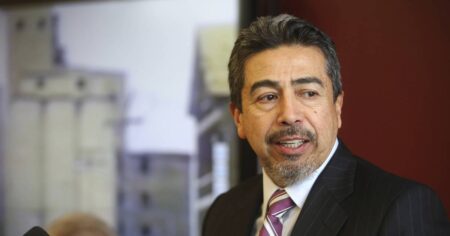
A federal prosecutor on Thursday delivered an impassioned defense of the deferred prosecution deal with former Ald. Daniel Solis, telling the federal judge overseeing the high-profile case that Solis’ cooperation was perhaps “singular” even in the city’s long history of political corruption.“Some may view (Solis’ cooperation) as being with little precedent, but what Mr. Solis did also was with little precedent,” Assistant U.S. Attorney Amarjeet Bhachu said during a status hearing in Solis’ case. “He didn’t just talk. He took action. He worked with the federal government for six years to expose corruption.”AdvertisementBhachu was responding to a victim-impact statement from Solis’ replacement as 25th Ward alderman, Byron Sigcho-Lopez, who asked U.S. District Judge Andrea Wood to consider Solis’ “rampant and unchecked corruption” when deciding whether to go along the deal, which will leave Solis with a clean slate in three years if he continues to cooperate.Sigcho-Lopez urged the judge in the two-page letter to consider “scaled and appropriate penalties” that reflect the seriousness of Solis’ conduct, which he said did long-term damage to the citizens of the ward.Advertisement“If former Alderman Solis is not held accountable/charged, we feel that our hard work to reform will be undone,” Sigcho-Lopez wrote.Bhachu, however, told Wood on Thursday that the letter overstated Solis’ misconduct and failed to take into account the unprecedented level of his cooperation.When Solis was confronted by investigators back in 2016, Bhachu said, he “had a choice” about what his path would be, including to refuse to cooperate, deny accountability, and fight any charges that came his way.“That is an easy path that many in this city to date have followed,” Bhachu said. “Mr. Solis chose a more difficult path, judge. He cooperated with the government for approximately six years. When we asked him to meet, he did so. When he was asked to make a recording with a third party, he did it.”During the course of his cooperation, Solis personally made “hundreds of recordings” and helped form the basis of government requests for wiretaps on others, Bhachu said. Solis’ efforts make him one of the most significant government witnesses of the last several decades.“A lot of people talk about cleaning up corruption, and often all it amounts to is talk,” Bhachu said. “It’s rare when someone actually delivers, and in this regard, Mr. Solis delivered.”Bhachu also said Solis has suffered for his corruption, even if it won’t include a felony conviction. He lost his seat in the City Council, he can’t run for public office again, and he’s been ostracized by former colleagues, according to the prosecutor.“Life is never going to be the same for him again,” Bhachu said. “These are all real consequences.”AdvertisementAfter Bhachu finished, Solis’ attorney, Lisa Noller, said she had nothing to add, “Because we agree with all of it.”At the conclusion of the hearing, Wood agreed to exclude time in Solis’ deferred prosecution deal, meaning his case will be set for dismissal on April 8, 2025 as long as he continues to cooperate with the ongoing investigations.Solis’ legal saga began in 2016 when he secretly agreed to wear a wire for federal investigators and helped build racketeering cases against Ald. Edward Burke and then-House Speaker Michael Madigan, two of the longest-serving and most powerful politicians in the state.The deferred prosecution deal was signed by Solis on the day after Christmas 2018 and kept secret for nearly 3 ½ years before the U.S. attorney’s office on finally put it on the record earlier this month.As part of the deal, Solis was charged in a one-count criminal information with corruptly soliciting campaign donations from a real estate developer in exchange for zoning changes in 2015, when Solis was head of the City Council Zoning Committee.At Solis’ arraignment last week, Assistant U.S. Attorney Amarjeet Bhachu told Wood he’d learned the city may want to intervene in Solis’ case as a victim. Bhachu said that while the U.S. attorney’s office “always invites the participation of victims in criminal cases,” he thought it was “doubtful” that the city would legally qualify as a victim given the facts of the Solis case.AdvertisementHours later, Mayor Lori Lightfoot, who has been highly critical of Solis’ deal, issued a statement that called him out for violating the public trust “in profound ways” but stopped short of any seeming attempt to derail the deferred prosecution.Instead, Lightfoot, a former federal prosecutor, said she had instructed the Law Department to file a victim impact statement with the court.“Because of all of the crimes that have been put on the public record, Solis victimized the residents of his ward and residents in the entire city, all of whom were deprived of the integrity and honesty that should be sacrosanct with all public officials,” the mayor said. “No one is above the law and Chicago residents expect that their elected officials will be held accountable.”It was not the first time Lightfoot has been critical of Solis. After the Tribune reported on Solis collecting his pension after leaving office in 2019, Lightfoot said she was “confident he will face a moment of reckoning.”“What that will be, when that will be, that is not under my control,” Lightfoot said that fall.She has since publicly and privately criticized the deal prosecutors reached with Solis, calling it “unconscionable” that he might not face a conviction or lose his pension.AdvertisementIn his letter, Sigcho-Lopez detailed a number of ways in which he says Solis’ corrupt zoning practices allegedly have harmed his ward, from displacing thousands of low-income residents in Pilsen to letting politics trump the public interest in important development projects in Chinatown.“The harm caused by this corruption is generational,” the letter stated. “The people of the 25th Ward continue to feel the aftermath.”He also touched on the pending cases against Burke and Madigan, who have both pleaded not guilty. In particular, Sigcho-Lopez said lobbyists connected to the alleged corruption schemes “will continue to be rewarded with public contracts without any accountability, if convicted parties are perceived to be ‘let off the hook.’ “Noller could not immediately be reached for comment. A spokesman for U.S. Attorney John Lausch also could not be reached.“As Mayor, it is my priority that all efforts are made to ensure that individuals engaged in City business are doing so with honesty and integrity. Over the past week, the City has had productive conversations with the U.S. Attorney’s office regarding defendant Daniel Solis. Given the discussions, the City sees no need to formally intervene. Separate and apart from this specific proceeding, we will continue to aggressively protect our residents and notably our taxpayers against individuals who commit crimes or otherwise unethically obtain city resources.”jmeisner@chicagotribune.com

The burgeoning Chicago tech scene has a new player: the Department of Defense.The Defense Innovation Unit, a military technology accelerator, is opening an office in Chicago to tap into the region’s technology ecosystem, from electric vehicles to artificial intelligence, and better wage 21st century warfare.AdvertisementThe office will be located at the Discovery Partners Institute offices on South Wacker Drive for a two-year lease beginning in June, the Defense Department announced Thursday. The commitment to developing a stronger tech innovation pipeline in Chicago and the Midwest is long term, according to Michael Brown, director of the innovation unit.The Defense Department brought in 100 new vendors last year, mostly from other regions, Brown said. The new innovation hub should significantly boost the representation of Midwest tech companies as Defense Department contractors.Advertisement“We brought in 15 from this region, and we’re looking to triple that over the next couple of years,” Brown said during the announcement Thursday at MxD, a digital manufacturing innovation center at Goose Island.The Chicago office will be the fifth for the Defense Department, which has innovation units in Silicon Valley, Boston, Austin and at the Pentagon. Founded in 2015, the Defense Innovation Unit was established to find, develop and employ new technology to speed up adoption and enhance national security.It is also being touted as a boost to Chicago’s technology scene, from academic institutions and innovation centers to startup companies.“We want to open DoD as a viable market for business, to startups that today don’t understand they can do business with the department,” said Ryan Whelan, a U.S. Army Reserve major who heads up the Midwest region for the innovation unit. “The other thing that we want to do is accelerate the growth of these emerging technologies by creating new opportunity for commercial tech and accelerating its adoption in the defense space.”Whelan said new technologies, from electric vehicles to agricultural technology, can strengthen national security and help the U.S. “fight wars better” as it competes with countries such as China, Russia and others.Those sentiments were echoed by a full roster of Illinois political leaders, including Gov. J.B. Pritzker, Mayor Lori Lightfoot and both Illinois senators, who were on hand Thursday for the defense innovation hub announcement.U.S. Sen. Tammy Duckworth, an Iraq War veteran who serves on the Armed Services Committee, said the innovation unit enables the military to leverage new technologies and level the battlefield.“We’re putting our troops at risk of losing battles if we don’t invest in the technologies that will help us to compete in the next century’s battlefield,” Duckworth said. “Whether that’s an island in Southeast Asia or a piece of code that holds up our electrical grid, I know firsthand how important it is to have all of the resources possible when on the battlefield.”AdvertisementU.S. Sen. Dick Durbin said the Chicago office will be a boon for the state and the Midwest, and a resource for national defense. He said the development of EV technology in Illinois, specifically the launch of the Rivian truck manufacturing plant in Normal, could find applications on the battlefield.The Rivian facility, which launched production in September, is building $70,000 electric trucks and SUVs for consumer use.“They can go straight from the assembly line in Normal to driving through rivers, even rock crawling up mountains,” Durbin said. “Just imagine how useful that vehicle could be on the battlefield.”The Chicago defense innovation hub will occupy a small footprint in the Discovery Partners Institute offices, with room for five or six employees, the Defense Department said. It will likely need to find new quarters when the two-year lease is up.The Discovery Partners Institute, a University of Illinois-led initiative, is building a 500,000-square-foot innovation hub to develop Chicago tech talent at The 78, a 62-acre megadevelopment slated for long-vacant land in the South Loop. The facility is slated to open on the south end of The 78 by 2024.Whelan declined to say if the Defense Innovation Unit would follow the Discovery Partners Institute to its new digs. If it does, it may have a casino for a neighbor. Chicago-based Rush Street Gaming, which owns four casinos including Rivers Casino Des Plaines, is proposing a $1.62 billion riverfront casino at The 78, one of three bids in contention to become Chicago’s first gambling mecca.Advertisementrchannick@chicagotribune.com
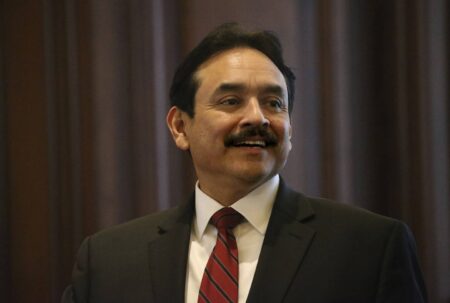
Two longtime Democratic state senators whose names have come up as part of the wide-ranging federal corruption probe that led to charges against former Illinois House Speaker Michael Madigan have dropped their reelection bids.Sens. Tony Muñoz of Chicago, an assistant majority leader, and Steve Landek, who doubles as mayor of Bridgeview, withdrew their names from the June 28 primary ballot, each likely clearing the way for their political allies to take over the respective seats. Neither Muñoz nor Landek has been accused of any wrongdoing.AdvertisementMuñoz, a former Chicago police officer who’s been in the Senate since 1999, could not immediately be reached for comment Thursday, but he issued a statement announcing he plans to retire when his term is up in January.“I was taught at a young age that hard work and determination is the key to success,” Muñoz said. “I have applied this to everything I have accomplished, especially as a state senator.”AdvertisementState Sen. Tony Muñoz listens in during a Senate hearing at the Illinois Capitol building in Springfield on April 7, 2022. (Antonio Perez / Chicago Tribune)With no candidate in the June 28 Republican primary for the newly drawn 1st Senate District, Muñoz’s withdrawal leaves son-in-law Javier Loera Cervantes as the sole candidate on the ballot. There is, however, an objection pending against Cervantes’ nominating petition.Landek, who was appointed to a vacant Senate seat with Madigan’s help in 2011, declined to comment on his decision. But with him out of the running, the only remaining candidate on the primary ballot is Democrat Mike Porfirio, a Lyons Township trustee who previously worked as Landek’s chief of staff in his Senate office and also as public works director in Bridgeview. No Republicans are currently running for the seat.Neither Cervantes nor Porfirio could be reached for comment.By putting their names on the ballot and then withdrawing after the filing period is closed, Muñoz and Landek likely warded off other potential candidates who might have been interested in running for an open seat but wouldn’t have wanted to take on an incumbent.Landek is expected to remain in the Senate until the end of his term and he also continues to serve as Bridgeview mayor, a job he first won in 1999. He is also the head of the Democratic Organization of Lyons Township.Had Landek remained on the ballot it would have been the first time he faced voters since his name surfaced in a sweeping federal corruption probe that led to the indictment of Madigan and a guilty plea from Landek’s former neighboring state senator, Martin Sandoval. A Chicago Democrat, Sandoval died in December 2020 of COVID-19 after pleading guilty to bribery and tax charges and agreeing to cooperate with federal prosecutors.Federal agents who raided Sandoval’s Springfield office in September 2019 seized a number of items, including a flash drive with “Landek written on it,” according to search warrant documents.Landek, who shared an office suite and a legislative assistant with Sandoval, has not been charged with any wrongdoing.AdvertisementSign up for The Spin to get the top stories in politics delivered to your inbox weekday afternoons.One month later, in October 2019, Landek told the Tribune the flash drive likely contained information about office bills, rents and phones, and possibly legislation he sponsored for the Illinois Municipal League. He said at the time that he hadn’t been interviewed by federal authorities.Sen. Steve Landek, D-Bridgeview, is seen on the Senate floor at the Illinois Capitol in Springfield on Jan. 3, 2013. (E. Jason Wambsgans / Chicago Tribune)When federal agents descended on village hall in southwest suburban Lyons two days after raiding Sandoval’s state Capitol office, “items related to the Democratic Organization of Lyons Township” were among the records they sought, according to a search warrant.The list of items that were seized in the Lyons raid also included a framed photograph of Lyons Village President Christopher Getty with Muñoz. Muñoz, like Sandoval, came up through the now-defunct Hispanic Democratic Organization, a Chicago patronage army backed by then-Mayor Richard M. Daley.In October 2019, Muñoz issued a statement saying that questions about the photo were “the first time I’m hearing about this.”“Our local government officials visit the Capitol while we’re in session, and I often meet with and take pictures with them,” he said at the time.AdvertisementSeparately, a court filing earlier this year in the federal case against former state Rep. Luis Arroyo, who has pleaded guilty to a bribery scheme involving sweepstakes gambling machines, revealed that Muñoz testified before a grand jury in the matter.A motion from Arroyo’s attorneys seeking probation rather than prison time noted Muñoz testified that Arroyo only approached him to arrange a meeting. Muñoz had previously sponsored a measure that would have banned the machines, which died in the House after being approved without opposition in the Senate.In February 2020, the village of Bridgeview, where Landek is mayor, received a federal grand jury subpoena for a range of documents, including communications with Madigan and his longtime confidant Michael McClain, a former state lawmaker and lobbyist who was charged alongside the former speaker last month in a 22-count federal indictment.As part of the February 2020 subpoena, authorities also sought communications with Madigan’s hand-picked alderman, Marty Quinn, 13th, and his brother Kevin Quinn, who’d been ousted from the speaker’s political organization over sexual harassment allegations.Most of the documents requested in the subpoena were for information related to Raymond T. Nice, a longtime precinct captain in Madigan’s 13th Ward organization. Authorities sought contracts, invoices and tax records, among other documents. While Nice is not named in the Madigan indictment and has not been charged, the Tribune has reported that prosecutors alleged Nice was designated a subcontractor and had payments funneled to him through a ComEd lobbyist. Nice did little or no work, prosecutors said.As the Tribune has previously reported, Bridgeview was among the more than half-dozen suburbs that awarded insurance business to the firm that employed Madigan’s son, Andrew.AdvertisementBridgeview selected Mesirow Financial as its broker for risk management insurance in December 2010, about a month before Michael Madigan presided over a meeting of local Democratic Party leaders who unanimously chose Landek to replace retiring Sen. Lou Viverito. In 2012, Landek declined to say whether Andrew Madigan was involved in securing the three-year contract, but he said all insurance brokerage deals in the village went through a competitive bidding process.The federal indictment of Michael Madigan alleges that during a 2018 meeting about a potential appointment to a state board, he asked then-Ald. Danny Solis, who was wearing a wire, to steer insurance business to his son.dpetrella@chicagotribune.com
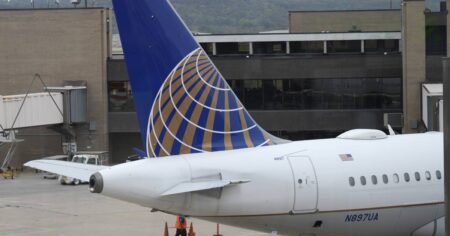
CHICAGO — United Airlines reported Wednesday that it lost $1.38 billion in the first quarter of 2022 but said it expects to return to profitability in the current three-month period as post-pandemic travel ramps back up.The Chicago-based airline posted revenue of $7.67 billion in the quarter that ended March 31. That was down 21% from the first quarter of 2019.AdvertisementThe airline is still running fewer flights than before the pandemic. But it said it had reopened all of its lounges, resumed 19 international routes and restarted services to six cities that haven’t been served since the pandemic began.The number of miles flown by paying passengers fell 27% from a year earlier. However United is flying with roughly 73% of its available seats full. While not as high as the 81% of all seats before the pandemic, it is much better than it was in 2021 first quarter, when roughly half of all seats were filled with paying passengers.AdvertisementThe first quarter started off troubled for the airline industry, dominated in the early weeks by omicron variant of the COVID-19 virus. The virus abated, and caseloads across the U.S. have been low for some time. A federal judge this week put an injunction on the government’s mask mandate on planes, trains and travel hubs but the Justice Department said Wednesday it is filing an appeal seeking to overturn the order.“We continue to believe we will see a strong spring and lead in to summer as restrictions disappear and more people travel,” said analysts at Cowen & Co. “We believe if the U.S. testing mandate were to be eliminated, we would see strong pent-up demand for the summer on trans-Atlantic routes.”The airline appeared optimistic that its pandemic-related losses were behind it. United said it expects to post a profit for the second quarter and for the full year 2022. This is despite United facing higher fuel costs this quarter, paying on average $2.88 for fuel, up 40% from a year earlier. The airline forecast an operating gross margin of 10%, which was above analysts’ expectations.“The demand environment is the strongest it’s been in my 30 years in the industry … we’re now seeing clear evidence that the second quarter will be a historic inflection point for our business,” United Airlines CEO Scott Kirby said in a statement.United’s quarterly loss amounted to $4.24 a share and compared to a loss of $1.36 billion, or $4.29 a share, in the same period a year earlier. Analysts had been expecting a loss of $4.22 a share in the latest quarter, according to FactSet.
Federal charges unsealed in Chicago on Thursday allege three dealers participated in a massive art and sports memorabilia fraud scheme involving forged signatures of baseball greats Babe Ruth, Lou Gehrig, and Cy Young, as well as phony paintings purportedly by artists such as George Ault, Ralston Crawford and others.Charged in the 34-page indictment were brothers Donald Henkel and Mark Henkel, of Michigan, as well as Raymond Paparella, of Boca Raton, Florida.AdvertisementThe wire fraud charges alleged Donald Henkel purchased items such as paintings, baseballs, baseball bats, celebrity photographs and books, record albums, programs and even “vintage pens” for use in the scheme.The Henkel brothers then used a series of co-conspirators, including Paparella, as “straw sellers” to conceal the brothers’ involvement and pass the fake items off as legitimate to galleries and collectors across the country, the indictment alleged.AdvertisementMany of the items eventually netted hundreds of thousands of dollars in illicit sales, which was split among the co-conspirators, the indictment alleged.Among the victims of the 15-year fraud scheme was a Chicago-area auction house, according to the indictment. Other victims included art galleries and auction houses in New York, Texas, Pennsylvania, Michigan, California and London.One of the first schemes alleged in the indictment was the 2005 sale of baseballs purportedly signed by early greats Honus Wagner and Christy Mathewson to a sports memorabilia dealer in Exton, Pennsylvania.The Henkel brothers allegedly recruited an associate, identified only as Co-Schemer A, to provide false information about the authenticity of the baseballs to the victim, who sold them at auction for $121,000, the indictment alleged.In March 2016, Donald Henkel allegedly contacted the Chicago-area auction house about the sale of a fraudulent painting by Crawford, a famous American abstract painter, lithographer and photographer who died in 1978.Henkel had “made the painting falsely appear like one of Crawford’s works,” titled “Smith Silo Exton,” including adding a phony signature on the work, according to the charges. The fake painting sold for about $395,000, and about $300,000 of the proceeds went back to Henkel, the indictment alleged.Attorneys for the three defendants were not listed in court records Thursday afternoon.The case is the latest in a long line of fraud investigations involving doctored art and sports memorabilia in Chicago’s federal court.AdvertisementNearly a decade ago, a Florida art gallery owner was sentenced to a year in prison for participating in an international scheme that reaped millions by passing off phony prints as originals signed by masters from Pablo Picasso to Marc Chagall.In 2017, Arkansas collector John Rogers received a 12-year sentence for altering sports memorabilia items to make them appear authentic and using proceeds from the fraud to repay customers who had figured out the items were fakes.In one instance, Rogers had a trophy company fix a nameplate to a Heisman replica to make it look like it was the authentic 1978 trophy awarded to University of Oklahoma running back Billy Sims, according to court records.jmeisner@chicagotribune.com
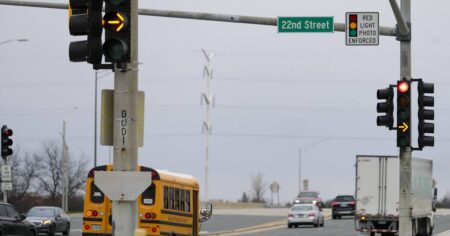
Tony Ragucci, a former cop and longtime mayor of Oakbrook Terrace, pleaded not guilty Thursday to federal charges stemming from a sprawling bribery investigation involving red-light cameras.Ragucci, 66, was charged in a criminal information made public earlier this week with one count each of honest services wire fraud and filing a false tax return. He faces up to 20 years in prison if convicted, but sources have said he is cooperating with investigators and expected to plead guilty at a later date.AdvertisementA longtime police officer who was elected mayor of Oakbrook Terrace in 2009, Ragucci is the latest suburban politician to be indicted on charges he accepted cash to allow red-light cameras into his town. He resigned from office more than two years ago amid revelations of the federal investigation.Among those charged so far in the same overall probe are former state Sen. Martin Sandoval; former Crestwood Mayor Louis Presta; John O’Sullivan, the former Worth Township supervisor and state lawmaker; and political operative Patrick Doherty.AdvertisementSources told the Tribune that new charges against others in the investigation were expected soon.Ragucci’s arraignment before U.S. Magistrate Judge Jeffrey Gilbert was held by telephone due to ongoing COVID-19 protocols at the Dirksen U.S. Courthouse.Ragucci spoke only briefly to acknowledge that he understood the proceedings and the conditions of his release on a recognizance bond. His not guilty plea was entered by his attorney, Michael D. Krejci.Prosecutors accused Ragucci of accepting thousand of dollars after the state in 2017 let his suburb put red-light cameras at a busy, but arguably safe corner outside a west suburban mall.According to federal prosecutors, the year before the cameras became operational, Ragucci was paid off as part of a scheme in which the red-light camera firm paid a 14% commission on revenue generated on the cameras to another firm it had hired as a “sales consultant” to get village business. That consulting firm’s officials then paid a portion of the commission to Ragucci, first $3,500 a month, then an amount based on how much cash the cameras generated, prosecutors alleged.The then-mayor also directly accepted $12,500 cash from an official of the red-light camera firm as contracts were renewed, unaware that the official was secretly working with federal investigators on a wide-ranging corruption probe, prosecutors alleged.The alleged payments were being made at a time the Tribune was investigating how Ragucci and red-light camera firm SafeSpeed were able to get cameras installed at the busy but relatively safe intersection of Illinois Route 83 at 22nd Street, a corner shared by Oakbrook Terrace and neighbor Oak Brook.[READ MORE] Following ex-Oakbrook Terrace Mayor Anthony Ragucci’s indictment, activists call for end of red-light camera program »AdvertisementOak Brook officials fought the cameras, saying the corner didn’t need them, and the Illinois Department of Transportation had the final call because the cameras would be put on a state route. IDOT had previously deemed the corner too safe for cameras, then there were even fewer crashes, yet somehow IDOT reversed course to allow the cameras.That reversal came after Sandoval, the then-powerful head of the Senate Transportation Committee, intervened on SafeSpeed’s behalf, as did another state senator, Tom Cullerton.Sandoval, who died of COVID-19 in December 2020, admitted to accepting bribes from the SafeSpeed official, Omar Maani, who at the time was secretly working with federal investigators. Cullerton later admitted to taking part in an unrelated ghost payroll scheme and awaits sentencing.The charges against Ragucci came the same month that federal prosecutors pushed for a two-year sentence for Presta, the former Crestwood mayor, who admitted to taking a cash-stuffed envelope from Maani in exchange for Presta’s support of lucrative SafeSpeed cameras there.SafeSpeed and its CEO, Nikki Zollar, have denied any wrongdoing, saying that any bribes offered by Maani occurred without the company’s knowledge.In a statement released after Ragucci’s arraignment Thursday, SafeSpeed said the company “remains both shocked and saddened that one of its former colleagues was engaged in criminal conduct and recruited outside individuals to help further his self-serving activities.”Advertisement“Their actions were clearly in their own self-interest and done without SafeSpeed’s knowledge and undercut the important work SafeSpeed does,” the emailed statement read. “The criminal activity of a few individuals does not and should not reflect the values and integrity of SafeSpeed, its employees, and its clients.”jmeisner@chicagotribune.com
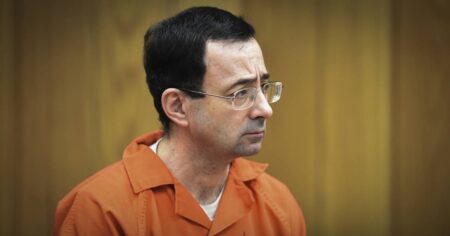
DETROIT — Thirteen sexual assault victims of Larry Nassar are seeking $10 million each from the FBI, claiming a bungled investigation by agents led to more abuse by the sports doctor, lawyers said Thursday.It’s an effort to make the government responsible for assaults that occurred after July 2015. The Justice Department’s inspector general concluded last year that the FBI made fundamental errors when it became aware of allegations against Nassar that year.AdvertisementNassar was a Michigan State University sports doctor as well as a doctor at USA Gymnastics. He is serving decades in prison for assaulting female athletes, including medal-winning Olympic gymnasts.“This was not a case involving fake 20 dollar bills or tax cheats,” attorney Jamie White said. “These were allegations of a serial rapist who was known to the FBI as the Olympic U.S. doctor with unfettered access to young women.”AdvertisementNassar, he added, continued a “reign of terror for 17 unnecessary months.”An email seeking comment was sent to the FBI.White is not suing the FBI yet. Under federal law, tort claims must be a filed with a government agency, which then has six months to reply. A lawsuit could follow, depending on the FBI’s response.“No one should have been assaulted after the summer of 2015 because the FBI should have done its job,” said Grace French, founder of a group called The Army of Survivors. “To know that the FBI could have helped to avoid this trauma disgusts me.”White noted the 2018 massacre at Florida’s Marjory Stoneman Douglas High School. The FBI received a tip about five weeks before 17 people were killed at the school, but the tip was never forwarded to the FBI’s South Florida office. The government agreed to pay $127.5 million to families of those killed or injured.In the Nassar case, Indianapolis-based USA Gymnastics told local FBI agents in 2015 that three gymnasts said they were assaulted by Nassar. But the FBI did not open a formal investigation or inform federal or state authorities in Michigan, according to the inspector general’s report.Los Angeles FBI agents in 2016 began a sexual tourism investigation against Nassar and interviewed several victims but also didn’t alert Michigan authorities, the inspector general said.White said more than 100 women were assaulted after July 2015, and he expects other lawyers will file claims against the FBI. Nassar wasn’t arrested until November 2016 during an investigation by Michigan State University police.AdvertisementFBI Director Christopher Wray has said he’s “deeply and profoundly sorry” for delays in Nassar’s prosecution and the pain it caused.The Michigan attorney general’s office ultimately handled the assault charges, while federal prosecutors in Grand Rapids, Michigan, filed a child pornography case against Nassar.Michigan State University agreed to pay $500 million to more than 300 women and girls who were assaulted. USA Gymnastics and the U.S. Olympic and Paralympic Committee made a $380 million settlement.
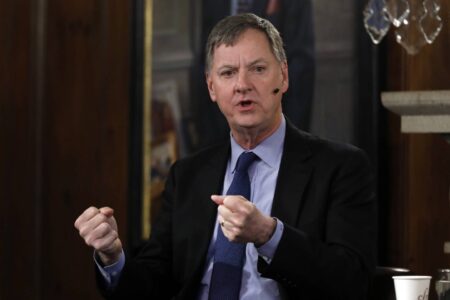
Charles Evans will retire early next year after 15 years as president of the Federal Reserve Bank of Chicago, a tenure that made him the longest-serving current regional Fed president, the bank announced Thursday.Among Fed officials, Evans has been a vocal supporter of lower interest rates. His departure comes as the Fed is wrestling with how quickly and how high to boost its benchmark short-term rate in its fight against inflation, which is at its worst level in four decades.AdvertisementRegional Fed presidents like Evans take part in the central bank’s eight policymaking meetings each year. But every year, on a rotating basis, just four of the 12 regional bank presidents have a vote on the central bank’s interest rate decisions. The Chicago Fed president will have a vote next year.Charles Evans, President and CEO of the Federal Reserve Bank of Chicago, speaks at the Council on Foreign Relations, in New York, Wednesday, Nov. 6, 2019. Evans, president of the Federal Reserve Bank of Chicago, said Thursday, April 21, 2022, that he will retire early next year, after 15 years in the position that has left him the longest-serving regional bank president. (Richard Drew/AP)In a statement, the Chicago Fed described Evans as a “strong supporter” of improving the central bank’s communication with the public. It also noted that he helped develop the Fed’s so-called “dot plot,” which four times a year anonymously displays each Fed official’s preferred path for interest rates in the coming years.AdvertisementThe Chicago Fed said it has formed a search committee for Evans’ replacement, led by Helene Gayle, CEO of the Chicago Community Trust, a nonprofit group, and David Habiger, CEO of JD Power, an auto review website.Evans’ departure is unlikely to lead to any significant shift in the Fed’s policymaking, said Michael Pugliese, an economist at Wells Fargo.“I would not anticipate us making any major changes to our monetary policy forecast,” Pugliese said, referring to Wells Fargo’s outlook.
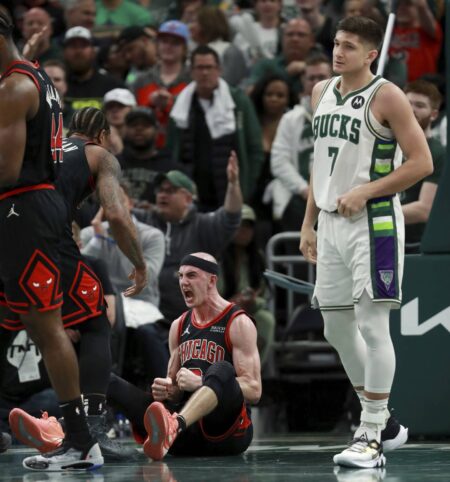
MILWAUKEE — The Chicago Bulls knew what was coming when they exited the Fiserv Forum locker room for the second half of Game 2.With a 63-49 lead in their pocket, the Bulls were more confident than they’d been in a game in weeks. But a double-digit lead only means so much when two-time MVP Giannis Antetokounmpo is staring you down from across the court.AdvertisementSo the Bulls knew what needed to happen to withstand the oncoming flurry from the Bucks — bend, but don’t break.“We talked about it at halftime, not coming out of the second half lackadaisical,” DeMar DeRozan said. “We were ready for it. We had a lot of games this year where we came out in the third quarter and laid an egg. This time around we were just trying to understand the moment.”AdvertisementBulls guard Alex Caruso celebrates beside Bucks guard Grayson Allen (7) in the second half on April 20, 2022. (Chris Sweda / Chicago Tribune)The next two quarters devolved into a dogfight between the both team’s stars. Khris Middleton sank four 3-pointers in the third quarter. Antetokounmpo leapt between Bulls players to rebound a missed free throw and jam it into the basket to cut the lead down to eight points, then smacked away DeRozan’s final shot of the quarter.In the fourth quarter, DeRozan knocked down back-to-back jumpers over Antetokounmpo’s hand. Nikola Vučević sank a pair of 3-pointers from the top of the arc. Alex Caruso stepped in front of Antetokounmpo for the final play of the game, drawing a charge to snuff out the last attempt at a tying drive.When the Bucks pulled within three points in the third, the Bulls stars grabbed each other to form a huddle on the court. The tone was urgent, but coach Billy Donovan said it held an undercurrent of self-belief: “Hey, we’re going to make a run. Now it’s time for us to respond. We’ve got to respond right now.”For the Bulls, managing the topsy-turvy nature of a playoff game has been a key learning curve in this opening series. This is an unexperienced postseason team — DeRozan, Caruso and Tristan Thompson have played and won in the postseason, but stars like Zach LaVine are unexperienced in this atmosphere.Donovan warned his players that it’s rare to hold a lead in the playoffs. That rang true in Game 2 as the Bulls repelled three Bucks’ comeback attempts that nearly swung the score.The Bucks went on a 17-6 run to close the third quarter. The Bulls countered with a 9-0 run to start the fourth. Each time the score ticked closer, the Milwaukee crowd rumbled into a pitched roar, heightening every play and jeering every mistake.Bucks forward Khris Middleton tries to make a pass as Bulls center Nikola Vucevic (9) and guard Alex Caruso (6) apply pressure in the second half on April 20, 2022. (Chris Sweda / Chicago Tribune)Chicago Tribune SportsWeekdaysA daily sports newsletter delivered to your inbox for your morning commute.“The really good teams in this league, they do that,” Donovan said. “They understand the swings in the game, they don’t get emotionally wrapped up and they’re able to focus on the next possession in front of them and just go out there and play. I think we’ve learned some of that.”At times this season, the Bulls have looked shaken, even defeated. They dug themselves into holes in first quarters and imploded in third quarters. Injuries forced young players into roles they weren’t expected to carry. The team ended the regular season with a dismal losing spell, giving up crushing losses that created a fair cloud of questions over whether this team had the legs to even get a single playoff win.Advertisement“The last four home games, that really was not us at all,” Donovan said. “It was disappointing to be playing and feel like we were better than that.”But Wednesday’s win returned the Bulls to the roots of the team that sat atop the Eastern Conference at the start of the year.Caruso noted the game plan for Game 2 wasn’t that different from Game 1. The defensive scheme stayed the same. The offense still ran through DeRozan and Vučević. The difference came from intensity, an intangible that required nonstop focus to keep the Bucks from breaking through.The win gave the Bulls a lift they’ve been needing for months. And as they return to Chicago for their first home playoff game, it’s the type of momentum they hope can swing a series.“We had a long season, we had a lot of adversity,” Caruso said. “It was almost a little bit like we were just trying to start the playoffs already. We were kind of in a hole, but we got our spirit back.”ExpandAutoplayImage 1 of 41Bulls forward DeMar DeRozan (11) walks to the bench in the final seconds of the second half of Game 1 on April 17, 2022, at Fiserv Forum in Milwaukee. (Armando L. Sanchez / Chicago Tribune)