



Federal and state officials have urged reforms at the rural facility for people with mental and developmental disabilities. But the state-run center still has more allegations of abuse and neglect than any other in Illinois.
By MOLLY PARKER
Lee Enterprises Midwest
BETH HUNDSDORFER
Capitol News Illinois
This article was produced for ProPublica’s Local Reporting Network in partnership with Capitol News Illinois and Lee Enterprises.
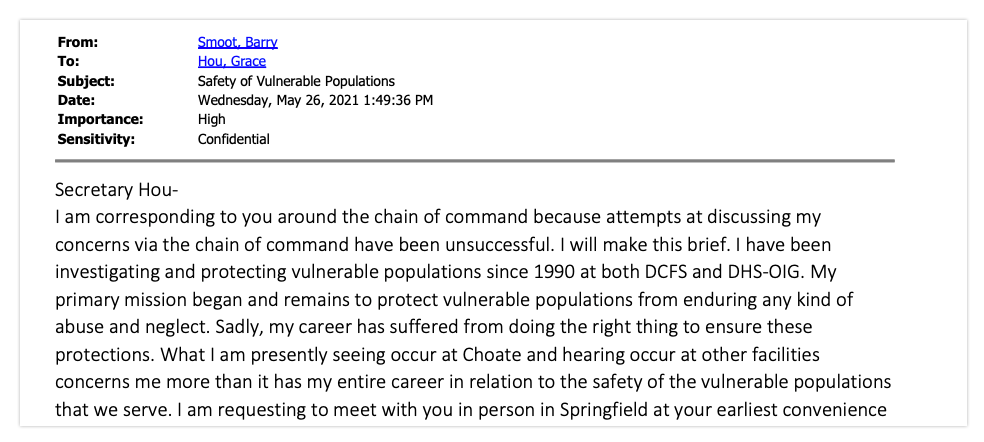
Over a year ago, the security chief at Choate Mental Health and Developmental Center in southern Illinois sent an email to the head of the state agency that operates the facility, warning her of dangerous conditions inside.
“What I am presently seeing occur at Choate and hearing occur at other facilities concerns me more than it has my entire career,” Barry Smoot, a decades-long IDHS employee, wrote to Illinois Department of Human Services Secretary Grace Hou on May 26, 2021. Among the recommendations he wanted to make: that cameras be installed inside the facility.
Hou responded that same day, agreeing to meet.
But no meeting took place. Instead, Hou suggested Smoot start by sharing his concerns with her chief of staff, Ryan Croke, and the director of the Division of Developmental Disabilities, Allison Stark, according to records of the exchange. But those meetings never happened, either. (Stark left the agency in July.)
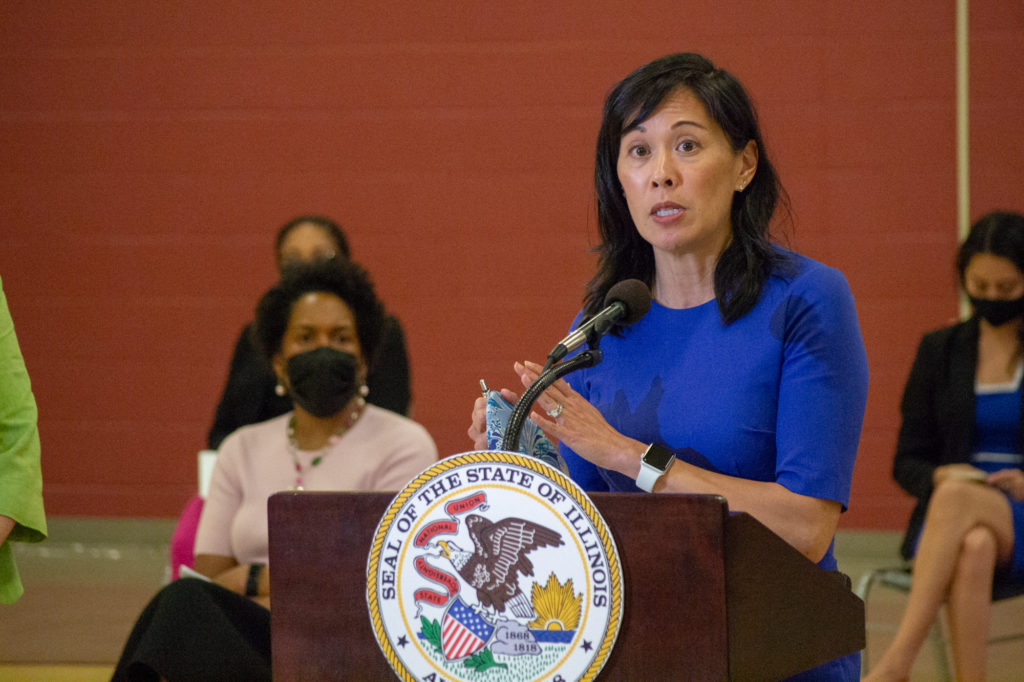
It would take more than a year, and some high-profile arrests related to abuse at the facility, before the agency unveiled a plan to address poor conditions at Choate. This June, Hou sent a letter addressed to “stakeholders” in which she publicly acknowledged safety concerns at Choate for the first time. The agency, she said, would be rolling out a series of reforms in response to “serious allegations about resident abuse and neglect” at the facility located at the edge of the small town of Anna.
The reform plan, she wrote, includes hiring four additional security officers, installing 10 surveillance cameras on the facility grounds, having staff undergo new training and increasing the presence of senior IDHS officials inside the residential units. Her letter referenced safety issues that arose “in the last year” but offered no other specifics.
At least 26 Choate employees have been arrested on felony charges over the past decade, according to reporting published today by Capitol News Illinois, Lee Enterprises and ProPublica. Of those, the local state’s attorney has filed charges against more than a dozen, including three administrators, since 2019, when Hou was appointed IDHS secretary by Gov. J.B. Pritzker. (Charges have been dropped against two of the administrators charged with official misconduct and obstruction of justice.)
Marisa Kollias, a spokesperson for the agency, said the facility is working expediently to implement these reforms, but she cautioned that it will take time to implement all aspects of the plan. Senior IDHS officials told reporters in an interview last week that the enhanced training and monitoring have been underway for months and, to date, the department has hired one of the four new security officers. The department ordered the cameras this summer, but they are on backorder and no date has been set for installation, the department officials said.
In a statement, Kollias said that the agency determined, “based on information gathered” after the secretary’s initial response to Smoot, “that it was inadvisable for IDHS management staff to communicate with him any further.” The department did not provide further details.
Camera Controversy
Smoot was not the first to raise alarms. The inspector general’s office at IDHS has repeatedly cited the facility for failing to adhere to rules regarding reporting and investigating abuse and neglect allegations.
IDHS’ inspector general recommended the installation of cameras in the course of 21 investigations into abuse and neglect allegations at Choate between fiscal years 2015 and 2021, according to a review of internal records by the news organizations. Each time, Choate officials responded to the inspector general that it was “not an option due to budget concerns.”
This summer, advocates and insiders praised Hou’s announcement that IDHS would finally install cameras.
But in response to reporters’ questions, Kollias, the agency spokesperson, clarified that the cameras would go outside the facility.
One former investigator with the inspector general’s office, when told of the plan to put cameras outside, called it “a waste of money and time.” Almost all abuse and neglect allegations stem from incidents that occur inside.
“This is all being done for show,” said former Office of the Inspector General Supervisor and Choate Unit Director Charles Bingaman, who retired from IDHS in 2013. “I predict that it will have no real impact on patient safety.”
Senior IDHS officials acknowledged to reporters in an interview last week that the inspector general had previously recommended interior cameras.
But placing cameras in interior common areas on a residential unit requires the consent of every resident who lives in that unit, or their guardian, per guidelines from the federal Centers for Medicare & Medicaid Services, which partially funds Choate. Placing them outside does not require consent.
Kollias said that officials met virtually this month with organizations led by parents of residents in IDHS’ developmental centers, including Choate, who informed the agency they do not want cameras inside the facilities.
The Office of State Guardian — which handles the personal, financial and legal affairs of people who require a guardian because they are developmentally disabled, elderly or mentally ill — represents 22 patients at Choate. An office spokesperson said the department did not object to cameras inside the facility and continues to have conversations with IDHS regarding their installation. A senior IDHS official, who spoke to reporters on condition that her name not be used, said that the installation of cameras outside Choate is a “pilot program” to try to help with the issue of residents leaving the facility without authorization and improve security on facility grounds.
A Long History of Problems
States across the nation have closed dozens of large facilities like Choate in the past 20 years, following a 1999 U.S. Supreme Court decision that ruled it is unconstitutional to segregate people with disabilities from the rest of society. But Illinois has been a holdout. It houses more people with developmental disabilities in large institutions, and spends more to operate those institutions relative to statewide personal income, than almost every other state in the nation, according to a review of data compiled by researchers with the University of Kansas.
For years, the state has also failed to intervene when serious abuse patterns are found inside its institutions. Since the late 1990s, state and federal overseers have told Choate to do more to protect and serve its residents.
In 1992, the American Civil Liberties Union sued the state of Illinois on behalf of patients, alleging that poor conditions at state-run psychiatric hospitals violated patients’ rights to safety and medical care. Five years later, a report commissioned by the ACLU found that Choate had a culture of staff intimidating and abusing patients. In one case, a patient who had a colostomy as the result of a gang rape was repeatedly punished by staff for urinary and fecal incontinence, according to the report. That same year, the parties settled the case with the state of Illinois, which agreed to enhance staffing and training.
In 2005, after two patients died from neglect at Choate, Equip for Equality, a federally designated legal advocacy organization for people with disabilities, found numerous unsafe conditions and poor treatment of residents. The advocacy group — which had been appointed by the state to monitor conditions at the facility — cited issues such as the way Choate staff used restraints to control residents, tactics that Equip for Equality called “extraordinarily excessive” and said were in violation of state and federal law. In its report, the organization called Choate’s practices “archaic.”
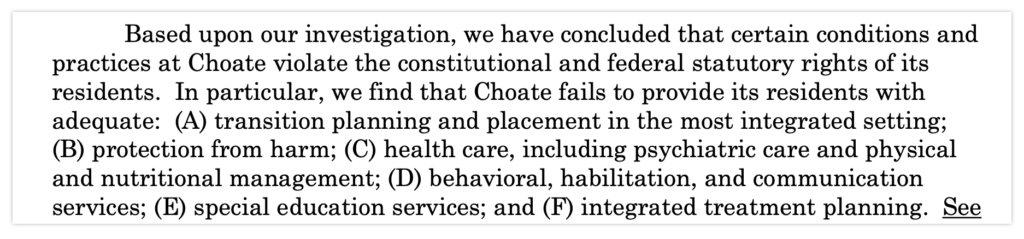
In response to Equip for Equality’s findings, the U.S. Department of Justice’s Civil Rights Division launched an investigation and warned the state in 2009 that the Choate staff’s failures to help residents successfully transfer out of the facility into community living arrangements violated the Americans with Disabilities Act. The facility had further failed to protect them from harm and provide adequate health and psychiatric care, the DOJ found.
Stacey Aschemann, a vice president with Equip for Equality, expressed disappointment that so little has changed since her organization’s and the Department of Justice’s investigations.
Equip for Equality began once again monitoring conditions inside Choate in early 2021. Those monitoring activities included stationing employees inside the facility; interviewing staff, residents and their guardians; and reviewing records.
Based on that monitoring, Aschemann said, the abuse and neglect of residents by staff continues to be a “serious concern.” Equip for Equality will continue to monitor the facility to determine whether the changes Hou announced in mid-June adequately address the safety and quality concerns raised by the organization, Aschemann said.
Smoot said leadership’s slow response to the serious issue he encountered left him deeply troubled. But it was not the first time he had sought to bring problems within IDHS to the attention of senior leadership.
Prior to his role at Choate, Smoot worked as an investigator for the IDHS inspector general, probing allegations of abuse and neglect of disabled adults who lived in their homes.
After leaving the OIG, Smoot worked security at IDHS facilities, ending his career at Choate.
Earlier this year, he self-published a book, “Failure to Protect,” outlining many of his concerns about the inspector general office’s weak oversight authority and how he felt the agency had failed the residents at state-run facilities like Choate.
In December, on the last day of his 20-year career with IDHS, he sent Hou an email to let her know that no one had followed up with him.
This time, there wasn’t a response, according to records of the email exchange obtained by reporters. Smoot said he wasn’t expecting one, but he hoped someone would heed his warning and take his advice. “Without any time left, it was a Hail Mary pass,” Smoot said in an interview.