


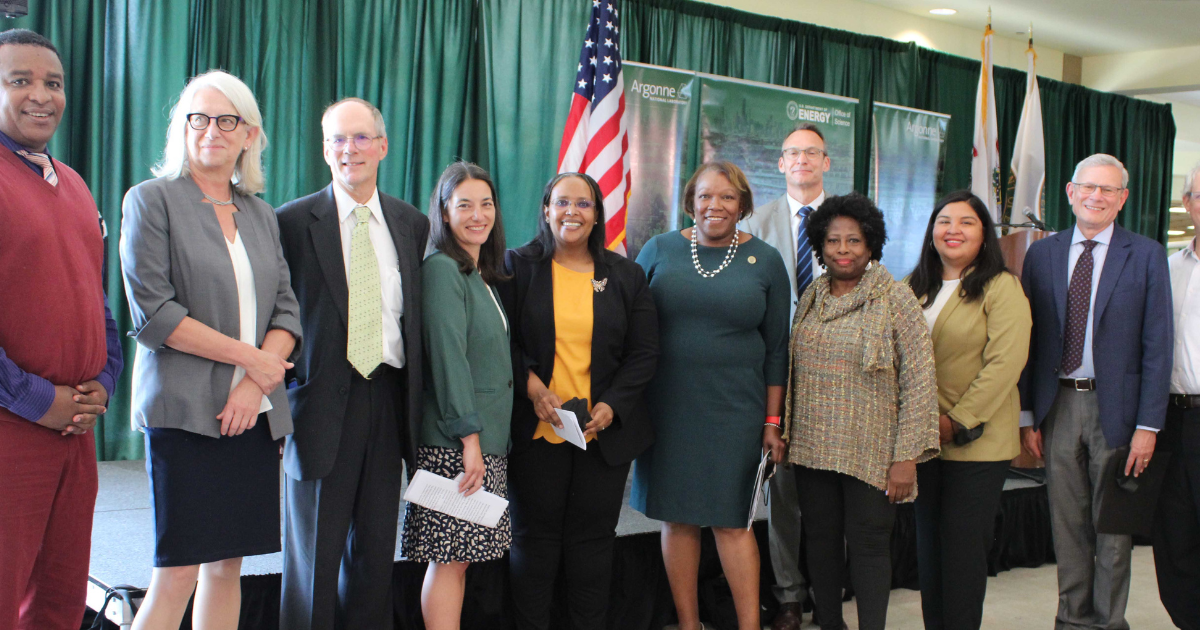
The U.S. Department of Energy (DOE) has awarded DOE’s Argonne National Laboratory and a team of academic and community leaders, including City Colleges of Chicago, $25 million over five years to advance urban climate science by studying climate change effects at local and regional scales. The results of this new research will inform communities to build resilience to future effects of climate change.
Argonne and partners will establish an Urban Integrated Field Laboratory called Community Research on Climate and Urban Science (CROCUS) focusing on the Chicago region. CROCUS will use community input to identify questions and specific areas of urban climate change to study, ensuring that research results directly benefit local residents. CROCUS researchers will also work with organizations and students to collect on-the-ground data and develop climate models.
Like other U.S. cities, Chicago is already experiencing disruption from climate change in the form of extreme weather, flooding, drought and heat waves. Unfortunately, the neighborhoods that are most at risk for climate-related disasters have historically been understudied and unable to access the resources or services they need. That’s why CROCUS has strong representation from local organizations to develop its research goals.
Researchers will measure Chicago’s temperature, precipitation, and soil conditions. They will explore how trees, open spaces, buildings, expressways and Lake Michigan are shaping the city’s climate, as well as how the Chicago area influences climate regionally. And because no two communities are alike, the study will create more detailed climate models than ever before to reveal the effects of climate change on individual neighborhoods. Instead of looking at the climate of the entire region or city as a whole, researchers will be able to predict how climate will evolve at a much smaller scale–even down to street level. This will help communities identify and vet solutions that will make their neighborhoods resilient against the effects of a changing climate.
“The Chicagoland area provides a rich environment for study and we are excited to work with such a diverse group of community, research and educational partners,” said Cristina Negri, director of Argonne’s Environmental Sciences Division and CROCUS lead. “The climate here is noticeably changing. Through CROCUS, we can all join forces to understand the underlying processes and provide science-based information. This will help local planners enact solutions leading to an equitable and effective transition to a resilient and carbon-efficient future for all communities.”
Collaboration is central to CROCUS’s work in Chicago. Argonne is partnering with local, regional and national colleges and universities who will recruit and train the next generation of climate and environmental researchers. To address the underrepresentation of people of color in this field of study, the CROCUS collaborative includes minority-serving institutions and historically Black colleges and universities. CROCUS academic partners include Chicago State University, City Colleges of Chicago, Discovery Partners Institute, North Carolina A&T State University, Northeastern Illinois University, Northwestern University, University of Chicago, University of Illinois at Chicago, University of Illinois Urbana-Champaign, University of Notre Dame, University of Wisconsin-Madison, University of Texas-Austin, and Washington University-St. Louis.
“Partnering with Argonne National Laboratory and DPI on climate change research and education is critical to the communities we serve, the ones often left out of the conversation,” said City Colleges of Chicago Chancellor, Juan Salgado. “What we do today in educating the next generations on how to combat climate change will advance urban climate science as well as help low-income communities adapt to changes. We are confident that the results of this intentional collaboration will inform our communities and help them remain resilient against climate change.”
This study focuses on climate change at the neighborhood level, so the research team includes community-based organizations on Chicago’s South and West Sides. This unique collaboration will empower community members to share their needs and concerns, ensuring that researchers deliver information critical to neighborhoods as they transition to clean energy and green infrastructure. Community partners include Blacks in Green (Woodlawn), Greater Chatham Initiative (Chatham), Puerto Rican Agenda (Humboldt Park), and Metropolitan Mayors Caucus (Chicago metropolitan area).
While Chicago is the center of this study, the new insights and lessons learned will help researchers create a blueprint to assist other cities across the country and around the world as they work to become climate change resilient.
“If we understand how climate and urban systems interact at increasingly detailed scales, we can address the challenge in a fair, equitable and sustainable way,” Negri said. “By advancing the science, we can help neighborhoods, governments and communities envision a climate-ready future. We’re all in this together.”
CROCUS is funded by the Biological and Environmental Research program in the DOE’s Office of Science. Learn more at anl.gov/crocus.