




AsChicagoans continue to grapple with the highest inflation seen since the early 1980s, a shrinking economy is raising fears that a recession is right around the corner.
Advertisement
In June, the Consumer Price Index hit 9.4% in the Chicago area. Food prices were up more than 11% and housing costs were up 8.6% compared with the same month last year
According to AAA, average gas prices in the state have fallen from about $5.31 per gallon to about $4.53 per gallon over the last month — but they’re still up from an average of $3.42 per gallon this time last year.
Advertisement
Wages and salaries have increased nationally — they were up 5.3% in June compared with last year, according to the Bureau of Labor Statistics — but they still aren’t keeping up with inflation. That means real wages are actually declining, economists said.
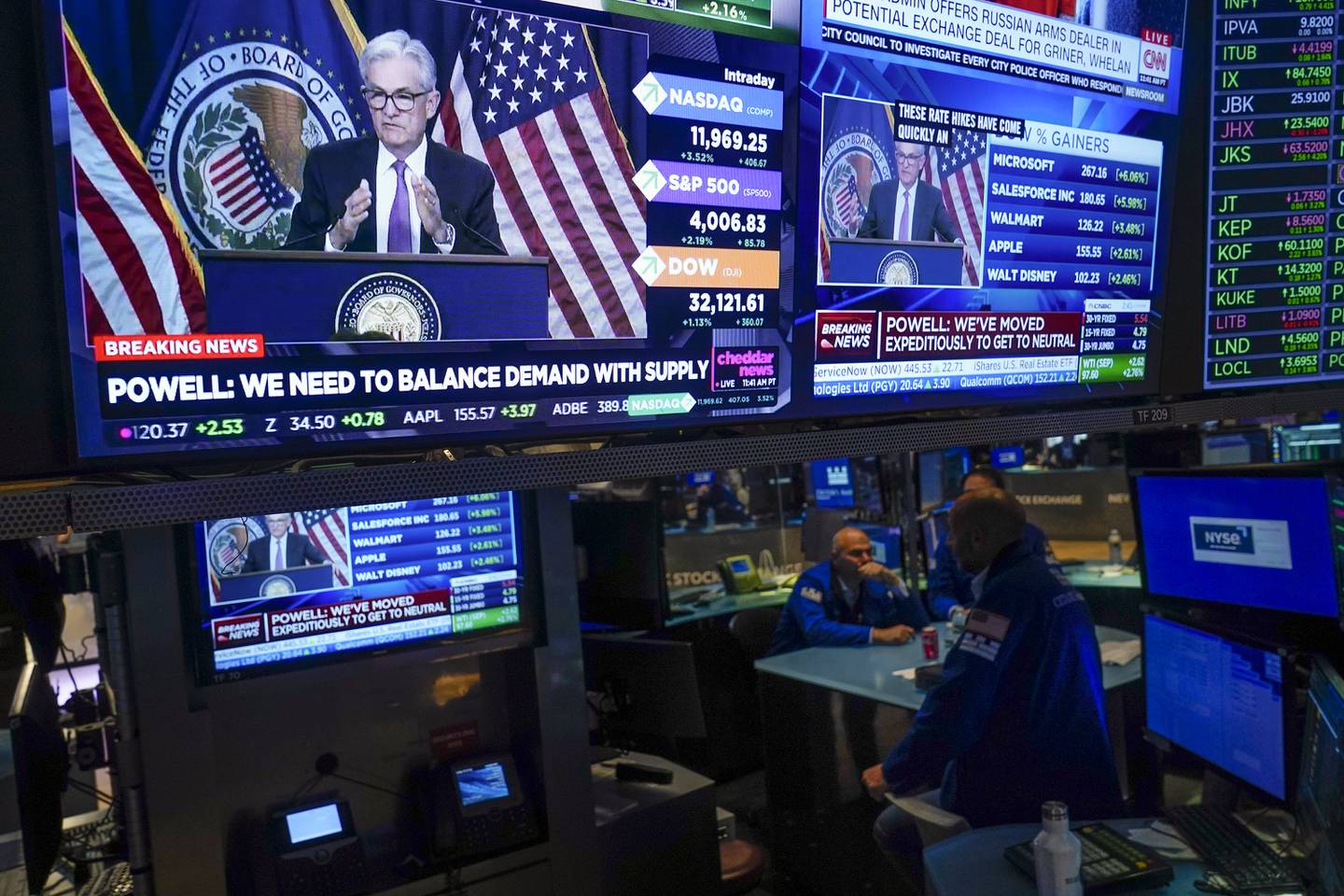
The Federal Reserve has continued to hike interest rates, most recently last week, in an effort to combat inflation, but economists say the agency is walking a tight line between slowing the economy down enough to tamp down prices without tipping it into a recession.
Here’s what you should know.
Not yet, economists told the Tribune. The gross domestic product shrunk for the second quarter in a row last week, a benchmark economists often use to determine whether the country has entered a recession. But experts also look at other economic markers such as unemployment and consumer spending, and those aren’t raising alarm bells right now.
“I think we’re quickly going into one, but we’re not there yet,” said Phillip Braun, a clinical professor of finance at Northwestern’s Kellogg School of Management.
Braun expects the country to enter a recession in the third quarter, during which he expects more negative economic growth in addition to a weakening of the job market. “I think we’re at the turning point for the job market,” he said.
Austan Goolsbee, an economics professor at the University of Chicago Booth School of Business, said he doesn’t believe the U.S. is in a recession but that it could enter one “easily” in the near future.
“If you look since World War II, there have been 14 recessions,” Goolsbee said. “And by far the most common cause of recessions is the Fed raising the interest rate faster than the economy can handle.”
Advertisement
On a Thursday earnings call, commercial real estate giant CBRE predicted a fourth quarter recession preceded by a third quarter economic slowdown.
“Our baseline for the next year is that we’ll be in a mild recession,” the firm’s chief financial and investment officer, Emma Giamartino, told investors.
Higher interest rates are the Fed’s way of trying to tamp down inflation. The agency has hiked rates four times since March, most recently raising rates 0.75% last week.
The idea is that by making it more expensive to borrow money, people will spend less, and that decrease in consumer demand will bring down prices for goods and services that have skyrocketed this year.

The danger, economists say, is that raising interest rates too aggressively and diminishing access to credit could tip the U.S. into a recession that would bring layoffs and rising unemployment.
“You do need to be mindful that you could go further than the economy can handle and mess up the soft landing,” Goolsbee said. “If you’re raising the rates as fast as they have been raising, there’s a high danger that you can’t make the soft landing.”
Advertisement
The Fed is hoping to curb inflation by slowing demand. But it doesn’t have tools to affect supply.
“You can also have higher prices because of shortages or lack of supply,” said Peter Bernstein, chief economist at RCF Economic & Financial Consulting in Chicago and an economics instructor at DePaul’s Driehaus College of Business “Higher interest rates are not going to do much to solve the supply side of the market.”
Food prices, Bernstein noted, have been affected by the halt of grain exports from Ukraine, which only just resumed Monday.
“That’s not going to be solved by raising interest rates,” Bernstein said. “That’s going to be solved by some sort of either resolution of the circumstance in Ukraine or just some gradual adjustments that take place in other producers of grain.”
U.S. wheat prices are still high, though the global price of wheat has gone down, Braun said. The rise in U.S. prices could be partially explained by the war in Ukraine causing increased demand for U.S. wheat globally, though other factors are likely involved as well, he said.
Braun said interest rate increases are unlikely to make a mark on inflation until early-to-mid 2023.
Advertisement
The abundance of job openings at this stage of the pandemic has given workers leverage to choose better, higher-paying jobs and put pressure on employers to court them. A recession would tip the balance of power from employees back to their bosses, experts said.
“There’s no question they will lose that leverage,” said Robert Bruno, director of the labor studies program at the University of Illinois.
In a recession, upward wage pressure will disappear, and jobs will be harder to come by, Braun said.
The construction and manufacturing industries may be among the first to feel the effects, he said. Home sales have declined 21% from January through June, according to data from the National Association of Realtors.
Layoffs in the housing and lending sectors have already begun. Among those reporting job cuts in recent months are the online mortgage company loanDepot, online real estate broker Redfin, Compass and Rosemont-based Interfirst Mortgage Co.
The nation’s largest bank by assets, JPMorgan Chase, laid off hundreds from its mortgage unit and reassigned hundreds of others.
Advertisement
Many employers have upped wages during the pandemic, particularly in the restaurant, retail and travel industries. Some big employers raised wages to $15 an hour and higher, despite the federal minimum wage sitting at $7.25.
According to the Bureau of Labor Statistics, about a quarter of U.S. private-sector businesses increased pay or paid employees bonuses because of the pandemic. In the accommodation and food services industries, that proportion was more than 45%.
Advertisement
Bruno worries the Fed’s approach will hurt workers who were only just starting to see net pay increases for the first time in four decades.
Legislative solutions focused around bringing in high quality jobs and increasing productivity are needed to meet high demand for goods and services rather than suppress it, he said.
“This is something that elected leaders in Springfield need to role up their sleeves and address,” Bruno said.
Illinois’s seasonally adjusted unemployment rate was 4.5% in June, and the Chicago metro area’s was a slightly lower 4.3%, according to the Illinois Department of Employment Security.
Those are healthy numbers, economists said, and both are the lowest they’ve been since March 2020. For comparison, the unemployment rate in the Chicago area was 6.9% last June, and the state’s was 6.5%.
Still, Illinois was tied for the fifth-highest unemployment rate in the U.S. in June, according to the Bureau of Labor Statistics. The national unemployment rate held steady at 3.6%.
Advertisement
Goolsbee said a number of factors can affect a state’s unemployment rate, including the age of its population and what its major industries are. In agricultural and rural states, he said, people tend to leave if they can’t find a job, keeping the unemployment level in those states low.
“Illinois is a state with a lot of urban and suburban population. I think it’s the case that even if you go back before COVID and before this business cycle, average unemployment in Illinois was probably higher than in Iowa or Indiana,” Goolsbee said.
Braun said the 4.5% unemployment rate was about average for what Illinois has seen since the 1980s.
The leisure and hospitality industries, which are critical in Chicago, were hit particularly hard during the pandemic, Bernstein said. Those jobs are coming back, but they haven’t fully recovered, he said.
Leisure and hospitality was the industry with the largest month-over-month job growth in June, with an increase of 9,900 jobs, according to IDES.
Other big Illinois industries, such as airlines, logistics and manufacturing, were also hit hard by the pandemic, Goolsbee said.
Advertisement
“We’re not fully out of the woods on these things, and I think that Illinois has suffered from some of that,” he said.
The Associated Press contributed.


