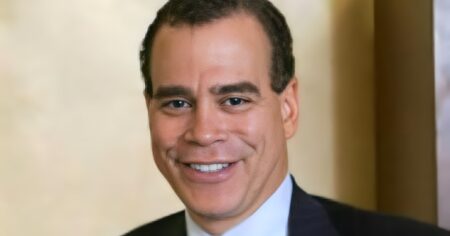



“It’s an invitation,” says Aaron Hughes, cocurator of “Remaking the Exceptional: Tea, Torture, and Reparations,” an exhibition currently on display at the DePaul Art Museum. Marking the 20th anniversary of the opening of the Guantánamo Bay detention camp, the exhibit examines the similarities between survivors of torture at the U.S. military prison with survivors of police torture here in Chicago.
The installations, paintings, and sculptures are an invitation, as Hughes puts it, “To be with the work. To be with the research. To be with the questions. That invitation that we have been continuously invited into by survivors, by those most impacted. All our work is part of sharing that invitation.”
And it’s strange: while one might expect a show about police torture, U.S. imperialism, and violence to be cold and hard to look at, the two-floor exhibition is indeed inviting. I have visited it three times so far, moving quietly through the rooms, looking at walls emblazoned with the names of police torture survivors, gazing up at pastel drawings of flowers pressed neatly into the corner of one room.
It is not easy to sit here with the stories of brutality inflicted upon these survivors, but something continues to beckon me back. The work, the stories, even the quiet hum of survivor interviews piped through an installation on the first floor seems like an opening, a gesture to sit and stay awhile. Each time I exited the doors of the DePaul Art Museum, I found myself promising myself that I’d be back.
The exhibition is the outgrowth of a ten-year collaborative partnership between Hughes and cocreator Amber Ginsburg. Together, Hughes and Ginsburg created the Tea Project, a performance and installation partially inspired by the words of one Guantánamo survivor who, in the epilogue of his book, said he would like to have tea with all of the people he wrote about. Thinking of a cup of tea as a site of connection with the possibility to transcend cultural and national divides, Ginsburg tells me, “We really started as within the anti-war movement, driven through Aaron’s experience of being a veteran and that being, in his words, a radicalizing experience.”
“Remaking the Exceptional: Tea, Torture, and Reparations | Chicago to Guantánamo”
Through 8/7: Wed-Thu 11 AM-7 PM, Fri-Sun 11 AM-5 PM, closed Mon-Tue; DePaul Art Museum, 935 W. Fullerton, 773-325-7506, artmuseum.depaul.edu. Artists Dorothy Burge and Vincent Wade Robinson are in residency and working in the museum’s event space during open hours through June 29; upcoming public events at the museum include a release party and poetry reading for the exhibition’s catalog on Thursday July 14. Go to resources.depaul.edu for more information.
Bringing together Hughes’s military background with her everyday experiences as “a citizen in America during an ongoing war,” Ginsburg and Hughes began to look “for moments of beauty.” But this was not simply an aesthetic practice of beautification, but rather one of deep, committed research and community building. It was in this process of seeing the “many instances of creative making along the way,” that Ginsburg and Hughes came to the idea of an exhibit that highlighted the devastating, intricate connections between the U.S. military practices of torture with domestic ones, as seen through police torture here in Chicago.
As they talk, Ginsburg and Hughes reference “creative acts of resistance to state violence.” I ask them to clarify—what do they mean by that? So often one of the critiques lobbed at artists, makers of all genres, is that their art does little to materially affect the outcomes of harm. Hughes explains, “We use that term to describe a spectrum of creative acts. [For example,] the gesture of making a mark on a Styrofoam cup in complete isolation and that mark being seen as a threat to a massive prison, and yet people continue to make those marks and make flowers and poetry, it’s creativity despite.”


Hughes’s comment draws attention to the fact that, as of 2017, survivor-made art from Guantánamo is no longer allowed outside of the prison. He tells me that he believes this is because the art was considered “a threat to the logic of that system of incarceration and confinement and torture.” To further illustrate this point are two empty frames on the second floor of the exhibition, where paintings by Sabri al-Qurashi were intended to hang. The artwork’s inability to make it to the DePaul Art Museum, despite the organizers’ best efforts, is proof “that people that survive Guantánamo and survive police torture here in Chicago and survive the carceral system here in Illinois: many of them still live in a state of being un-free. And, you know, our work is connecting the dots so we can seek liberation together. And art is a way to imagine that,” says Hughes.
Ginsburg draws my attention to another subject the exhibition explores: legal advocacy. She remarks, “The one other area that I would add that has been very inspiring to us is also the kind of legal advocacy as a creative legal resistance. Really emulating that in the exhibition are the two reparations banners looking across at each other.” Here, Ginsburg is referring to two floor-to-ceiling banners on the second floor positioned on opposite walls titled Speculative Reparations Ordinance for Guantánamo Torture Survivors and Speculative Reparations Ordinance for Chicago (Burge) Police Torture Survivors. Constructed in 2012 by attorney and organizer Joey Mogul, the banners draw a speculative legal framework of reparations for torture survivors. In 2015, Speculative Reparations Ordinance for Chicago was animated through the actual approval of a reparations ordinance in the Chicago City Council. This piece of art, like so many others in the exhibit, has real-life ramifications.
Nothing illustrates this to me more, though, than what happened the last time I visited the exhibition. Through an open door I saw Dorothy Burge, one of the artists featured in the exhibit, smoothing squares of blue fabric on a table. Burge is a quilter and an activist, and her quilted portraits hang from the ceiling of each room, hovering over quotes from torture survivors painted on the walls. Though I was feeling shy, I entered and introduced myself to Miss Dorothy, who immediately invited me to an online workshop she was scheduled to lead: guiding participants through the process of making quilt squares emblazoned with positive messages for torture survivors. Behind her stood Vincent Wade Robinson, a police torture survivor himself, who along with Burge is an artist-in-residence at the museum this month.
Miss Dorothy led me back through the exhibit I just pored over, and showed me photographs of her grandnieces and nephews who are the subjects of some of her quilts. She showed me a photograph of a survivor of Guantánamo standing in a wrecked building and told me how much the photo reminded her of the wreckage of Cabrini-Green when it was demolished. She pointed to the purple and green portraits she’s made of incarcerated people and told me that two of the subjects have since been freed. As we parted ways at the entrance, she again invited me to attend her workshop. I am reminded of Aaron Hughes’s words: that the show is an invitation. The invitation seems beautiful, difficult, and urgent. Most of all, I realize that it is alive and breathing, a hand outstretched for me to come back, sip (metaphorical) tea, and listen.