

Close Menu
  • Home
  • News
    • Local
  • Opinion
  • Business
  • Health
  • Education
  • Sports
  • Podcast

Subscribe to Updates

Get the latest creative news from FooBar about art, design and business.

What's Hot

More than a Mission: Paying It Forward for the Future of Education

AFL-CIO Remembers Legendary Civil Rights Leader, the Rev. Jesse Jackson

IN MEMORIAM: Eternal Salute to The Reverend Dr. Jesse L. Jackson, Sr.

Facebook X (Twitter) Instagram
  • Lifestyle
  • Podcast
  • Contact Us
Facebook X (Twitter) Instagram Pinterest Vimeo
The Windy City Word
  • Home
  • News
    1. Local
    2. View All

    Uncle Remus Says Similar Restaurant Name Is Diluting Its Brand and Misleading Customers

    Youth curfew vote stalled in Chicago City Council’s public safety committee

    Organizers, CBA Coalition pushback on proposed luxury hotel near Obama Presidential Center

    New petition calls for state oversight and new leadership at Roseland Community Hospital

    Food Pyramid Blind Spots: What Supermarket Civil Rights Teaches Us 

    NBA: Hawks’ CJ McCollum made it work during a “storm”

    Birmingham-Partnered Warming Station Will Open Sunday and Monday Nights

    Skater Emmanuel Savary Sharpens Routines for the 2026 U.S. Championships

  • Opinion

    Capitalize on Slower Car Dealership Sales in 2025

    The High Cost Of Wealth Worship

    What Every Black Child Needs in the World

    Changing the Game: Westside Mom Shares Bally’s Job Experience with Son

    The Subtle Signs of Emotional Abuse: 10 Common Patterns

  • Business

    Illinois Department of Innovation & Technology supplier diversity office to host procurement webinar for vendors

    Crusader Publisher host Ukrainian Tech Businessmen eyeing Gary investment

    Sims applauds $220,000 in local Back to Business grants

    New Hire360 partnership to support diversity in local trades

    Taking your small business to the next level

  • Health

    Food Pyramid Blind Spots: What Supermarket Civil Rights Teaches Us 

    Birmingham-Partnered Warming Station Will Open Sunday and Monday Nights

    Empowering Black Parenting: Tips and Insights That Matter

    Why Tracking Racial Disparities in Special Education Still Matters 

    Dying From a Name: Racism, Resentment, and Politics in Health Care Are Even More Unaffordable

  • Education

    Cuts to Childcare Grants Leave Rural Students in Limbo

    Why Black Parents Should Consider Montessori

    Black Educators, Others Reimagine Future of Education

    OP-ED: Economic Empowerment Has Always Been a Part of Black History

    “What About People Like Me?” Teaching Preschoolers About Segregation and “Peace Heroes”

  • Sports

    NBA: Hawks’ CJ McCollum made it work during a “storm”

    Skater Emmanuel Savary Sharpens Routines for the 2026 U.S. Championships

    NFL Divisional Round: The Schedule is Set

    NFL Divisional Round: The Schedule is Set

    A Jacksonville journalist brings humanity to an NFL Press Conference

  • Podcast
The Windy City Word
Local

A quantum leap forward: U. of C. gets $150 million from Google, IBM to build world’s most powerful supercomputer

staffBy staffUpdated:No Comments3 Mins Read
Facebook Twitter Pinterest Telegram LinkedIn Tumblr Email Reddit
Share
Facebook Twitter LinkedIn Pinterest WhatsApp Email

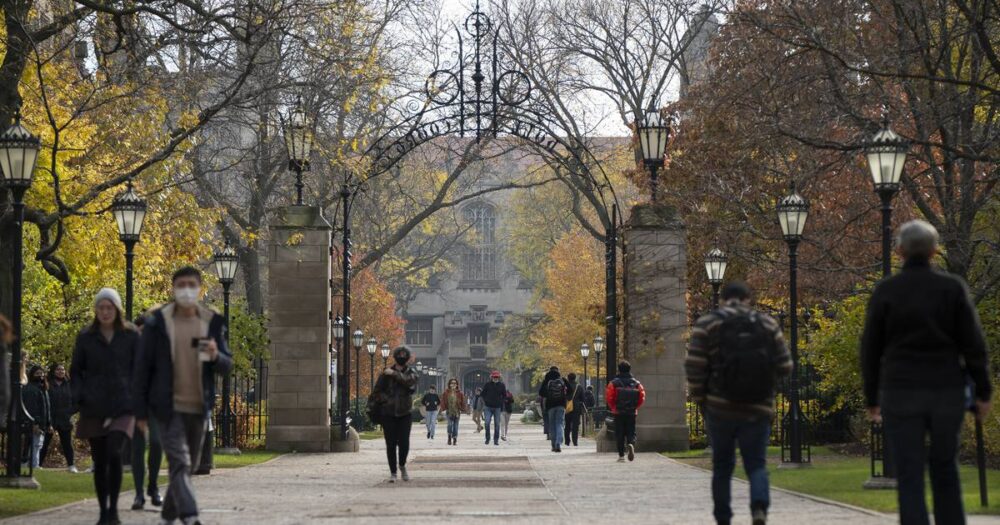
The University of Chicago’s computing ambitions took a quantum leap forward Sunday with a commitment of $150 million in funding from IBM and Google to build the world’s most powerful computer.

The partnership with the University of Tokyo, announced at the G7 summit in Japan, will seek to create the first quantum supercomputer, building up the technology over the next decade to a processing power that would dwarf any computer in current usage.

Advertisement

The funding will also support research and training needed to operate the supercomputer.

“It would solve problems that current supercomputers can’t solve,” said Fred Chong, a computer science professor at University of Chicago. “Things like developing new materials or fertilizers or drug discovery, certain kinds of computations that are just too complex for the machines that we have now.”

Advertisement

The agreement to develop the quantum computer technology was engineered by former Chicago Mayor Rahm Emanuel, now serving as U.S. Ambassador to Japan, who was part of the signing ceremony Sunday with top leaders from IBM, Google and the two universities.

IBM will invest $100 million over 10 years to develop the supercomputer, while Google is committing up to $50 million to support quantum computing research and workforce training. The ultimate goal is to build a computer powered by 100,000 qubits — the basic unit of information in quantum computing.

The most powerful quantum computing chip today is a 433-qubit processor unveiled by IBM in November. A qubit is capable of faster and far more complex computations than a classic binary chip.

“Building a quantum computer is an ambitious undertaking that requires partnership,” Hartmut Neven, vice president of Google Quantum AI, said in a news release.

An emerging field, quantum technology operates at the subatomic level, building devices that detect, harness and leverage the tiniest particles to make potentially enormous advances in a wide range of applications. The University of Chicago has been at the forefront of the technology, helping the region become a leading global hub for quantum development and research.

Building the world’s first quantum supercomputer would be a “significant” boost, Chong said. The biggest challenge, he said, is the lack of a blueprint for making one.

“We wouldn’t be able to build it with today’s technology,” Chong said. “It uses too many resources, actually, which is why we’re creating this effort.”

For example, quantum computers need to operate at a temperature close to absolute zero. Like some massive 1960s-era UNIVAC computer, the quantum supercomputer would be “too large” without advancements in technology, requiring hundreds of refrigerators just to keep its cool while calculating, Chong said.

Advertisement

Both universities will develop prototypes over the next decade, hopefully progressing up to 1,000, 10,000 and ultimately 100,000 qubits of processing power, Chong said.

Once built, the quantum supercomputer would be exponentially more powerful than any classical computer. While the possibilities are endless, Chong said he has one application at the top of his supercomputer to-do list: fertilizer.

“A good one that has been proposed is to understand nitrogen fixation,” Chong said. “Essentially creating fertilizers using the least energy possible, with less energy producing food more efficiently.”


rchannick@chicagotribune.com

Share. Facebook Twitter Pinterest LinkedIn Reddit WhatsApp Telegram Email
Previous Article17-year-old girl shot on Lake Shore Drive in Lincoln Park, police say
Next Article Coalition Urges Lawmakers to Go Back to Drawing Board for School Board Map
staff

Related Posts

Uncle Remus Says Similar Restaurant Name Is Diluting Its Brand and Misleading Customers

Youth curfew vote stalled in Chicago City Council’s public safety committee

Organizers, CBA Coalition pushback on proposed luxury hotel near Obama Presidential Center

Leave A Reply Cancel Reply

Video of the Week
https://www.youtube.com/watch?v=AxFXtgzTu4U
Advertisement
Video of the Week
https://www.youtube.com/watch?v=OjfvYnUXHuI
ABOUT US


The Windy City Word is a weekly newspaper that projects a positive image of the community it serves. It reflects life on the Greater West Side as seen by the people who live and work here.

OUR PICKS

Interior 2024 Chrysler Pacifica Hybrid Pinnacle PHEV 360 Video

HEADLINES

Unveiling the Bold Design of the #Tucson: A Closer Look

MOST POPULAR

Food Pyramid Blind Spots: What Supermarket Civil Rights Teaches Us 

Birmingham-Partnered Warming Station Will Open Sunday and Monday Nights

Empowering Black Parenting: Tips and Insights That Matter

© 2026 The Windy City Word. Site Designed by No Regret Medai.
  • Home
  • Lifestyle
  • Podcast
  • Contact Us

Type above and press Enter to search. Press Esc to cancel.