



By TotallyRandie
The fourth quarter of the year is often dubbed “giving season,” and for good reason. As October fades into November, the cultural zeitgeist shifts toward gratitude and the spirit of the holidays. For most, this means making a yearly donation to a local food bank or participating in a toy drive for the less fortunate. But for Houston’s own Travis Scott, “giving season” isn’t a seasonal trend—it’s a sophisticated, year-round blueprint for community empowerment.
Since launching the Cactus Jack Foundation in November 2020 alongside his sister, Jordan Webster, Scott has moved beyond the traditional celebrity check-writing model. While the world watches his every move on global stages, his foundation has been quietly and consistently pouring into the soil that raised him. Whether it’s supporting SWAC baseball athletes or funding the Waymon Webster Scholarship Fund for HBCU students, the mission is clear: provide the resources for the next generation to not just survive, but to lead.
From the Streets to the Stars
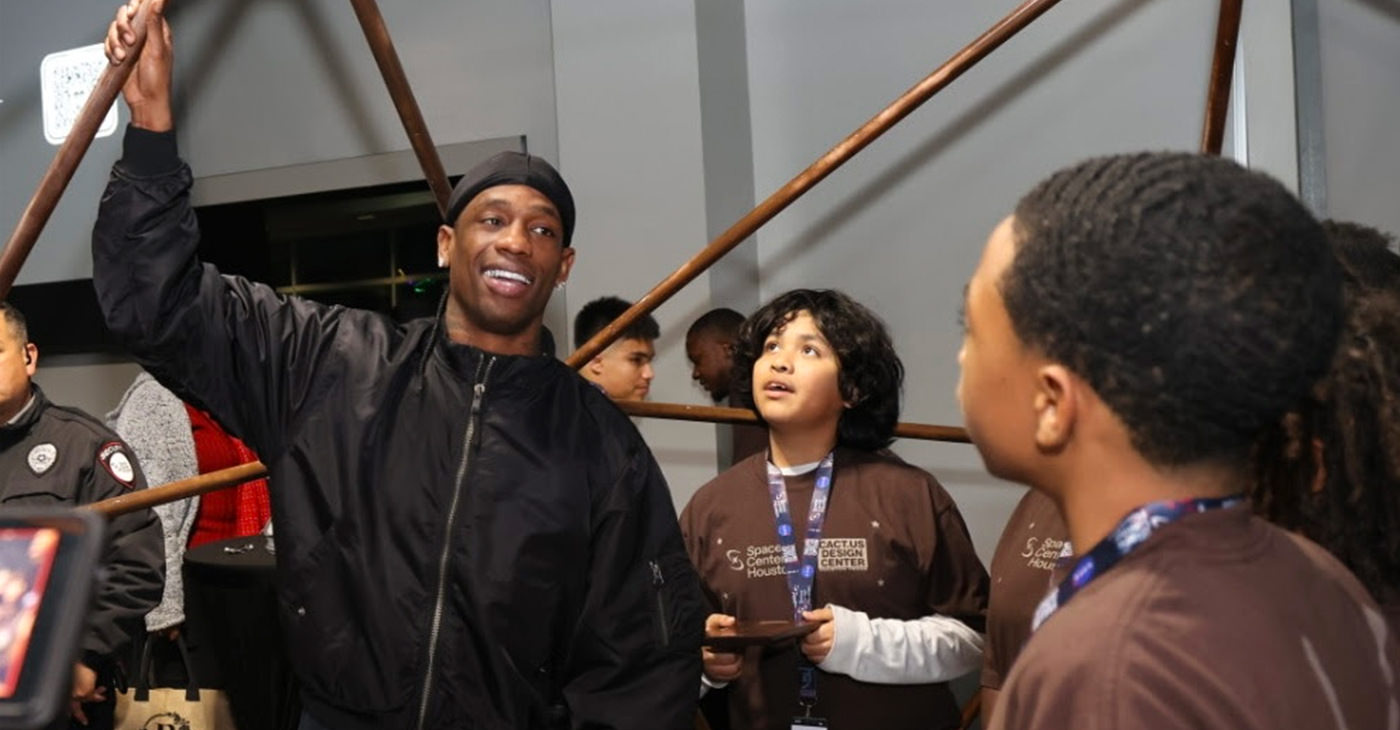
This past fall, the foundation took its most ambitious leap yet. In October 2025, Cactus Jack partnered with Space Center Houston—the official visitor center of NASA Johnson Space Center—to launch a first-of-its-kind STEM incubator.
The program was specifically designed for students within the Houston Independent School District (HISD), many of whom come from underserved communities where a career in aerospace often feels like a light-year away. For eight weeks, these middle schoolers weren’t just reading about science; they were living it.
Through a mix of virtual workshops and hands-on sessions at the Cact.Us Design Center and TXRX Labs, students were paired with actual NASA engineers. They weren’t tasked with busywork; they were challenged to solve real-world problems of space habitation, including:
- Lunar Water Filtration: Designing systems to purify water on the moon.
- Space Habitats: Creating structures designed for food preservation in extreme environments.
- Robotics: Developing rovers capable of navigating uneven lunar terrain.
The Power of Being Present
The program culminated in a private showcase at Space Center Houston this past December. Standing alongside retired NASA astronaut and Chief Science Officer Megan McArthur, Scott watched as HISD students presented high-fidelity prototypes. In that room, the disparity usually associated with these neighborhoods vanished, replaced by the technical language of CAD modeling and systems thinking.
But the work didn’t stop at the laboratory. The 6th Annual “Winter Wonderland Toy Drive” at Texas Southern University took place the very next day, showcasing the foundation’s dual-threat approach to philanthropy. While the STEM program looked toward the future, the toy drive took care of the present, putting smiles on the faces of thousands of Houston families with toys, groceries, and essential goods.
“Opportunities like this are being offered to help enrich our students’ lives and inspire them to pursue careers in fields where they can not only thrive but also bring back solutions to their communities.” — Travis Scott
More Than a Headline
Critics and social media skeptics often tweet that “Travis Scott is everywhere but Houston.” The data and the faces of the students at Space Center Houston suggest otherwise. While his music may be a global export, his legacy is being built brick by brick (and circuit by circuit) in HISD classrooms.
By bridging the gap between hip-hop culture and NASA’s high-tech corridors, the Cactus Jack Foundation is teaching us a vital lesson in giving forward. It’s not just about the gift under the tree in December; it’s about the skills, the confidence, and the “out of this world” opportunities provided in the months leading up to it.
Travis Scott may be a global icon, but in Houston, he’s becoming something much more important: a catalyst for the next generation of innovators.

Bell @TotallyRandie
Multi-Media Correspondent & Digital Creator
BlackPressUsa.Com/TotallyRandie.com /Stylemagazine.com