





The rate of violent crime on CTA trains began to drop this year for the first time since the COVID-19 pandemic emptied public transit of many riders, but it remains near the highest levels seen in the past decade — and more than twice as high as the years before the COVID-19 pandemic.
At the same time, the arrest rate for violent crimes on the “L” fell to its lowest level in at least a decade, a Tribune analysis of Chicago police data shows.
Advertisement
Chicago police and CTA officials have repeatedly announced they were adding extra officers, unarmed security guards or K-9 teams to the public transit system this year. But concerns about crime that have persisted through much of the COVID-19 pandemic, and the low arrest rate, pose continued challenges for a public transit system still looking to draw back riders and city residents who rely on it.
From January through November, there were about 6.2 violent crimes on the “L” for every million rides. That was down from a similar time period in 2021, when violent crimes reached 6.8 per million rides, but remained higher than any other year in the past decade.
Advertisement
As the violent crime rate dropped in the first 11 months of the year, nonviolent crimes, like pickpocketing, ticked up, to 6.5 per million rides from 5.9 during a similar period last year. Still, the nonviolent rate remained lower than during similar periods in 2018, 2019 and 2020, when it reached the highest rates of the past decade and topped 8 crimes per million rides.
The numbers come from a Tribune analysis of CTA ridership numbers and reports of crimes considered serious enough to report to the FBI as “index” crimes, like pickpocketing, robbery and sexual assault. Violent crimes include robberies, homicides and more aggressive assaults and batteries.
The analysis focused on crimes reported in the city of Chicago, which covers the majority of the CTA system.
Overall, the raw number of violent crimes on the CTA rail system rose in the first 11 months of 2022, compared with a similar period last year, from 489 to 591. But ridership was also up in 2022, and that ended up slightly lowering the odds of becoming the victim of a violent crime.
Concerns about crime on the “L” during the COVID-19 pandemic have mirrored concerns citywide about unrelenting gun violence and the perception of safety. And on buses, too, drivers have voiced concern about violence against operators.
On the trains, crime and arrest trends have troubled some riders, like Sam Bergman, 22. He now avoids taking the train after becoming entangled in what looked to him like a mugging that spilled over into the Red Line car he was riding in one evening at the end of October.
What seemed like a fight in the next train car burst through the emergency exit door into his car, Bergman said. One person looked clearly beaten up, and seemed to be trying to call 911. In the tumult, Bergman and his girlfriend got shoved into a corner of the car, but managed to avoid getting hit, he said.
When the train got to the next stop at Grand and State downtown, Bergman and his girlfriend left the train with the person who seemed to be the victim. They alerted a CTA employee at the station, and paramedics and police soon arrived. Bergman said he gave a description of the alleged attackers to the police, then walked the rest of the way to his Streeterville home.
Advertisement
Without a car, he now relies on buses. They can be slower and less reliable, he said, but it’s worth it to him to not have to go back into a train station.
Bergman frequently checks to see if police have made an arrest in the case. Some seven weeks later, police had not reported an arrest, crime data showed.
“Someone can do this on the trains, and even with the security guards and cameras and a decent police response time, there are no arrests made,” he said. “It just surprises me. And it doesn’t seem like there’s anything to deter this kind of crime on the trains if there aren’t arrests when it happens.”
Police are making few arrests for “L” crimes, both violent and nonviolent. The arrest rate for violent crimes dropped sharply so far this year, with police making an arrest in 14.5% of violent crimes on the train system from January through November, compared with 19% during the first 11 months of 2021. The arrest rate for nonviolent crimes remained flat at 2.1%.
In November, for example, there were 38 reports of violent crime on the CTA rail system, and — as of mid-December — police hadn’t recorded an arrest in any of them. That included reports of 30 robberies or attempted robberies, eight of them with a gun.
Arrests only help drive down crime to the extent that someone who is an active, repeat offender is arrested, and no one else steps in to commit crimes in their place, said John Eck, a professor at the University of Cincinnati who studies policing and crime prevention. If a situation makes committing a violent act easy, the person arrested will easily be replaced by another, he said.
Advertisement
If there is a clear suspect, it would make sense to arrest that person, he said. But maximizing arrests at all costs doesn’t pay off.
“That’s like saying I’m going to the store, I’m going to spend as much money as possible, I do not care what I walk home with,” he said.
The presence of extra officers and security on transit might be playing a role in reducing violent crime because their presence can be a deterrent, he said. Nonviolent crimes, like pickpocketing, are harder for officers to address because they are more hidden, so those same tactics might not work for property theft, he said.
There are also other tactics agencies like CTA can use to improve safety, like good access to communication for employees, he said.
“It seems reasonable to suggest that the presence of these officers were able to drive down violence without driving up arrests to any great extent,” he said.
Chicago police announced they were adding additional officers to the system multiple times this year. CTA also added extra unarmed, private security guards, and brought back K-9 security teams years after deciding not to use them.
Advertisement
Chicago police did not answer questions about the number of officers patrolling the CTA system or the nature of the deployments. In spring 2020, police planned to temporarily add about 50 officers to CTA trains and platforms to bring the total number of officers assigned to the system to some 200 at that time.
Police spokesman Tom Ahern said the additional officers are intended not just to enforce laws, but to be a visible presence to help deter crime. They are expected to hold roll calls and safety drills on the system, and provide safety tips to passengers, he said in a statement.
He also highlighted the strategic decision support center that opened in June 2020 to monitor video of CTA properties and analyze data and crime patterns.
CTA spokesman Brian Steele said about 300 unarmed security guards are scheduled to patrol the system each day, though the exact number fluctuates with absences. Fifty K-9 teams are also patrolling the CTA, he said. The security dog teams recently reached their full level of deployment, after recruitment and training by the contractor.
CTA also has more than 33,000 security cameras, Steele said. The Tribune in 2019 highlighted how reports of serious crime rose even after tens of thousands of the cameras were added.
Steele declined to provide specifics on where the guards and dog teams patrol, citing security, but said they are assigned to trains, platforms and stations throughout the system all day, every day, and their assignments are based on data and information gathered by working with police. There is a greater presence of unarmed guards on the busy Red and Blue lines, which operate 24 hours a day, he said.
Advertisement
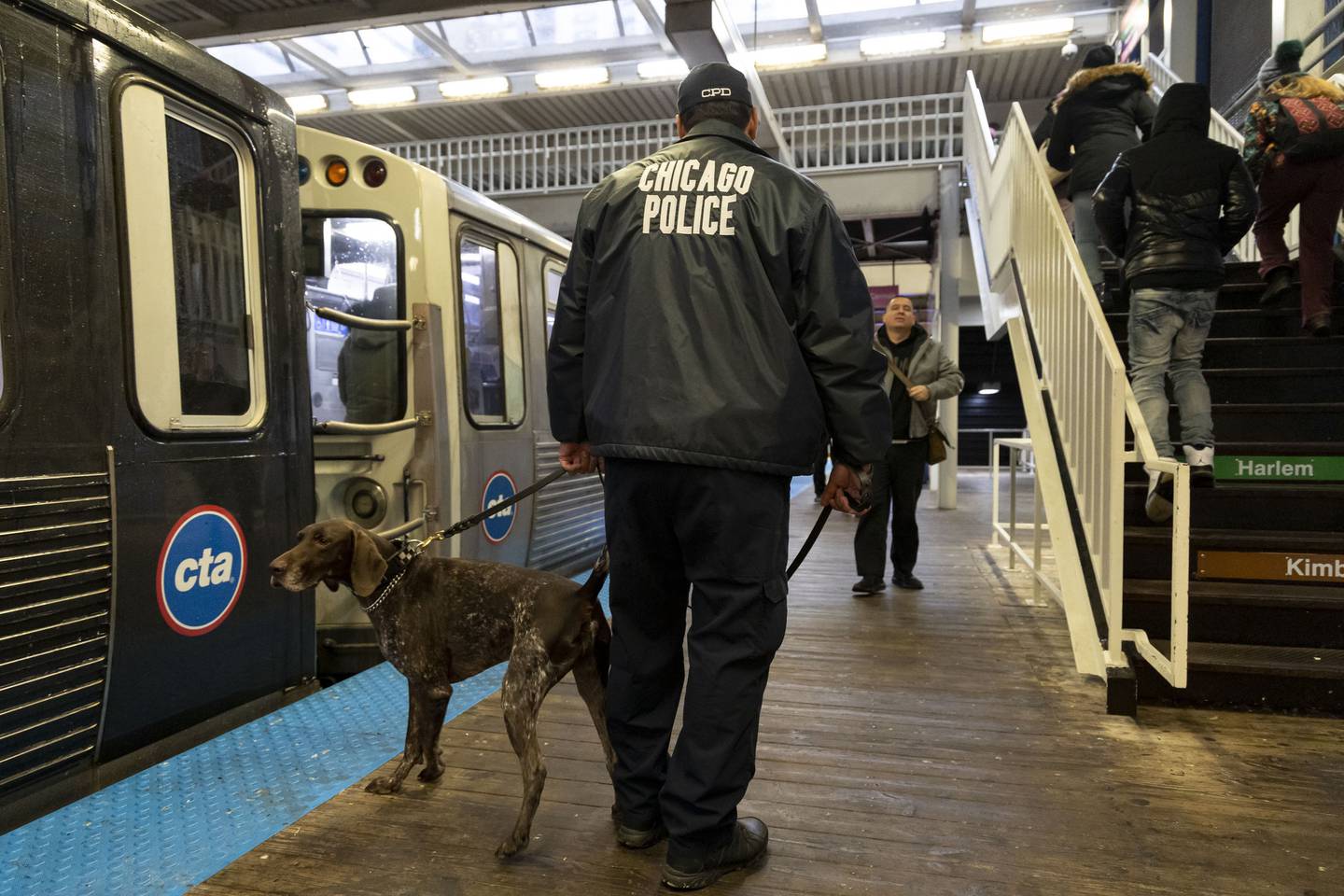
The security dog teams are mostly focused on fare enforcement, he said.
The guards and dog teams are intended to create a greater sense of security on the system, deter crime and monitor for suspicious activity or crime and report it to the police, he said. Their effectiveness “should be measured over time.”
“Though overall crime on CTA is comparatively low and in line with other major U.S. transit agencies, one crime is one too many,” Steele said in a statement. “And the CTA recognizes that a recent uptick in crime across the city — including on and near the CTA — requires a stepped up approach.”
A chaotic situation on the Red Line one weekend night over the summer led Spencer Farrell to avoid taking the train after dark.
Shortly before midnight, Farrell, 20, saw people running through emergency exit doors between cars on the crowded train. Someone called out that there was a shooter, he recalled, and passengers ran toward the back of the train.

Farrell made it to the last car on the train and searched for a spot underneath a seat. The train stopped between the Grand and Lake stations downtown, and power was cut off, he said. Passengers called 911, pulled open doors and tried to call the train operator.
Advertisement
Police eventually arrived and searched through the train cars, and passengers were allowed to file onto an emergency walkway to exit the subway tunnel, he said. Farrell took a ride-share to his South Loop home, unwilling to get on another train.
Farrell still rides the train to school and to work, but now takes ride-shares at night. The experience has made it more difficult for him to go out, he said. The sound of a train door opening makes him tense up.
“It makes the city feel more claustrophobic, in a way,” he said. “It feels like an additional barrier when I’m going out.”


