



Austin McAfee/Icon Sportswire via Getty Images
by Jabari M. Evans, University of South Carolina
For most college football coaches, the move from a mid-major conference to a Power Five conference would be met with widespread praise.
Not so for Deion Sanders.
When the Pro Football Hall of Famer announced he would be leaving Jackson State University, where he has coached the football team since 2020, to become head coach at the University of Colorado Boulder, many ardent fans and supporters reacted with dismay and disbelief – particularly his fans and supporters from the Black community.
Jackson State is one of 107 historically Black colleges and universities, or HBCUs. Some HBCU alumni and supporters saw Sanders as betraying the cause of rejuvenating HBCU sports and returning them to a time when football greats such as Jerry Rice, Walter Payton and Steve McNair attended HBCUs as a stepping stone to professional stardom.
Debates about whether he was a “sellout,” a “traitor” and a “hypocrite” quickly surfaced on social media and in major media outlets.
As a scholar who specializes in Black culture, I was struck by the ways in which this Sanders story was tied to a concept I write about called clout-chasing. It’s a process in which cultural capital is harnessed on social media to attract media attention, likes, followers and fame. You’ll often see young people looking to launch careers as content creators described as clout chasers.
Institutions, however, can also chase clout. And I saw Jackson State doing just that when it hired Deion Sanders.
Black Schools Matter
Over the past decade – after the rise of the Black Lives Matter movement, the spread of national anthem protests and the murders of George Floyd and Breonna Taylor – HBCUs have received more attention and investment as places for the revitalization and advancement of the Black community.
In 2019, Black billionaire Robert Smith promised to pay the student loan debt of that year’s entire graduating class at Morehouse College. In the summer of 2021, the Department of Education awarded more than US$500 million in grants to HBCUs. Finally, President Joe Biden’s American Rescue Plan and other forms of pandemic relief have provided nearly $3.7 billion in relief funding to HBCUs.
HBCU athletic departments have also received increased visibility. Though HBCU programs have always been overshadowed by schools in conferences like the Big Ten and SEC – what are known as Power Five conferences – HBCU sports have started to receive more national television coverage. Top recruits have started taking official visits to HBCUs as they weigh which school to commit to.
In the summer of 2020, after star basketball recruit Makur Maker spurned offers from the University of Kentucky and UCLA to attend Howard University, The New York Times proclaimed that a movement of top Black athletes attending HBCUs was underway.
A star with staying power
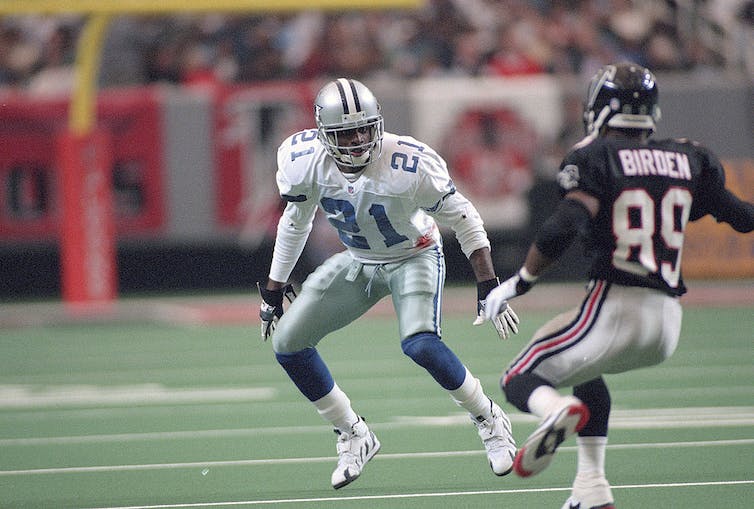
Like many, I grew up watching Deion Sanders play professional football and baseball. I idolized him. He wore gold chains, danced his way to the end zone, wore expensive suits and – most importantly – he was a celebrity who fully embraced Black popular culture. He was also one of the first athletes to understand that he was a brand off the field.
His appeal transcended race, gender and class, putting him in a rarefied group that includes Michael Jordan, Serena Williams and LeBron James.
Focus on Sport/Getty Images
Even after his playing career ended in 2005, Sanders’ star never dimmed. He had his own reality show produced by Oprah, has served as a regular analyst on the NFL Network, and has acted as a pitchman for companies like Nike, Under Armour, American Airlines and Aflac.
Sanders has also seamlessly adapted to the social media era, regularly posting videos on Instagram to an audience of 3 million followers.
Simply put, he is still one of the most famous people in the world. Like his younger counterparts with huge online followings – digital natives like Odell Beckham Jr. and LaMelo Ball – Sanders possesses an immense amount of digital clout.
Coach Prime joins the HBCU ranks
I was hardly surprised when Sanders made a quick splash in Jackson.
Fueled by the talents of his son, quarterback Shedeur Sanders, and former top high school recruit Travis Hunter, Jackson State quickly attracted national attention as a HBCU powerhouse.
After a COVID-shortened 2020 season, Sanders, whose players affectionately call him Coach Prime, led the school to two consecutive appearances at the Celebration Bowl, an annual game in which the champions of the two prominent HBCU conferences face off.
While boosting Jackson State’s profile, Sanders also presented himself as someone scholars like Brandon J. Manning have termed a “race man,” or a loyal member of the Black race who dedicates their life to directly contributing to the betterment of Black people.
Under the pretense of looking out for the future of HBCU athletics, Sanders said he would be better positioned than anybody to protect the legacy of HBCUs. Black student athletes, he argued, should choose to go to Jackson State because their association with him would not only give them clout, but also the kind of attention and encouragement that they could expect to receive from a Power Five program.
Yet it was always going to be close to impossible to keep Sanders at Jackson State if he consistently won.
Many suspected that Sanders eventually wanted to compete against top-tier programs like the University of Alabama and the University of Georgia. In fact, during an October 2022 interview on CBS’s “60 Minutes,” Sanders talked openly about listening to offers from bigger schools.
Despite these realities, many Black folk wanted to believe Sanders would be in it for the long haul. Now they’re dismayed, believing the momentum Sanders gave to HBCU athletics could come to a screeching halt.
God changes his mind
But unlike some prominent Black cultural critics who derided Sanders’ decision, I don’t think he’s a sellout.
Jackson State was arguably chasing some clout of its own when it hired Deion in the first place. At the time, Sanders was a coach with no experience beyond the high school level. He did, however, have plenty of experience performing – and winning – in the brightest of spotlights. Jackson State probably knew that taking a flier on an untested celebrity coach would be worth it: It would attract attention and, with it, money.
On the flip side, I also believe Sanders knew that he could build his coaching clout further at Jackson State by appealing to what sociologist Saida Grundy calls the Black respectability politics and Christian values of HBCU campuses. You could see this when he said that God told him “to even the playing field” for those who attend Black schools.
It was a symbiotic arrangement all along: Sanders leveraged his clout to grow the program that embraced him, but he was also hoping to attract the attention of an even bigger program.
I believe Sanders ultimately did more good than harm in terms of raising the profile of HBCU athletics. Furthermore, one person was never going to catapult HBCUs to the prominence of Power Five programs.
Sanders is part of a bigger group of former professional players and coaches leading HBCU programs. Former NFL head coach Hue Jackson now heads the football program at Grambling State University; NFL Pro Bowler Eddie George currently mans the sidelines at Tennessee State University; and Olympic gold medalist Cynthia Cooper-Dyke coaches the women’s basketball team at Texas Southern University.
If Sanders was a sellout, it was only in one sense: Jackson State football games routinely sold out during his tenure, shattering attendance records for the program.
Jabari M. Evans, Assistant Professor of Race and Media, University of South Carolina
This article is republished from The Conversation under a Creative Commons license. Read the original article.
About Post Author