



Next to an almost-200-foot red-and-white-striped tower at Argonne National Laboratory sits a building filled with newly opened boxes of instruments. These tools measure climate conditions like air quality and precipitation, and compared with the lab’s historic tools, like the tower outside, they’re small — really small.
That’s because instead of measuring the region’s atmospheric conditions from Argonne’s sprawling site in DuPage County, researchers will use these tools in a different kind of lab — the city of Chicago. Data collected will be used in modeling to show the effects of climate at scales as small as individual neighborhoods, said Cristina Negri, the director for the project.
Advertisement
Argonne recently won a $25 million grant from the U.S. Department of Energy to establish an urban laboratory in Chicago called Community Research on Climate and Urban Science, or CROCUS. Researchers with the lab will develop data sets about Chicago’s climate by placing instruments throughout the city and gathering community observations.
Some of the effects of climate change, such as increased flooding and urban heat, are known to disproportionately affect certain communities, especially those on the South and West sides of Chicago. The lab aims to quantify that, Negri said.
Advertisement
“It’s really to provide the data to show what are the drivers for this difference, and then how it materializes itself,” Negri said. “Until you know that, and you can prove it with data, it’s very hard to take action.”
What makes this operation unique, said Naomi Davis, founder and CEO of Blacks in Green, an environmental justice and economic development organization, is that community members were included in Argonne’s plans from the start. She said that oftentimes organizations in the Black community are contacted at the end of a process, after decisions have been made and the project has been designed.
“Those are kinds of approaches that have always been inappropriate and that we reject,” Davis said. “So what was beautiful about the Argonne approach is that they were inviting us to a process of designing a process.”
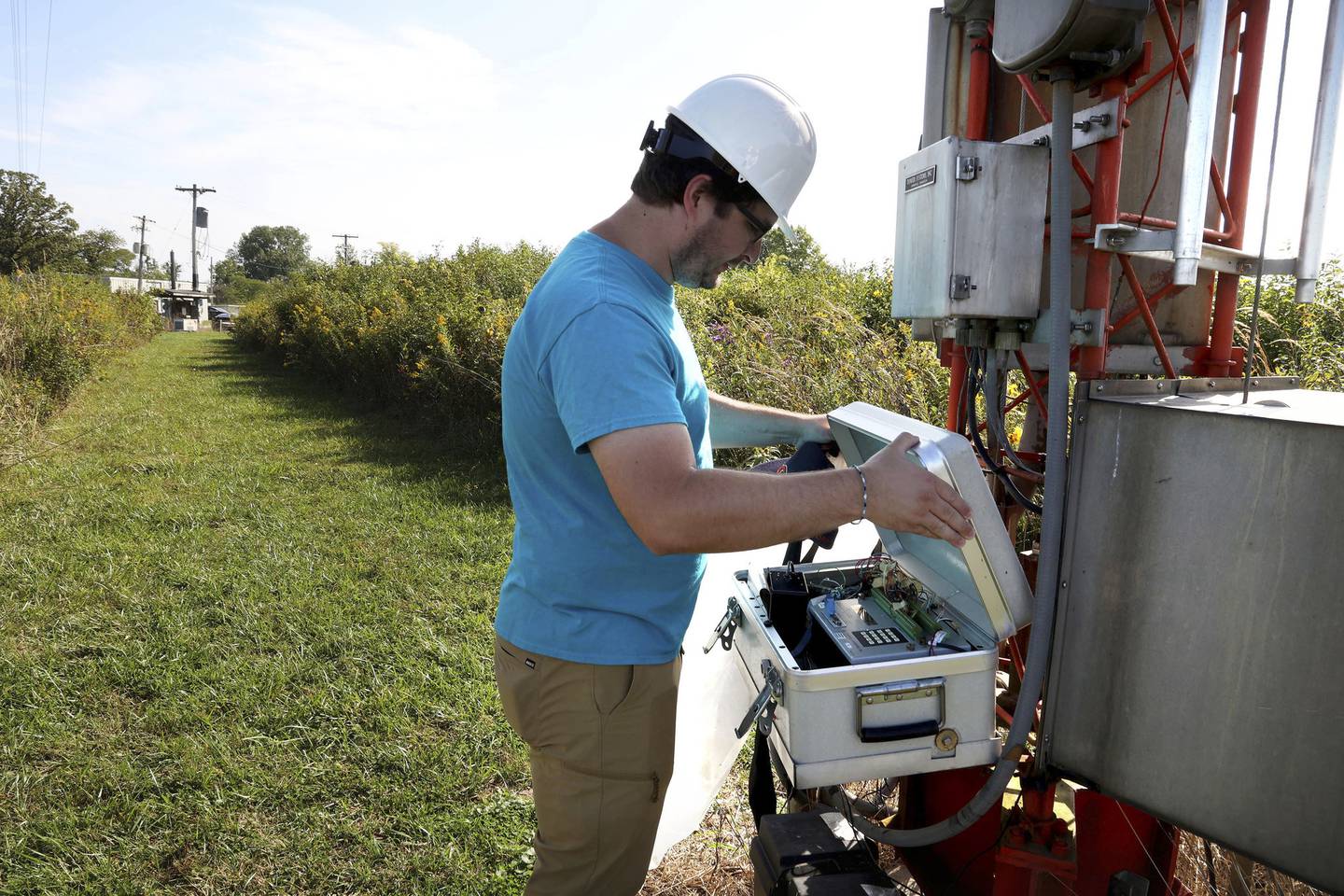
Surrounded by about 5 acres of prairie filled with yellow and violet wildflowers, researchers gathered at Argonne’s test site on a recent blue-skied weekday to troubleshoot some of the tools that will eventually be installed in Chicago.
There was a palpable excitement as Paytsar Muradyan, an assistant atmospheric scientist, opened a crate.
“It’s like Christmas,” one team member said.

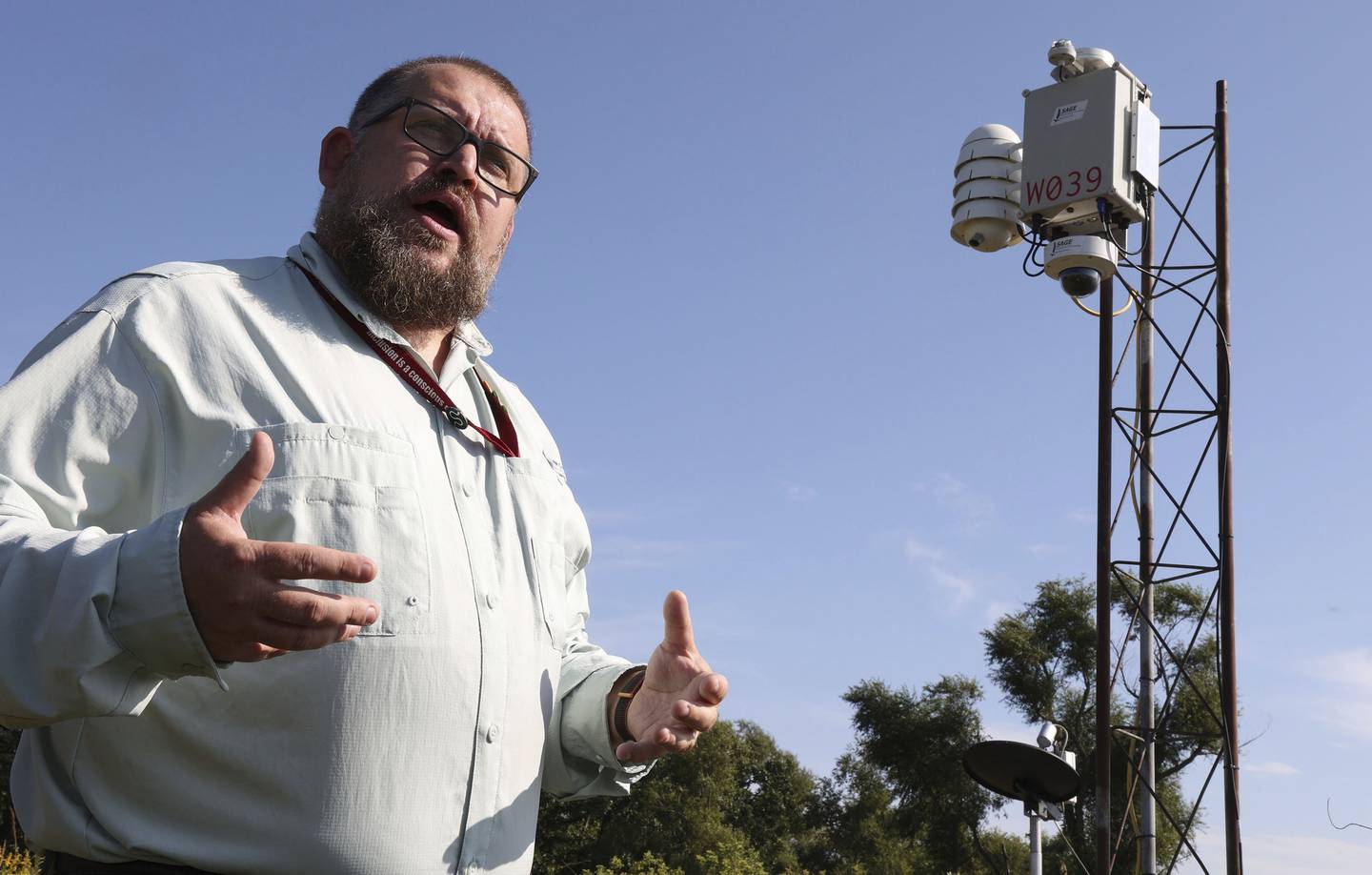
Inside was an atmospheric lidar, which stands for Light Detection and Ranging. The machine emits a rapidly pulsing laser into the sky to collect information on the composition of the air, including pollutants like particulate matter emitted by industries and vehicles.
Several of these machines — as well as sensors for measuring temperature, soil composition, precipitation and more — will be linked to central computers to make the sensors autonomous, said Scott Collis, who is leading the measurement strategy team. These computers will also use artificial intelligence and algorithms to detect patterns and ensure the technology collects the best data relative to the unique traits of a city, like the impact of buildings on wind.
Advertisement
Where each device goes depends on a variety of factors. One goal is to place these instruments at points where environmental conditions visibly change, like the tree canopy in Hyde Park compared with West Woodlawn, Collis said. Measuring at these points allow for the lab’s simulations to determine the scale of difference.
The most important factor in determining instrument location, however, is the input of community members, he said.
The effort includes more than 10 academic partners and four community partners: the Puerto Rican Agenda of Humboldt Park, Blacks in Green in West Woodlawn, the Greater Chatham Initiative and the Metropolitan Mayors Caucus.
“The science questions that we are going to ask are going to be very informed by very deep conversations that we will have with the community,” Negri said.
Jessie Fuentes, co-chair of the Puerto Rican Agenda of Chicago, said Argonne provided the organization with information about the specific climate concerns of Humboldt Park, such as rising heat, lack of green space and increased flooding, as well as Puerto Rico. “That struck a very personal chord with many of us who were involved with Hurricane Maria,” Fuentes said.
The Puerto Rican Agenda led relief efforts for Hurricane Maria in 2017 and is again calling for action after Hurricane Fiona hit Puerto Rico this week, leaving the island without power.
Advertisement
Fuentes hopes this project can provide a model for how climate solutions should be culturally relevant to the people the issue directly impacts.
“This really does away with the one-size-fits-all model,” Fuentes said.
Davis said she is looking to where this information can take her community in West Woodlawn.
“One of the things that African American communities are sick and tired of is being studied — we’ve had institutions across the centuries study us, but our lot never improves,” she said. “So what the rest of the story is about is how we take the data that we get and deploy it for the health, wealth and benefit of the Black communities.”
Collis described the operation of the lab as cyclical. Communities will provide input on areas of interest, such as spots of flooding or significant weather susceptibility, which will fuel where researchers collect observations in the city. These observations will be used for the lab’s climate simulations and provide more granular, scalable pictures of what climate change looks like.

Afternoon Briefing
Daily
Chicago Tribune editors’ top story picks, delivered to your inbox each afternoon.
The lab will provide open data sets for other agencies, organizations and researchers to use in their work, as well as websites for the public.
Advertisement
One of the most important metrics of success will be ensuring that this data can empower individuals and organizations in their work, Collis said. For example, if an organization is advocating for green space in a certain area, Collis hopes that data from the lab can give that group actionable metrics.
“Having the data alone contributes to a consciousness building that will drive people to act,” Fuentes said.
The lab will also employ citizen science so community members can collect data points themselves. For example, hand-held air quality monitors, which resemble green walkie-talkies, allow people to learn information about the air around them by connecting to a mobile app via Bluetooth.
While the hand-held tools aren’t are as precise as some of the more expensive technology, they can reveal notable differences in air quality from one area compared with another, Collis said. And even this more simplistic tech will calibrate with the Argonne system.
Per community member suggestions, the lab hopes to get these palm-size sensors in the hands of those interested, including schoolchildren, allowing them to measure environmental factors on their blocks and in their backyards.
“This is a new paradigm for doing science,” Collis said. “And it feels right.”


