




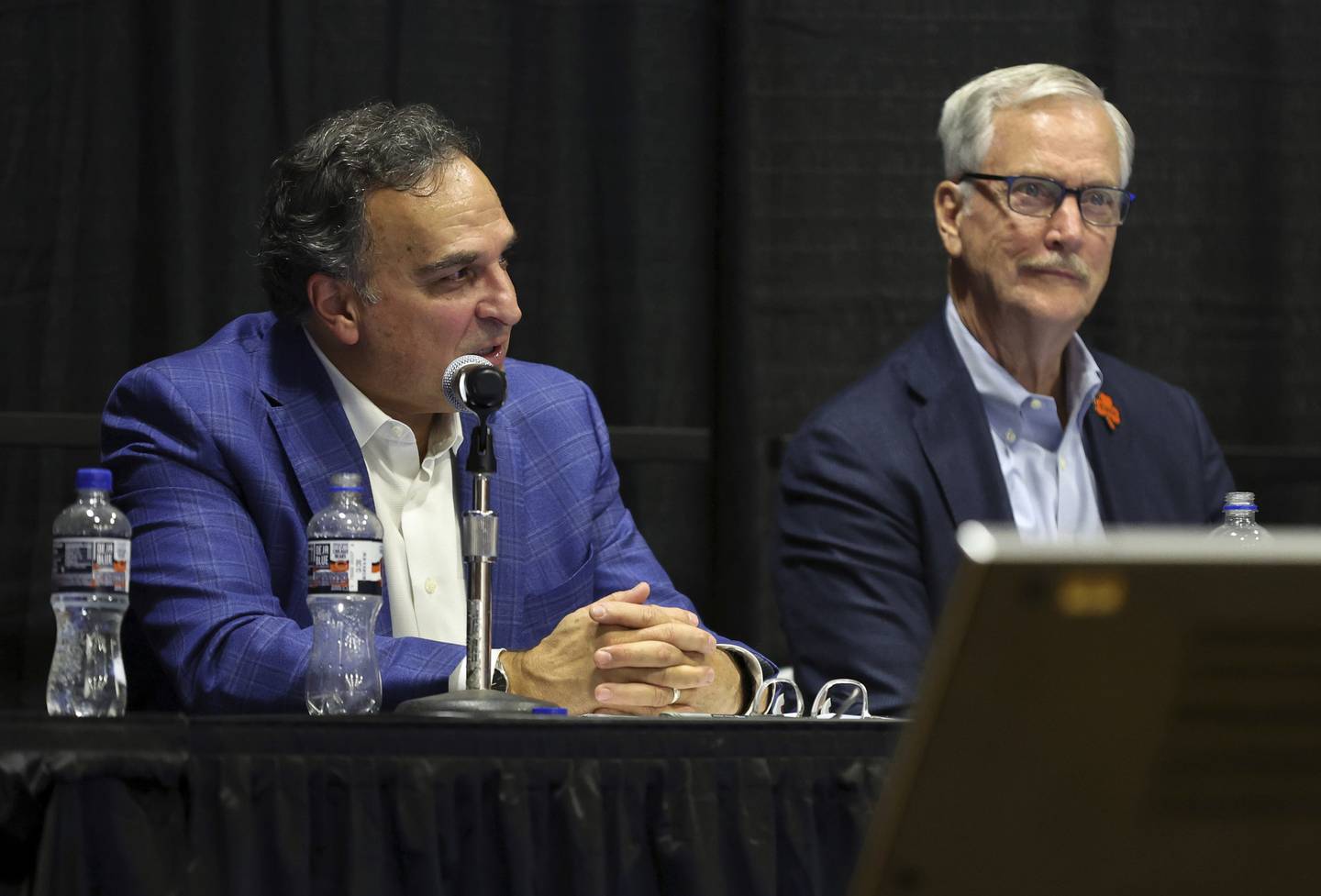
Bursts of applause greeted the Chicago Bears’ presentation of plans for a new enclosed stadium in Arlington Heights. “I’ve never had so many claps in my life,” team President Ted Philips said.
The team’s proposal to build the stadium and an adjoining mixed-use complex won support from many of those who attended the team’s initial sales pitch Thursday. That’s encouraging for team officials who emphasized that the project can’t happen without taxpayer funding. Numerous suburbanites told the Tribune that they supported the project — but didn’t want to pay more taxes for it.
Advertisement
Opponents already are mounting a drive to prevent any public spending on the deal. And one group of outside observers is backing up those opponents’ argument. Economists who’ve studied the issue say public funding for such sports stadiums and related development are usually a bad deal for taxpayers.
Advertisement
As the Bears prepare for their season opener Sunday at their current home, Soldier Field, the future of that century-old stadium and potential for a new stadium may hinge largely on an economic debate.
Recent deals to build National Football League stadiums have gotten huge amounts of public financing. The Tennessee Titans are in line to get $500 million from their state, while the Buffalo Bills expect $850 million in state and local financing. While the Bears say they’ll pay for the stadium and its non-retractable roof themselves, they say they need help to pay for infrastructure such as roads and sewers for the adjoining district, which would include residences, entertainment venues and other amenities.
In return, the team projects that construction of the project would create 48,000 jobs and a $9 billion economic impact. Without sharing the basis for their projections, the team said operations on the site would then create nearly 10,000 permanent jobs and generate more than $1 billion in economic impact each year.
Economists, though, are highly skeptical of such claims. They warn that stadium projects generally are a bad investment for local governments, largely because they take money that would otherwise go to other local businesses. A University of Chicago survey found that a majority of economists agreed that the costs to taxpayers are likely to outweigh the benefits.
Lake Forest College economics professor Robert Baade has authored several papers on the impact of sports stadium deals. He said such “pie in the sky” projections are often illusory. One common problem in estimating economic impact, he said, is the “substitution effect” — the idea that most of the money spent at stadium complexes by local residents would have otherwise been spent at other local restaurants, bars and businesses.
Another issue is that much of the money spent goes to the team, which is then spent on multimillion dollar salaries for players who often don’t live in the town where they play.
“The numbers are often wildly exaggerated,” he said. “We see white elephant stadiums and developments all over. It’s glamorous and seductive, but the economic realities are almost always disappointing.”
Baade said the team’s demands for public financing are typical of the “thinly veiled threats” by teams to take their ball and play elsewhere — as the Oakland Raiders did before moving to Los Angeles and then Las Vegas. In the Bears’ case, they could remain at Soldier Field. They have a lease through 2033, and Mayor Lori Lightfoot has proposed adding a $2 billion dome to the stadium —though she hasn’t said how that would be paid.
Advertisement
But Soldier Field is owned and operated by the Chicago Park District, and has the smallest seating capacity in the NFL, at 61,500. By building their own stadium, the Bears stand to gain hundreds of millions of dollars in stadium naming rights, a larger capacity, corporate suites, parking, concessions, and special events such as concerts, the Super Bowl, and college playoffs.
The Bears’ concept plan calls for a mixed-use development, to potentially include multifamily housing, retail, restaurants, a sports betting venue, a concert hall, parks and open space including a kayaking pond.
In Inglewood, California, housing prices skyrocketed after construction began there on the privately-financed Sofi Stadium.

Afternoon Briefing
Daily
Chicago Tribune editors’ top story picks, delivered to your inbox each afternoon.
But J.C. Bradbury, professor of economics at Kennesaw State University in Georgia, cited a study that found property values in Seattle and Charlotte, North Carolina, increased after professional basketball teams left those cities.
When the Atlanta Braves left Turner Field for their new stadium, property values also went up. But Bradbury’s study of the Braves’ new home at Truist Field found that rather than being the “home run” predicted for the local economy, it was more of a “pop fly.” In 2013, Cobb County pledged $300 million for the mixed-use development cost. But stadium revenue hasn’t matched that investment, costing residents roughly $15 million, or $50 more per household per year.
State lawmakers have expressed little enthusiasm for a subsidy for the Bears, which Bradbury said would divert consumer spending from Chicago. Arlington Heights Mayor Tom Hayes, though, has left the door open for a “last resort” public subsidy such as a Tax Increment Financing district, or TIF. It would use increases in property tax revenues, typically to pay for infrastructure such as roads and utilities.
Advertisement
Though such a subsidy likely would be far smaller than those for stadiums elsewhere, Bradbury said it would still likely not be worth it.
“To say that the Chicago deal is better is like saying that smoking one pack of cigarettes a day is better than a four-pack-a-day habit,” Bradbury told the Tribune. “Less of a subsidy is better, but it is still bad policy.”