




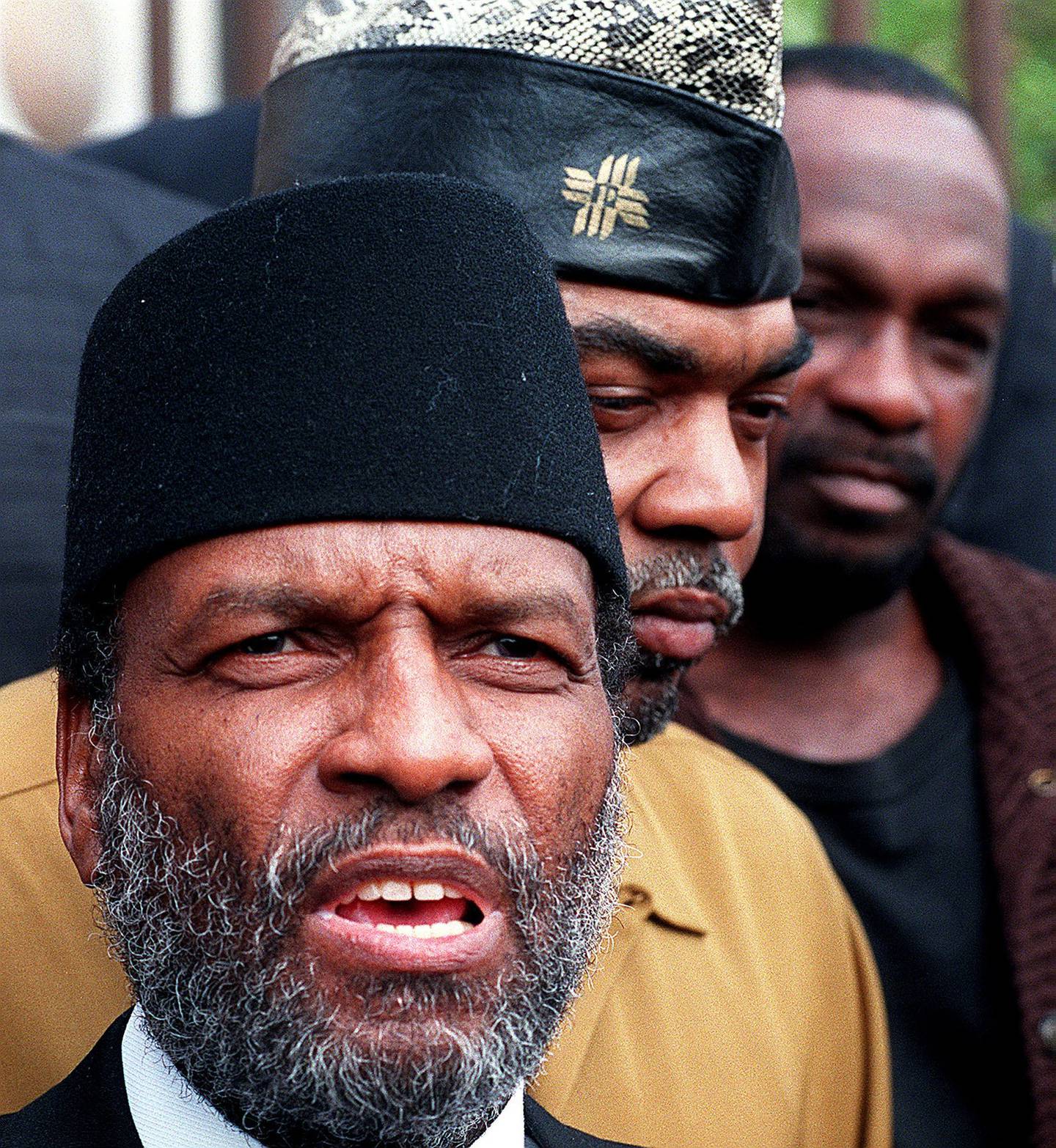
When Yosef Asiel recollects early memories of his father, Prince Asiel Ben Israel, he recounts thinking at the age of 7 that the title of prince signified he would be the one being served, a lofty assumption based on fairy tales.
Yosef Asiel told him as much. His father’s response: “Being a prince is about serving the people — not for me to be served. My responsibility is to do everything that I can, in my capacity, to ease the pain and the suffering of oppressed people.”
Advertisement
“I remember that because it changed my thought process relative to the type of man that my father was. And it automatically shifted my thinking to be more selfless in my endeavors,” said Yosef Asiel.
Ben Israel spent decades serving as the international ambassador of the African Hebrew Israelites of Jerusalem, a group with beginnings in the Great Plains during the 1890s that basically reverse-engineered Judaism from the Hebrew Bible, according to Jacob Dorman, author of “Chosen People: The Rise of American Black Israelite Religions.” Ben Israel wanted to emulate Jesus’ life and practices as a Jew.
Advertisement
Ben Israel died at age 81 on Aug. 21, according to his family. Services for the “charismatic leader” will be held at 9:30 a.m. Friday at Trinity United Church of Christ, 400 W. 95th St. and can be viewed on YouTube and Facebook.
Ben Israel was born Warren Brown on April 30, 1941, to Mary and Archie Brown Sr. As one of eight children, he attended Dunbar High School and DePaul University, where he became a member of the Alpha Phi Alpha fraternity.
Stints working for the Metropolitan Insurance Co. and selling jukeboxes to restaurants on behalf of the Eastern Music Co. preceded his introduction to the African Hebrews. Exposed to the teachings of the Israelites and African ancestry, he found his path and was given the Hebrew name Prince Asiel (prince of blessings) by Ben Ammi Carter, the spiritual leader of the group. The title of prince is indicative of Ben Israel’s leadership and longevity in the nation, according to the African Hebrew Israelites.
The more he studied the faith, the more Ben Israel tried to understand why so many Black Americans lived in a state of oppression. That question led him on a lifelong journey that started with the Bible and took him through Africa to Israel.
“When he would study Deuteronomy, the 28th chapter … he saw the Black man and woman in America,” Yosef Asiel said. “He said, ‘We have a responsibility and obligation if we’re going to overcome these curses that are outlined in the Bible, that we must return back to the place in which we fell.’”
Ben Israel’s purpose was to return to the Holy Land with Chicagoans, help them purge multigenerational traumas accumulated during slavery, segregation and Jim Crow to create a community where African Americans could govern themselves and live a free life. Ben Israel helped to build that community in Dimona, Israel, on the outskirts of the Negev Desert.
What started as a group of hundreds that left Chicago to set up residence in Israel (by way of Liberia) eventually grew to thousands of people and families that adopted Judaism as their principles of living. Ben Israel brought over thousands during the course of his lifetime — a calling to the Holy Land that found traction in the Black Power movement. The community is four generations strong, according to Ben Israel’s son.
“They came and made it bloom in the desert,” said the Rev. Henry Hardy, a friend of Ben Israel, who is set to eulogize him at Friday’s services. “They took it and transformed it into what is called the Village of Peace in Dimona, Israel. He was instrumental in moving persons there and did impact lives.”
Advertisement
“He had an undying love for Black people,” said Paul King, a friend of Ben Israel since 1959. It’s that love that comes across when talking to Ben Israel’s friends and family about his legacy, locally and abroad. People like U.S. Rep. Danny Davis and Carol Adams, former DuSable Museum CEO and president, ventured to Dimona at Ben Israel’s request over the years to see the community.
“What we had in common was our interest in the freedom and liberation of African American people, everywhere in the U.S. and beyond,” Adams said of her 40-year friendship with Ben Israel. “I supported the nation-building that they were involved in; they were seeking freedom and being willing to be brave enough to strike out and move. I was interested in the whole history, the adaptation, what they would do and how they would do it.”
Ben Israel shared the narrative of the nation-building going on in Dimona to all those who would listen — politicians, executives and professionals, said his executive assistant for 22 years, Daniehlah Israel. He thought sharing that knowledge aided African Americans in understanding and embodying who they are and helped humanity in general.

“That is the bridge that Ben Israel created and you see that actually manifested in the many different people that he brought together, in terms of all walks of life,” Daniehlah Israel said. “All of those people were brought together by the same man and given the same lesson in different ways and shown how they all are part of the puzzle that we need to bring together in order for us to be able to coexist.”
He was pretty clear that he was about uplifting humanity, Davis said. “He’s one of the most learned individuals I’ve ever encountered — could debate issues with the greatest of debaters and intellectuals and knew as much about Africa as anybody I’ve ever come in contact with, whether they were of African immediate heritage, or lived in Africa,” Davis said. “His whole persona was this action of a world order where Africans and people who had been descendants of Africa would find and share a level of equality and have our rightful space in the world society.”
Prince Sar Amiel, formerly known as Glenn Crockwell, 71, has been a member of the nation since his early 20s. He arrived in Dimona in 1979 and hasn’t looked back.
Advertisement
“We were the original Black Lives Matter,” he said. “We went from being Black to espousing and pushing a universal ideal: peace and to be able to take care of their families. But they’ve been constantly interrupted by Eurocentric civilization. You have people all over the world disenfranchised and moved out of their comfort spots, based on a Eurocentric hegemony that desires to control everything. My thing was: If we didn’t necessarily like the world that we live in, how come we don’t build us a world? It’s just a matter of doing it, and we did, in my lifetime.”
Ben Israel’s messages about abundant life and community equating to freedom resonates with Kristina King, president of the Shiloh Institute, an African American leadership development organization that connects Israel, Africa and Black America.
“Part of living an abundant life is living in community and wanting that same thing for other people,” King said. “We both came to the conclusion in our work with Israel, that the key is to live in community. Our community has to be bigger than our block. And that to live in community doesn’t mean that you just live next to your neighbor, that it is a people group living together. You grow your own food, you have housing, you have some type of childhood education and you eat together and talk together and get to know each other as a community. Those are very biblical principles, but that principle was very, very much the work and the legacy that he put in.”
Another part of those biblical principles centered on food. In 1982, Ben Israel started Soul Vegetarian East Restaurant, now Soul Veg City on 75th Street, a Chatham institution now run by his children, Arel Ben Israel and Lori Seay. The Chicago location was one of many throughout the years globally focused on serving food that feeds the spirit, mind, body and soul.
While Ben Israel’s legacy is multifaceted, that legacy did face challenges. Setting up a community from the ground up took time, funds and patience. Not everyone who ventured overseas to be a part of this communal utopia stayed. He also served seven months in federal prison in 2015 after pleading guilty to failing to register as an agent of former Zimbabwean President Robert Mugabe’s government. Yosef Asiel mentioned more arrests of his father in Uganda and Liberia. But he said what got Ben Israel through and made him great was his faithfulness and obedience.
Yosef Asiel will continue the work of his father as ambassador of the African Hebrew Israelite community, locally and in Dimona. But Yosef Asiel says he welcomes others to pick up the mantle and continue his father’s mission. After more than 50 years as ambassador of peace and unity, his father knew it would take more than that to reverse the systemic disenfranchisement of his people.
Advertisement
“He was so relentless, and so dutiful to his responsibility that it didn’t matter to him,” Yosef Asiel said. “He wanted to give everything he had to free an oppressed people. He had such a widespread impact that anybody who decides to pick up this work and continue his legacy is more than free to do so.”
In addition to Yosef Asiel, Ben Israel is survived by three wives, 14 children and a sister.


