



Close Menu
  • Home
  • News
    • Local
  • Opinion
  • Business
  • Health
  • Education
  • Sports
  • Podcast

Subscribe to Updates

Get the latest creative news from FooBar about art, design and business.

What's Hot

Chicago ‘Fibroid Slayer’ Makes History with Biggest Case of His Career

Charles Barkley Dares ESPN to Fire Him After Cardi B

Donalds Inching Closer to Becoming First-Ever Black Florida Governor

Facebook X (Twitter) Instagram
  • Lifestyle
  • Podcast
  • Contact Us
Facebook X (Twitter) Instagram Pinterest Vimeo
The Windy City Word
  • Home
  • News
    1. Local
    2. View All

    Uncle Remus Says Similar Restaurant Name Is Diluting Its Brand and Misleading Customers

    Youth curfew vote stalled in Chicago City Council’s public safety committee

    Organizers, CBA Coalition pushback on proposed luxury hotel near Obama Presidential Center

    New petition calls for state oversight and new leadership at Roseland Community Hospital

    Chicago ‘Fibroid Slayer’ Makes History with Biggest Case of His Career

    Venus Williams Calls a Sabalenka Exit a Tragedy

    COMMENTARY: Using Art, Healing, And Community to Transform Mental Health Dialogue

    OP-ED: Measure ER Offers an Opportunity to Vote Our Values

  • Opinion

    Rep Davis, Olive Post CDR., Call on Trump to Restore file of Black Vietnam War Hero to Website

    Capitalize on Slower Car Dealership Sales in 2025

    The High Cost Of Wealth Worship

    What Every Black Child Needs in the World

    Changing the Game: Westside Mom Shares Bally’s Job Experience with Son

  • Business

    Illinois Department of Innovation & Technology supplier diversity office to host procurement webinar for vendors

    Crusader Publisher host Ukrainian Tech Businessmen eyeing Gary investment

    Sims applauds $220,000 in local Back to Business grants

    New Hire360 partnership to support diversity in local trades

    Taking your small business to the next level

  • Health

    Chicago ‘Fibroid Slayer’ Makes History with Biggest Case of His Career

    COMMENTARY: Using Art, Healing, And Community to Transform Mental Health Dialogue

    OP-ED: Measure ER Offers an Opportunity to Vote Our Values

    Task Force Aims to Turn Birmingham Bystanders into Lifesavers Ahead of CPR & AED Awareness Week

    Atlanta’s Culinary Community Gathers to Fight Senior Hunger at TASTE 2026

  • Education

    COMMENTARY: Joy of Educating Black Boys

    ‘Find a Way or Make a Way’: Congresswoman Nikema Williams Announces $250,000 in Campus Security Funding for CAU

    How UNCF is Cultivating the Next Generation of Legacy Leaders

    Black Student Loan Default Rate Five Times Higher than Whites

    10 Assets of Black People

  • Sports

    Venus Williams Calls a Sabalenka Exit a Tragedy

    NBA: Adam Silver speaks on expansion, scandal, and more

    NBA Playoffs: ATL, Raptors and T-Wolves win Game 3s

    Dads, Kids & Community Clean with a Purpose

    WNBA Draft 2026 Explained

  • Podcast
The Windy City Word
Local

Tampons present an innovative way for scientists, researchers to test for COVID-19 in sewers

staffBy staffUpdated:No Comments4 Mins Read
Facebook Twitter Pinterest Telegram LinkedIn Tumblr Email Reddit
Share
Facebook Twitter LinkedIn Pinterest WhatsApp Email

On a sunny Thursday morning, at the mostly quiet intersection of Clifton Avenue and Broadway, Evan Berkowitz and John Leavell pulled a small steel cage the size of a coffee cup from a sewer with the mastery of someone who has done this a thousand times.

Inside the cage: a tampon, bloated and sodden with wastewater.

Advertisement

Beyond covering menstrual needs, tampons have been famously used to stop nosebleeds and dress emergency wounds. Now, they are being used to test sewage for COVID-19.

“I was just like, ‘You really use tampons?’” said Laura Clements, senior project manager at the University of Illinois Discovery Partners Institute. “It’s just crazy to me, but it’s true.”

Advertisement

And the results are reliable: As new coronavirus variants dominate COVID-19 cases in Chicago, researchers said they were able to detect the presence of the omicron BA.2 subvariant two weeks before it showed up in an individual clinical COVID-19 test.

Clements is part of a DPI team working with the Illinois Department of Public Health to test wastewater in order to monitor COVID-19 cases in the state. Though this type of community testing has been used across the country to detect COVID-19 since late 2020, scientists have only recently turned to using tampons as Moore swabs.
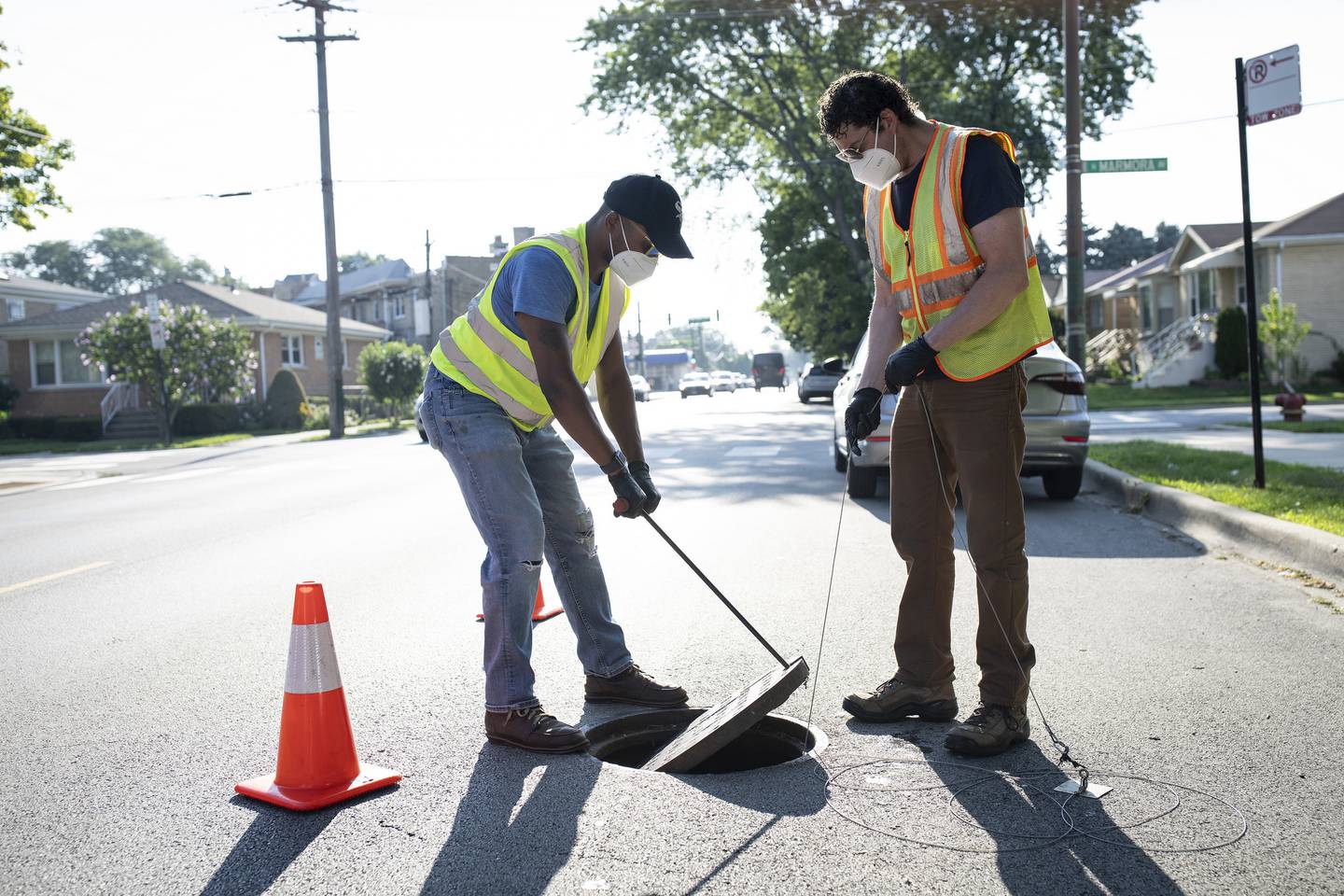
Evan Berkowitz, right, from Infrastructure Engineering, and John Leavell, from Current Water, lower a Moore swab containing a tampon into a Northwest Side sewer to test wastewater for the presence of COVID-19 and variants on July 21, 2022. (E. Jason Wambsgans / Chicago Tribune)

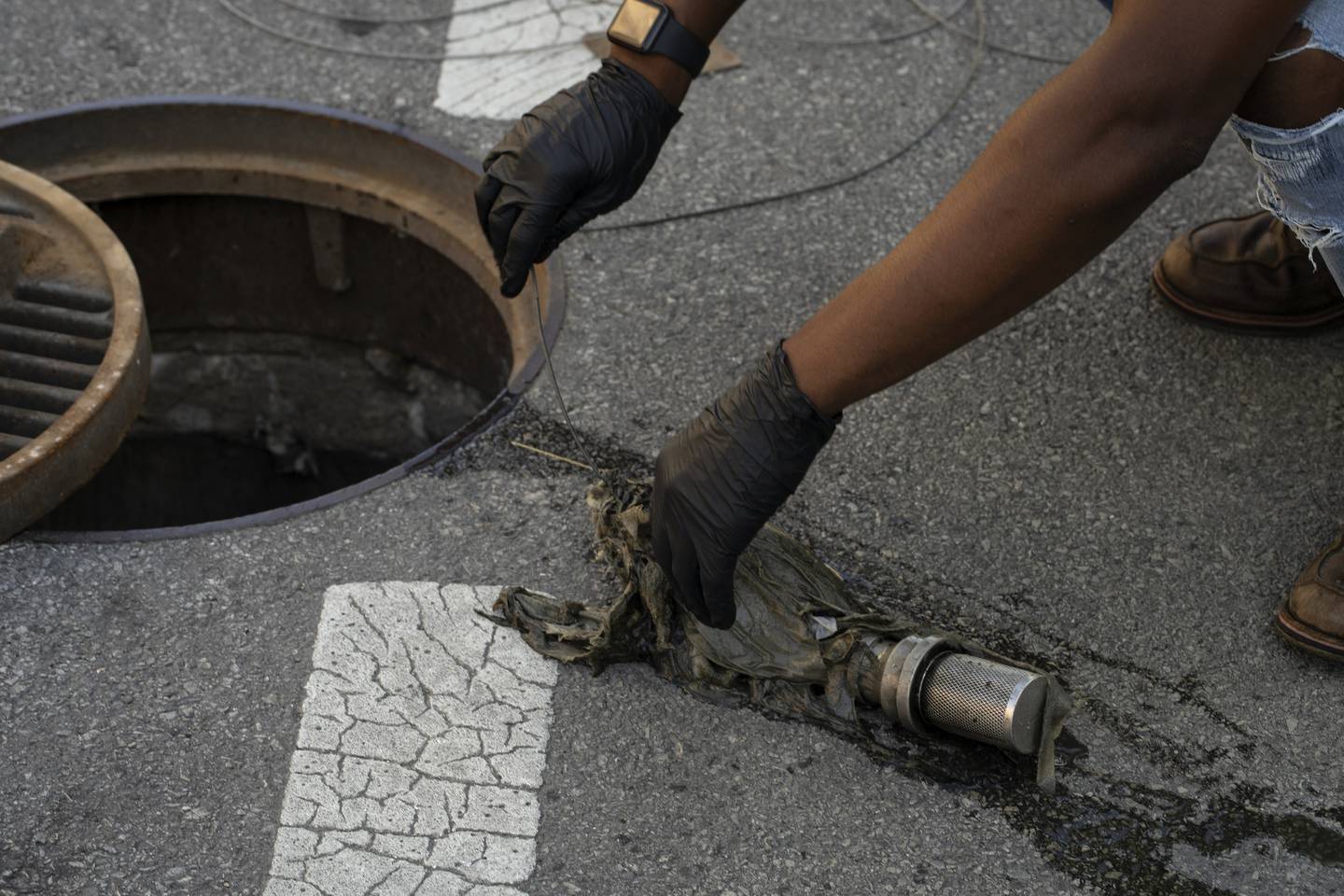
John Leavell recovers a Moore swab containing a tampon from an Uptown sewer to test wastewater for the presence of COVID-19. (E. Jason Wambsgans / Chicago Tribune)

Leavell and Berkowitz, contractors from Current Water and Infrastructure Engineering Inc., have been picking up the samples on the North and South Sides of the city four days a week every week since December. Researchers select locations to test based on COVID-19 vulnerability as well as on a lack of clinical testing availability, and “to have good, citywide representation,” said Rachel Poretsky, an associate professor of biological sciences at the University of Illinois at Chicago.

With the help of three traffic cones and bright yellow vests, the men brave the passing cars to lower a tampon 20 feet down into a sewer through a maintenance hole. They leave it there for two to five days, researchers explained, in the “murk and yuck,” where the tampon literally absorbs days’ worth of data.

When they return, they replace the sample with a fresh tampon and take it to a UIC microbiology lab — where the sample is tested for the coronavirus — and to Argonne National Laboratory for genetic sequencing to figure out what variants of the virus are present. Samples are collected twice weekly.

Tampons are not only an accessible and cheap alternative, but they are also easier to use than an auto-sampler, the equipment normally used in wastewater treatment plants, Clements said. An auto-sampler takes small, periodic samples for analysis.

Leavell and Berkowitz said it’s “much easier” to sample the wastewater with tampons.

“It’s more straightforward,” Leavell added.

Advertisement

Afternoon Briefing

Afternoon Briefing

Daily

Chicago Tribune editors’ top story picks, delivered to your inbox each afternoon.

“I’ve heard from people who use auto-samplers in the field, you pretty much have to be like a powerlifter to even pull it out of the sewer to get the sample while you’re sitting in the middle of traffic,” Clements said.

And that’s assuming the auto-sampler’s battery didn’t die and the wastewater didn’t freeze as it was being pumped out during the cold Chicago winters.

But the tampons initially presented a challenge. They could be easily flushed away by waste in the sewer pipes if they had nothing to safeguard them. So Charlie Catlett, a recently retired research scientist at DPI, came up with a solution.

“Charlie, basically, is the kind of person who just makes stuff just for fun, and not even for fun — out of necessity — but he just went into his garage and started tinkering,” Clements said.

The result: the small, coffee cup-sized steel cage that can be lowered down the maintenance holes and that protects the tampons from floating away. “Because you can’t just dangle a tampon in the sewer,” Poretsky said. The baskets, she added, are “kind of unique.”

“We really switched to full-time employing (the tampons) in the city sewers this winter,” Poretsky said. “And that was because we had to design the cages and design the system, but it turned out to be a sort of godsend to the contractors that we use to sample.” The tampon-in-a-basket system is that much faster too.

Advertisement

Clements said scientists have used tampons in the past to detect the presence of other diseases such as cholera. They might even be used to collect wastewater samples to be tested for monkeypox, a new virus spreading across the United States and in Chicago.


Share. Facebook Twitter Pinterest LinkedIn Reddit WhatsApp Telegram Email
Previous ArticleFormer First Lady Michelle Obama To Release New Memoir Centered On Self-Worth And Resilience
Next Article Patience, persistence and parades: Inside GM Ryan Poles’ championship visions for the Chicago Bears
staff

Related Posts

Uncle Remus Says Similar Restaurant Name Is Diluting Its Brand and Misleading Customers

Youth curfew vote stalled in Chicago City Council’s public safety committee

Organizers, CBA Coalition pushback on proposed luxury hotel near Obama Presidential Center

Leave A Reply Cancel Reply

Video of the Week
https://www.youtube.com/watch?v=AxFXtgzTu4U
Advertisement
Video of the Week
https://www.youtube.com/watch?v=OjfvYnUXHuI
ABOUT US


The Windy City Word is a weekly newspaper that projects a positive image of the community it serves. It reflects life on the Greater West Side as seen by the people who live and work here.

OUR PICKS

Funny Grandson’s Punishment: Car Ride Story!

2 Minute Warning LIVEstream “Sharing Frequencies: for Liberating Messages

Excerpt from Toyota Sustainability 2050 Challenge

MOST POPULAR

Chicago ‘Fibroid Slayer’ Makes History with Biggest Case of His Career

COMMENTARY: Using Art, Healing, And Community to Transform Mental Health Dialogue

OP-ED: Measure ER Offers an Opportunity to Vote Our Values

© 2026 The Windy City Word. Site Designed by No Regret Medai.
  • Home
  • Lifestyle
  • Podcast
  • Contact Us

Type above and press Enter to search. Press Esc to cancel.