




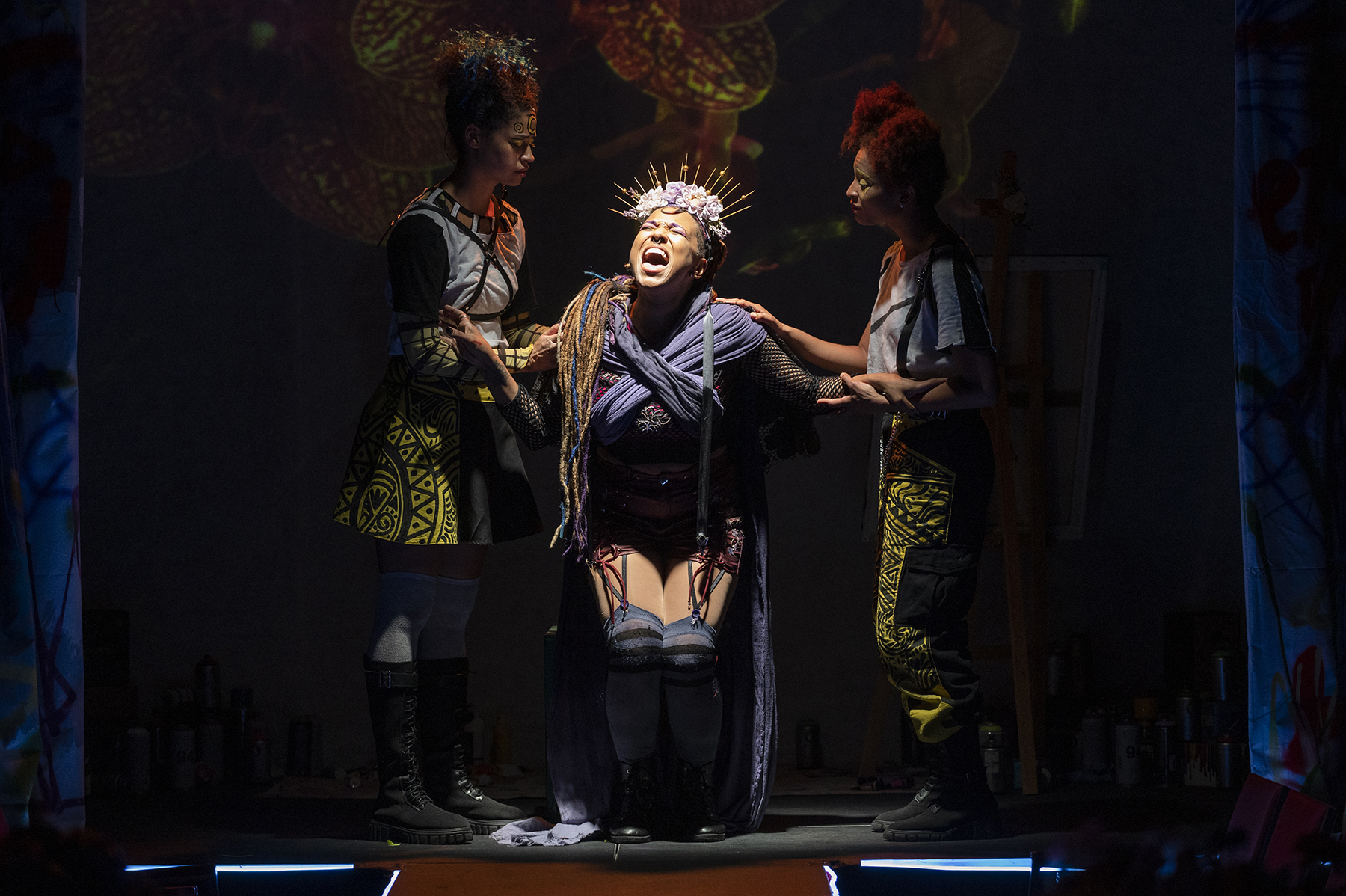
The same day that I saw Nikki Lynette’s new musical Get Out Alive with Haven, the U.S. rolled out the new 988 phone number for the National Suicide Prevention Hotline, with the promise that there will be more resources to address mental health and substance abuse issues, as well as support for those experiencing suicide ideation.
As Lynette makes clear in her show (developed at Northwestern’s American Music Theatre Project, where she was the first Black woman playwright selected for the program), for people with depression and a history of suicide, social stigma and shame are often the boulders in the way of seeking help—and just getting through each day is a Sisyphean struggle. Part bio-musical, part sociological exploration of the way depression affects Black Americans in particular, part ritual exorcism of that shame and stigma, the show is a defiant and raw challenge to the audience. Lynette wants us to think more empathetically about how we treat others with mental health issues—and how we treat ourselves when the blue devils of doubt, anxiety, and self-loathing start taking over our minds.
Get Out Alive
Through 8/6: Thu-Sat 7:30 PM, Sun 3 PM; also industry night Mon 7/25, 7:30 PM, open caption performances 7/28-7/31; Den Theatre, 1331 N. Milwaukee, 773-697-3830, havenchi.org, $36 ($46 reserved, $31 industry, $21 students)
Watching the show, I was reminded of the controversy that erupted in the 1990s over Bill T. Jones’s dance piece Still/Here, which illustrated the experiences of people with life-threatening illnesses (cancer, AIDS, cystic fibrosis) and grew out of workshops he and his company conducted with them. (The participants who shared their stories were present onstage in videos, much as Lynette makes space for Black people to speak on video in her show about how depression affects them.) In a now-infamous 1994 New Yorker review, “Discussing the Undiscussable,” critic Arlene Croce told her readers that she was declining to review Jones’s work, claimed he was guilty of promulgating “victim art,” and asserted, “By working dying people into his act, Jones is putting himself beyond the reach of criticism.” So . . . the critic is the real victim here? You can’t write about something if it makes you “feel sorry” for the people whose stories are being told?
I’ve taught Croce’s essay and the many cogent responses to it in various criticism classes over the years, and one point that a student made early on has always stuck with me: the people Jones worked with in creating Still/Here don’t refer to themselves as victims. That’s something Croce (and too many others) put on them as a label. And that’s something that Lynette’s piece tackles head-on: If we’re only willing to view people with depression and a history of suicide as damaged victims, rather than people with the same complicated histories that many of us have through being humans on a planet (especially this planet at this point in history), then we’re part of the problem.
The show, codirected by Roger Ellis and Lucky Stiff and co-choreographed by Keeley B. Morris and Jacinda Ratcliffe (who also appear as choral/supporting figures for Lynette), is structured as a song cycle in the form of a memorial. Two runway platforms bisect, with the playing area surrounded by floral arrangements (one bearing the legend “RIP to a Bad Bitch”) and shelves of votive lights created out of dozens of prescription pill bottles. (Eleanor Kahn designed the set.) DJ P1 serves as emcee and also pops up with a well-timed line or two during the 100-minute performance, while Chris Owens’s video projections offer trippy visuals in addition to the aforementioned documentary interviews.
Get Out Alive is essentially a chronology of Lynette’s journey with her own mental health, which culminated in a suicide attempt in Calfornia after losing a pregnancy with an abusive partner. Before she ended up in that situation, there was also a history of sexual abuse (as there is with so many people), family dysfunction (her father was largely out of the picture), and the added stress of being Black in racist America. When her mother is diagnosed with cancer, Lynette comes back to Chicago to care for her—with the quiet understanding with herself that once her mother is gone, she can once again deploy the “Get Out of Life Free” card of suicide and end the pain that has continued despite hospitalization and medication after her previous attempt.
With songs like “My Mind Ain’t Right” (which appeared in Spike Lee’s Netflix reboot of She’s Gotta Have It—the filmmaker shows up in the story as a kind of lifesaver at one point), the banger revenge anthem “I’ll Kill You and Cry on Your Grave” (dedicated to the man she calls “Lucifer, the Lord of Fuckbois”), and “The Strong One,” Lynette creates an Afro-goth/hip-hop soundtrack for her life story. It’s sometimes messy, sometimes funny, and of course sometimes deeply anguishing.
What it’s not is an exercise in begging for sympathy or framing herself as a victim. Lynette is asking us to consider why we cannot find it in ourselves to even listen to people with mental health issues without judgment, and without treating them as a punchline or danger to others. (See for example the rush to label every mass shooter as “mentally ill.”) If one in five Americans has mental health disorders (and that was, as Lynette points out in a February 2021 TED Talk, before the pandemic), then there are a helluva lot of “victims” out there.
Not all of us have the creative ability to transform our stories into music and storytelling, as Lynette does. But we do all have the ability to make space for each other’s stories, especially when those stories are coming from Black women who face disparities in mental health care as they do in so many other areas. Lynette, who opened for Pussy Riot on a U.S. tour, identifies punk and other alternative cultures in her TED Talk as a source of strength, since they’re used to being viewed as “creeps and weirdos.” But you don’t need to be punk to adopt Lynette’s demand for “radical social change” when it comes to fighting the pernicious demon of stigma.