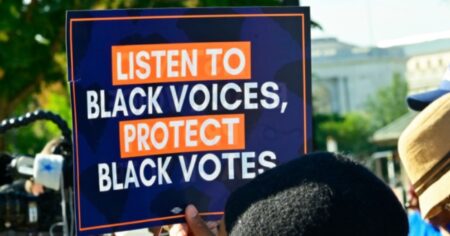




Families across the country are opening their monthly utility bills with a growing sense of dread. Groceries cost more. Rent costs more. Now electricity has become one more expense pushing household budgets to the breaking point, and for many in the Black community – as usual – the squeeze is being felt hardest of all.
Residential electricity prices are expected to average more than 18 cents per kilowatt-hour in 2026, about 5 percent higher than last year, according to the U.S. Energy Information Administration. At the same time, demand for power is climbing fast as the nation adds data centers, factories, and other large energy users. And consumers remain exposed to a market rattled by global conflict and swings in fuel prices.
These costs do not land on everyone equally. For a family with little left over at the end of the month, even a modest jump in the light bill means less for food, transportation or medicine. Low-income households spend three times more of their income on energy than other households, and Black households spend 43 percent more than white households, according to the American Council for an Energy-Efficient Economy.
The question every public official should be asking, then, is simple: How does America add the reliable electricity it needs while keeping costs down for the families least able to absorb them?
Instead, a group of state attorneys general has chosen a very different fight.
In November 2024, Texas Attorney General Ken Paxton sued three of the nation’s largest asset managers, BlackRock, State Street and Vanguard, and was joined by a coalition of other states. The lawsuit claims the firms bought up large stakes in major coal producers and then used their influence as shareholders to pressure those companies to cut production in pursuit of climate goals. The attorneys general argue this restricted coal supply, raised coal prices and, in the end, raised electricity prices for consumers.
Paxton and his colleagues have presented the case as a way to bring down power bills. But when Paxton’s office announced its settlement with Vanguard, it billed the deal as an agreement “to protect the coal industry.” That wording tells us a great deal about whose interests are really at the center of this case.
Attorneys general have only so much time, staff, and money. Every hour spent on litigation against investment firms is an hour not spent on the problems that actually drive up household energy costs: transmission bottlenecks, permitting delays, an aging grid, energy efficiency and the shortage of new power generation.
There is actually an even deeper problem with making coal the centerpiece of an affordability strategy. Coal has been losing ground in the marketplace for decades.
Around 1990, coal supplied more than half of the nation’s electricity. By 2025, its share had fallen to about 17 percent. Most of that decline came from competition, chiefly cheaper natural gas, along with the growth of renewable energy and tougher environmental rules. In the first three months of 2026 alone, coal plant output fell 11 percent from a year earlier, while renewable generation grew. And this summer, Lazard’s annual analysis found renewables remain the lowest-cost option for new power plants, even as existing plants have become more competitive and continue to provide real value to the grid.
Coal’s decline did not begin with Wall Street, investment policies or the climate movement. It is the result of decades of change in America’s energy economy. Where a coal plant remains affordable and necessary to keep the lights on, utilities should keep running it. But keeping a useful plant open is very different from treating the survival of an entire industry as public policy. If other sources can provide power more cheaply, government has no business shielding coal from that competition.
For Black communities, the cost of coal does not stop at the utility bill. Burning coal produces air pollution and coal ash that must be managed, and the Environmental Protection Agency notes that coal ash contains contaminants like mercury, cadmium, and arsenic. A landmark NAACP study found that the roughly 6 million people living near coal plants had lower average incomes than the nation as a whole, and that people of color made up a majority of those living near the worst polluters. Too many of our neighborhoods carry both burdens at once: high energy bills and a greater share of the pollution. Any policy that claims to help consumers should account for both sides of that ledger.
The truth is that families do not much care whether the power running their refrigerator comes from a coal plant, a natural gas facility, or a wind farm. They care that it is there when they need it and that they can afford to pay for it.
Critics of environmental policy often complain that government should not pick winners and losers in energy markets. That principle should apply evenly. Financial firms should not be allowed to break antitrust laws in pursuit of climate goals. But government should be just as cautious about using its power to guarantee coal a permanent place in the market. Coal, natural gas, nuclear, wind, solar, battery storage, and new technologies should all compete on cost, reliability, and what the grid needs.
The real challenge before the nation is building enough reliable power, and building it quickly. Clinging to coal’s past, especially through the courts, does nothing to solve that.
At a time when so many Americans are struggling just to pay bills, it is fair to ask why state officials are pouring so much energy into protecting one industry. Attorneys general should be working to make power more plentiful and more affordable. Families facing economic hardships deserve more than to be invoked as props in a political fight between government officials and some of the world’s largest financial institutions.
Based on reporting by Our Weekly Los Angeles / Our Weekly Antelope Valley.