



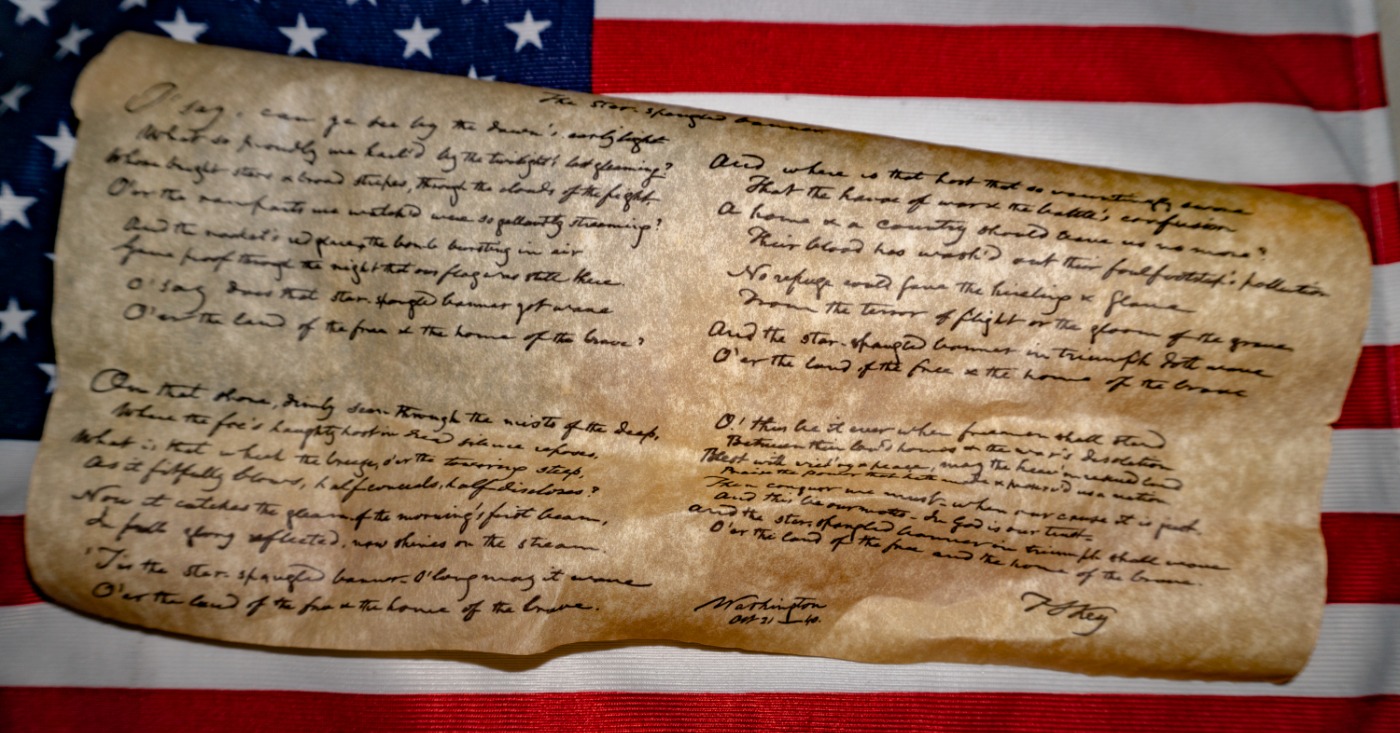
“The Star-Spangled Banner” is one of the most recognizable patriotic songs in American life, performed at ballparks, government ceremonies, military events and countless other gatherings. Yet the history behind the anthem is considerably more complicated than the familiar first verse suggests. Written by Francis Scott Key in 1814 after he witnessed the British bombardment of Fort McHenry, the song emerged from a nation at war while slavery remained firmly embedded in American society.
Key was a prominent lawyer and poet from Maryland who owned enslaved people and held deeply conservative views about slavery. The Smithsonian describes him as a slaveholder and a staunch advocate of slavery, noting the contradiction between his celebration of a “land of the free” and his own position on human bondage. His views are an important part of understanding the man who wrote America’s national anthem.
The circumstances that produced the song were dramatic. During the War of 1812, Key traveled to Baltimore to help negotiate the release of an American prisoner. He was aboard a ship where he could watch the British attack on Fort McHenry. When daylight revealed that the American flag was still flying over the fort, Key began writing the words that became “The Defence of Fort M’Henry.” The song was later renamed “The Star-Spangled Banner.”
What many Americans rarely hear is that Key originally wrote four stanzas. Today, the first stanza is overwhelmingly the portion performed as the national anthem. The remaining verses have largely disappeared from public performances, even though they provide additional context about Key’s political and racial worldview. The Library of Congress notes that the third stanza has generated particular controversy because of its reference to “hireling and slave.”
That language becomes especially troubling when placed against the history of the War of 1812. During the conflict, Britain recruited formerly enslaved Black Americans into the Colonial Marines by offering freedom. Some enslaved people viewed the British as an opportunity to escape bondage and fight for their own liberation. Key’s third stanza celebrates the defeat of Britain’s forces while referring to “the hireling and slave,” language that has long been criticized for its racial implications.
There is, however, an important historical qualification. Scholars do not agree completely about exactly whom Key meant by the words in the third stanza. The Library of Congress explains that the “slave” reference may have specifically targeted formerly enslaved people who joined the British Colonial Marines, but it could also have referred more broadly to British forces. That uncertainty should be acknowledged rather than presenting one interpretation as an indisputable fact.
The contradiction between Key’s celebration of freedom and his support for slavery was not invisible during his own lifetime. Abolitionists criticized the hypocrisy of praising America as “the land of the free” while slavery continued to exist. The Smithsonian notes that Key himself faced criticism and that his complicated relationship with slavery became part of the song’s historical legacy.
Key’s racial attitudes extended beyond his ownership of enslaved people. Historical accounts describe him as an opponent of abolition and as someone whose ideas about Black Americans were deeply shaped by the racial hierarchy of his era. This makes it difficult to separate the anthem entirely from the society and political beliefs of the man who wrote it. At the same time, historical context does not require Americans to abandon every meaning that later generations have attached to the song.
That distinction is important because “The Star-Spangled Banner” eventually acquired meanings that went beyond Key’s intentions. During the Civil War, the song became increasingly associated with Union patriotism. Over subsequent generations, it became a national symbol whose meaning was interpreted differently by different communities. For some Americans, it represents military sacrifice and national survival; for others, its history raises painful questions about whose freedom was being celebrated and whose freedom was being denied.
The song did not officially become America’s national anthem until March 3, 1931, more than a century after Key wrote it. By then, Americans had transformed the song into a national symbol far larger than its original wartime setting. That history is worth remembering because national symbols are not frozen in time. They can acquire new meanings as generations confront the contradictions contained within the nation’s past.
For Black Americans in particular, the history of the anthem can create a complicated emotional response. Singing about a “land of the free” while remembering that millions of Black people were enslaved when Key wrote the words presents a contradiction that cannot simply be ignored. The controversial third stanza makes that contradiction even more difficult because of its reference to enslaved people and the British forces offering freedom.
Understanding the full history of “The Star-Spangled Banner” does not require telling Americans what they must feel when they hear it. It does require honesty. Francis Scott Key created a song that became one of the country’s most powerful patriotic symbols, but he was also a slaveholder and an advocate of a system fundamentally opposed to the freedom celebrated in his famous words. The anthem’s history therefore contains both patriotism and contradiction—a reminder that America’s national story is not simply about the ideals it proclaimed, but also about the people who were denied those ideals and the continuing struggle to make “freedom” a reality for everyone.
Based on reporting by The Positive Community.
The post The Troubled History Behind the Anthem appeared first on BlackPressUSA.