



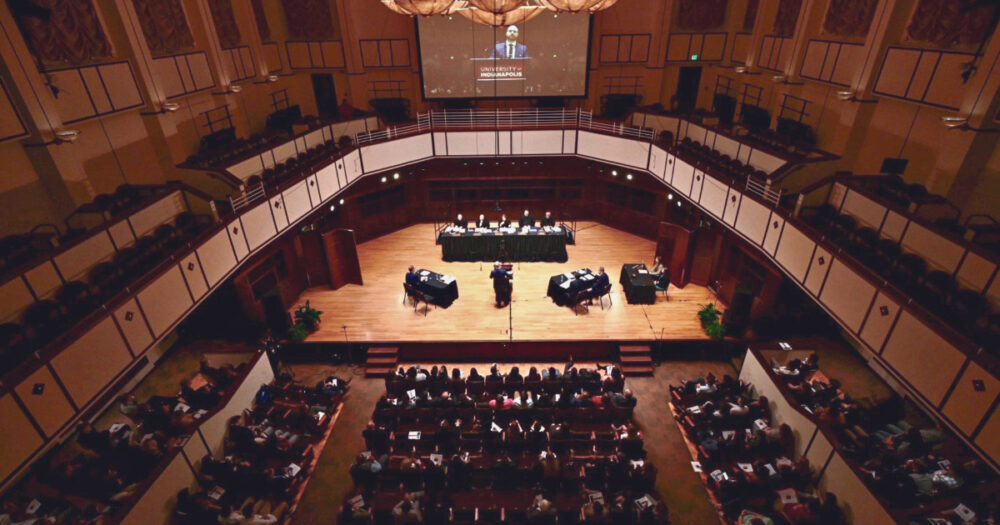
Photo caption: Indiana Supreme Court
Local challenge still awaiting Indiana Supreme Court ruling
By Elaine S. Povich, Indiana Capital Chronicle
Thousands of college students will get hundreds of dollars in compensation as colleges and universities move this summer to settle multimillion-dollar lawsuits stemming from canceled classes and activities during COVID-19 pandemic shutdowns.
While some of the class-action suits against the colleges and universities are still in litigation, and still others dismissed, several major cases have been settled in recent weeks.
The settlements mean students who were charged tuition and fees but weren’t able to use in-person services during the pandemic shutdowns will receive some compensation, though they won’t be refunded for all the on-campus amenities they lost.
The amounts depend on the total settlement figure, minus legal fees and other court expenses. Each case has a different timeline.
Most recently, the University of Delaware agreed in June to set up a $6.3 million fund to partially reimburse tuition and fees that the students paid for classes, housing and activities in 2020. The students argued that they did not receive the full benefit of in-person participation in academics and extra-curricular activities. Each student is expected to receive several hundred dollars in cash as part of the agreement.
But the university did not admit wrongdoing and maintained that extenuating circumstances of the pandemic, and the lack of an official contract between the school and each student, meant it was justified in taking the tuition and fees — an argument made by many other schools.
Many universities also have argued that they incurred significant expense in making the almost immediate transition to online classes. In interviews with Stateline, attorneys for some schools argued that the students’ argument was undercut by the fact that many chose to remain in remote classes after the campuses reopened, for convenience or health concerns.
Florida attorney Mendy Halberstam, who was not involved in the Delaware case but who represents other universities that have been similarly sued, said in an interview that the schools feel compelled to defend themselves against cases they believe “are lacking in merit.”
“They are not looking to make life difficult for their students,” he said, “but they also have to make sure of their [lack of] liability.”
There have been about 300 such lawsuits, according to Times Higher Education, a British publication that partners with The Wall Street Journal on rankings and evaluations of U.S. schools.
The University of Colorado, for example, settled a similar class-action case in April for $5 million.
Attorney Igor Raykin, who represented the Colorado students, said the settlement was “a reasonable offer given the challenges of the suit itself and the legal landscape in general.”
Among the challenges, Raykin said, is the fact that these were precedent-setting cases and that a lengthy legal process meant many of the students have already graduated and gotten on with their lives.
“We wanted to make sure the students would be getting something that would benefit them.” Individual awards will vary, he said, but typically will be in the hundreds of dollars.
In May, the University of Minnesota also settled a class-action lawsuit, allowing students to get bigger refunds of tuition and fees than the school initially allowed. And in June, a judge certified a group of students in a class-action suit against the University of Washington.
There was federal money that a lot of the schools were able to get. And we believe that money should have gone back to the students.
– Florida attorney Jeffrey Ostrow
However, early this year a judge in Rhode Island dismissed a case against the University of Rhode Island and several other schools in that state, ruling that there were no enforceable contracts breached in the shutdowns. The plaintiffs argued that the shutdowns denied them university experiences they expected, based on the schools’ marketing materials, websites, course catalogs, student handbooks and the like.
But U.S. District Judge John McConnell Jr. ruled that, “unfortunately for [the] plaintiffs, these general advertisements and distinctions do not create obligations on the part of the university — they are vague and more akin to puffery, rather than enforceable promises.”
Two weeks ago, the Florida Supreme Court announced it would consider a class-action suit from University of Florida students asking for compensation for being denied services during the COVID-19 shutdown.
But in another Florida case, the 11th U.S. Circuit Court of Appeals upheld a ruling from a lower court dismissing a student’s lawsuit against the University of Miami, a private school.
The university refunded pro-rated fees for housing, dining, student centers and gyms. The student argued that wasn’t enough, but the court ruled that she was “not entitled to damages stemming from any alleged breach of contract, unjust enrichment, or inadequate refunds on the part of Miami.”
“The pandemic forced students of all ages to learn from behind their computer screens for a period of time, and we certainly harbor a great deal of sympathy for those students whose educations and relationships were affected by the transition,” the court wrote.
“We hope that some comfort can be found, however, in our certainty that despite enduring the hardships created by the pandemic, any student who has earned a degree from a school like the University of Miami retains the unspoiled potential for a fulfilling and prosperous future.”
Florida attorney Jeffrey Ostrow, who represented students in a lawsuit against Barry University, a private school in Miami, said the cases have been “a mixed bag all over the place.” In one of the earliest settlements, Barry University in September 2021 agreed to set up a $2.4 million compensation fund for students.
Ostrow maintains that universities did enter contracts for in-person learning and campus activities.
“All these students signed up for a program in class,” he said, noting that schools often charged less for online classes before the pandemic. “Whether [the university] was forced to, or decided unilaterally to shut those things down, it’s not fair for them to keep the [in-class payments].”
He also noted that many schools got pandemic relief payments from the federal government to help them weather the pandemic.
“There was federal money that a lot of the schools were able to get,” Ostrow said. “And we believe that money should have gone back to the students.”
This article originally appeared on Indiana Capital Chronicle.