




By Jheri Hardaway, Staff Writer | The Carolinian
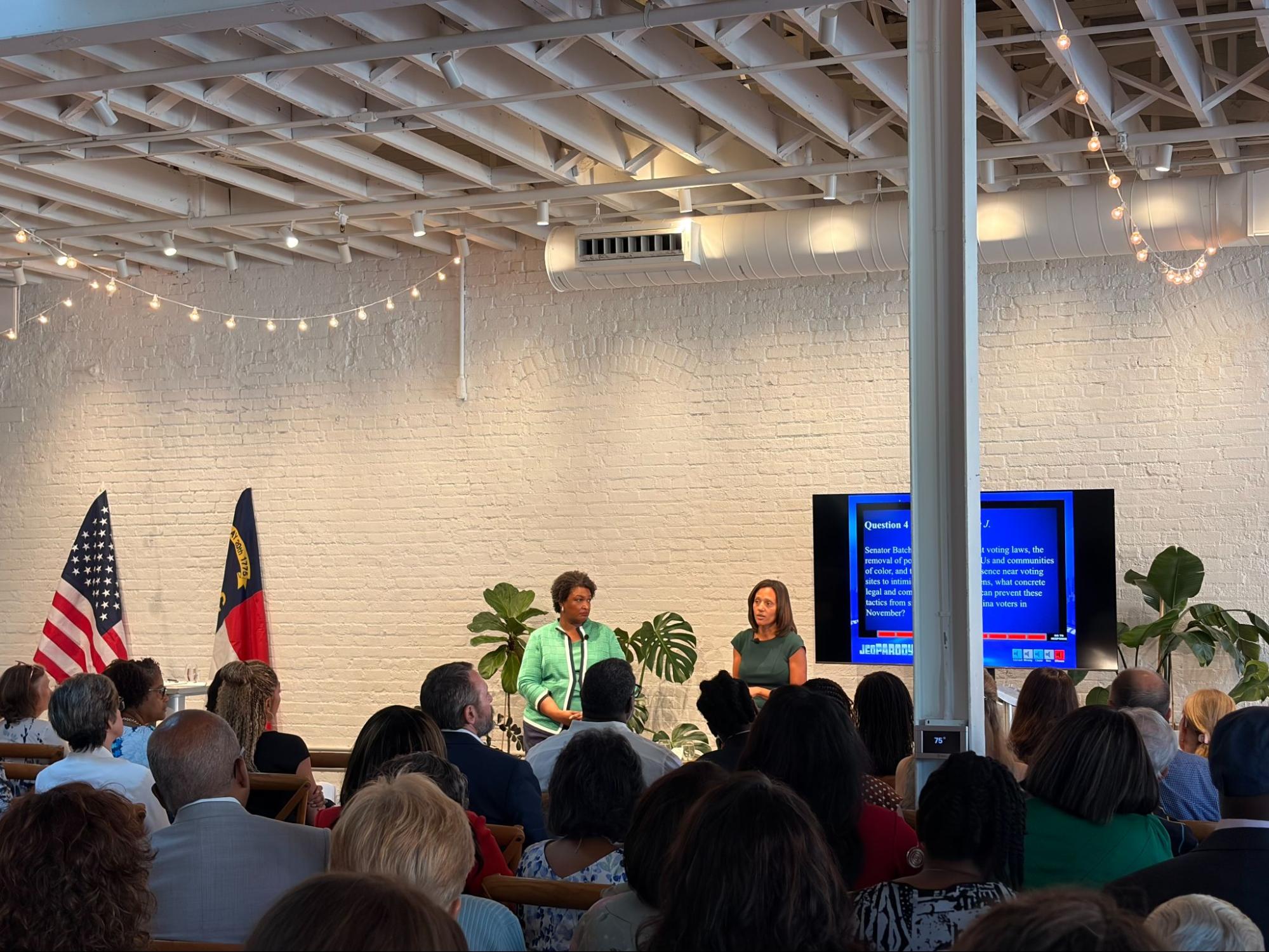
Raleigh, NC — It was a standing-room-only crowd in Raleigh as North Carolina Senate Democratic Leader Sydney Batch took the stage alongside national voting rights champion, attorney, and author Stacey Abrams for an intensive, data-driven Jeopardy-themed conversation on the political landscape. Way more innovative than standard campaign events, the fundraiser served as an evidence-based dissection of the most critical policy issues facing North Carolina and the nation, from structural failures in the healthcare system to coordinated threats against the judiciary and voting infrastructure.
The forum underscored a singular theme: true leadership does not distort the facts for comfort; it empowers communities by confronting brutal truths with an actionable strategy for progress. The evening kicked off with audience members selecting policy categories to guide the discussion. The first critical issue raised concerned the North Carolina State Health Plan and the state’s obligation to provide affordable, accessible healthcare to public employees and retirees without shifting the burden to them through increased premiums and co-pays.
Leader Batch addressed the crisis directly, pointing to fifteen years of fiscal management under opposing legislative leadership that failed to protect the state’s infrastructure. “We waited over a decade to have Medicaid expansion,” Batch stated, drawing a direct line between systemic policy delays and rising costs for private policyholders. “It isn’t about the fact that it’s going to just go down because all of a sudden we remove people from the rolls. All of us with private insurance are going to continue to pay the price because the uninsured are the most vulnerable.”
Batch, a cancer survivor who received treatment at UNC, shared a profound personal perspective on the geographic disparities embedded in the healthcare system, noting she met patients traveling from Nash County and the coast because vast swathes of North Carolina have become medical deserts.
The policy conversation grew sharper when analyzing the raw data of the current state budget. Batch highlighted the stark economic reality of a state maintaining a minimum wage of $7.25 an hour, amounting to just $15,080 a year for an individual working 40 hours a week for 52 weeks without a single day off. Despite this, she noted, the legislature’s current budgetary trajectory imposes higher co-pays and premiums on the expansion population and state employees.
Stacey Abrams echoed these concerns by providing data from Georgia, a state that spent $80 million on a partial Medicaid expansion model, two-thirds of which was swallowed by administrative costs rather than direct patient care. “Medicaid expansion is life-saving care,” Abrams urged, noting that Georgia’s refusal to fully expand Medicaid has left it with some of the worst maternal mortality rates in the nation and led to the systemic closure of rural and metropolitan hospitals alike.
In North Carolina, Batch noted that while progress has been made, such as extending postpartum Medicaid coverage for pregnant women from 60 days to 12 months. New hurdles, such as retrogressive three-month lookback periods and complex work requirements, threaten to deter families from seeking care. “When you are turned down once, you are unlikely to ever sign up again,” Batch warned. “That is not going to reduce the cost of medical care and treatment; it’s only going to increase it.”
The dialogue shifted to the legal and community protections necessary to combat stringent voting laws, including the strategic removal of polling places from historically Black colleges and universities (HBCUs) and minority communities. When asked what concrete measures can prevent voter intimidation at the ballot box, Leader Batch called for radical civic participation and the deployment of human infrastructure. She recalled past election cycles where voters in her own district faced intimidating displays, including oversized Confederate flags and armed individuals at polling sites. Batch emphasized the necessity of trained, nonpartisan observers and volunteer attorneys. “What we need to do as a people, and so many of you in this room with privilege need to do, is be there at these polling places,” Batch asserted. “You need to be those nonpartisan observers. You need to be the line that holds… We are doing our very best to make sure that we are hiring and we have a lot of volunteer attorneys to be on this line.”
Abrams contextualized this fight by emphasizing the practical, block-by-block mechanics of election security. “Help people make a plan to vote, make certain they know what day the election is,” Abrams advised, reminding the audience that working-class voters often carry logistical burdens that obscure election timelines. “We owe it to our ancestors. They’ve been through worse. So now it’s our turn.”
A central focus of the evening was a granular breakdown of what it takes to break the legislative supermajority in North Carolina and protect the judiciary from hyperpartisan overreach. The financial and strategic calculus laid out by Leader Batch presented a compelling argument for the efficiency of investing in state legislative races:
The U.S. Senate Math: A competitive, top-of-the-ticket statewide race in North Carolina can easily command a staggering $800 million in collective spending.
The NC Senate Math: By contrast, the entire Senate Democratic Caucus can mount a highly competitive battle to build a working majority for roughly $12 million.
“That is 1.5% of the entire U.S. Senate spend,” Batch calculated, demonstrating how direct financial resources go significantly further in targeted local legislative districts. To break the current Republican supermajority, the Senate Democratic Caucus needs to net just one seat to reach 21, while a “great year” could push the caucus to 23 or 25 seats, securing a functional tiebreaker alongside the executive branch.
Abrams backed this strategy by pointing to historical data from her 2018 gubernatorial run in Georgia. While she narrowly missed the executive mark by 53,794 votes, the targeted, down-ballot investment successfully flipped 14 legislative seats and broke a devastating supermajority. “All of the evil that they do that they cannot get through an impotent Congress is coming to a state near you,” Abrams warned, framing state legislatures as the primary battlegrounds for modern policy warfare.
Furthermore, both leaders stressed that legislative majorities are the ultimate defense mechanism for the judiciary. Batch raised the alarm regarding partisan maneuvers across the country, such as the introduction of recall mechanisms targeting independent judiciaries, and warned that maintaining seats like Justice Anita Earls’ on the North Carolina Supreme Court is crucial to preventing the systematic dismantling of democratic oversight.
Closing the night under the banner of “Keeping Hope Alive,” Abrams shifted the perspective from defensive posturing to a proactive framework for civic engagement. She contrasted the mechanics of authoritarianism, which she defined as taking power, hoarding power, and avoiding accountability. Democracy, which requires sharing power, leveraging power for the collective benefit, and maintaining strict accountability. Abrams challenged the audience to push back against the weaponization of language, specifically the targeted attacks on Diversity, Equity, and Inclusion (DEI) frameworks. “They see DEI for what it is: Diversity is people, Equity means fair access to opportunity, and Inclusion means respect for belonging,” Abrams declared. “In a democracy, that’s the DNA… We can’t let them seize our language and scare us into not calling the truth out. When they do that, we lose. When we refuse to let them take our language, we win.”
To counter structural voter fatigue, Abrams directed attendees to the 10 Steps Campaign, an action-oriented initiative designed to provide everyday citizens with an explicit plan for local resistance. The strategy hinges on executing practical steps: hosting and sharing informational narratives, organizing locally, litigating in both the courts and the court of public opinion, utilizing nonviolent disruption, and consistently engaging elected officials up and down the ballot.
As the standing-room crowd dispersed, the mandates left behind by both leaders were clear: fundraising is not merely an aggregation of dollars, and democracy is not a passive experiment. It is a continuous, disciplined application of hope, labor, and strategy.
Based on reporting by The Carolinian.
The post Standing Room Only in Raleigh with Leader Sydney Batch and Stacey Abrams appeared first on BlackPressUSA.