




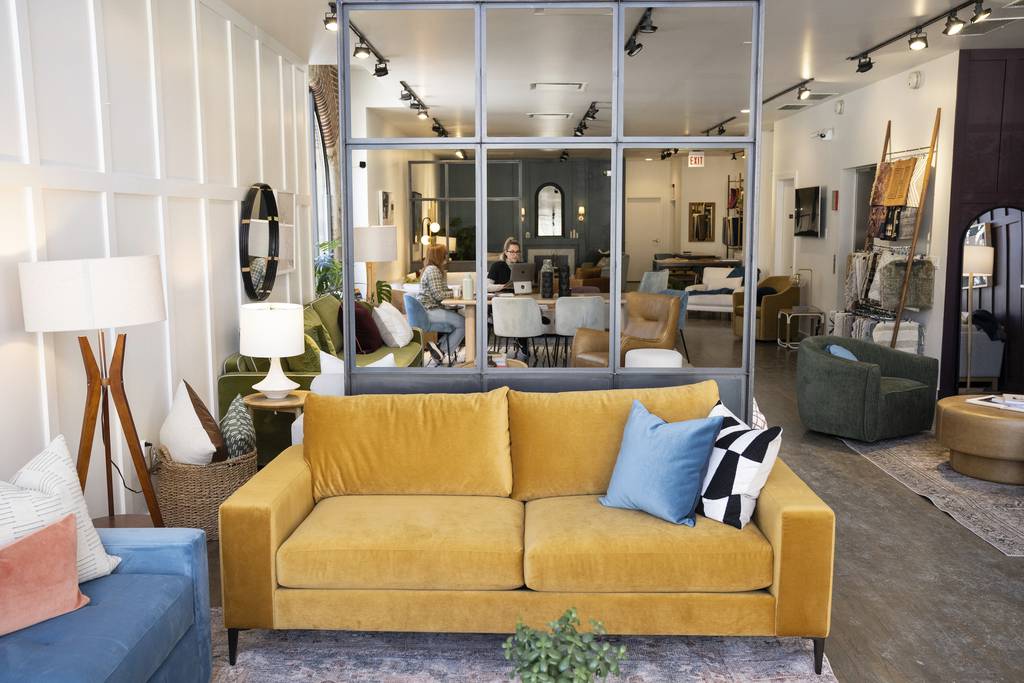
When Interior Define began a liquidation process in late December, the Chicago-based custom furniture retailer left thousands of customers with unfulfilled orders and little hope of recovering their money.
But the since-failed Silicon Valley Bank was repaid millions by Interior Define as both stood on the precipice of collapse.
In a confluence of business implosions, documents show Silicon Valley Bank was a secured lender to Interior Define before the retailer made an assignment for the benefit of creditors, a bankruptcy alternative under Illinois law that bypasses the courts to transfer an insolvent company’s assets free of unsecured debt.
Interior Define, which struggled much of last year with order backlogs, dwindling cash reserves and mounting debt, owed four secured lenders about $25 million in late 2022, but the balance was reduced to $14 million as of the Dec. 31 notice of assignment, according to published documents.
The $11 million difference, according to a source familiar with the situation, represents Interior Define paying off its Silicon Valley Bank loan before essentially seeking bankruptcy protection.
Within months, the bank would be in equally dire financial straits.
Silicon Valley Bank issued the secured loan for an undisclosed amount in May 2021, according to a report obtained by the Tribune from the state of Delaware, where Interior Define was incorporated.
The California-based technology lender collapsed last month amid a bank run and allegations of lax oversight, and was taken over by the Federal Deposit Insurance Corp.
North Carolina-based First Citizens Bank bought Silicon Valley Bank out of FDIC receivership on March 27, assuming assets of $110 billion, deposits of $56 billion and $72 billion in loans. It is unclear if any remnants of the Interior Define loan are part of that portfolio.
A spokesperson for First Citizens Bank did not respond to a request for comment.
Launched in 2014, Interior Define carved out a niche as a direct-to-consumer custom furniture retailer, leveraging its e-commerce site and a handful of brick-and-mortar stores, including its Chicago flagship in Lincoln Park.
Funded by $100 million in debt and equity financing, Interior Define brought in new leadership and rapidly expanded during the pandemic, growing from five to more than 20 retail stores. Derailed by supply chain issues and rising inflation, the company began experiencing “financial challenges” in early 2022, the assignee said in the notice.
By last summer, the company was unable to pay its overseas manufacturers and logistics providers, leaving its furniture orders in limbo and thousands of customers, many of whom had paid in full, waiting in vain for delivery.
In mid-December, the company and its secured lenders agreed to sell the brand and some assets to Denver-based Havenly, a direct-to-consumer home furnishing competitor, which lent Interior Define $3.95 million to continue operations, according to the assignment notice.
Havenly completed the foreclosure acquisition on Dec. 29 for an undisclosed amount, and two days later, Interior Define entered into the assignment for the benefit of creditors. Accounting firm Armanino was appointed assignee for the defunct Interior Define company.
A Havenly spokesperson declined to comment for this story.
As Havenly took over the Interior Define brand, the Dec. 14 loan also made it one of four secured creditors to the predecessor company. Havenly joined Silicon Valley Bank, Horizon Technology Finance and Powerscourt Investments on the short list, according to the Delaware secretary of state’s office.
Havenly has no legal obligation to fulfill any Interior Define orders placed before Dec. 29, but hoping to preserve the value of the brand as backlash grew on social media, the company paid to get about half of the overdue orders delivered, and also offered customers discounts on future orders.
That largesse has ostensibly expired, and customers with unfulfilled orders are now being instructed to file claims with the assignee by June 29, a long shot for recovering any money.
“The Assignee does not believe that any funds will be available for distribution to unsecured creditors,” according to the notice published Jan. 30.
Chicago-based attorneys representing the predecessor Interior Define company declined to comment.
Several customers now forced to become creditors, however, had plenty to say.
“It’s kind of odd for the new owner to try to revive the brand while picking and choosing whose orders are going to get honored and whose are not,” said Suzanne Roberts, 40, an Atlanta attorney whose Interior Define shipment never came in.
Roberts spent nearly $3,000 for a chair, two benches and four pillows at an Interior Define store near her home in October. She received one bench in January and a $471.85 credit for future furniture purchases in March.
Last week, Roberts received an email from Interior Define explaining the credit was for the throw pillows that were unable to be fulfilled by a third-party vendor. The company also delivered the news that no other furniture — or merchandise credit — would be forthcoming.
“This has been a quickly evolving process and after further order reconciliation, it’s been determined that we are unable to fulfill the remaining custom pieces of your order or issue an additional merchandise credit at this time,” the company said, encouraging Roberts to file a claim.
A utility company attorney, Roberts previously worked as a bankruptcy lawyer for six years.
Despite the most recent missive from Interior Define, she has yet to file a claim, holding out hope that the company will find a way to fulfill her order.
“What I want is the stuff,” she said. “I don’t want a bankruptcy claim.”
Ralph Cutler, 46, a web designer from Austin, Texas, ordered a $2,500 sleeper sofa from a nearby Interior Define store in June to convert his garage into a “granny flat” for vacation rentals and family visits. Paid for with a debit card, the sleeper sofa has yet to arrive.
The order status was updated through a series of emails over months. In November, Interior Define apologized for “dropping the ball,” pushing the delivery date back to mid-April.
Not prepared to wait 10 months for the couch, Cutler submitted an order cancellation on Nov. 28, seeking a refund. That set off a flurry of emails, but did not produce either the couch or the refund.
In January, after the foreclosure sale to Havenly, Cutler began receiving emails from Interior Define marked “under new management,” with an updated order status, but no mention of the refund request.
“Your order has been produced, but neither the new entity nor the estate have the funding or ability currently to fulfill this order,” the emails stated.
Last month, the company was more definitive, informing Cutler the order would not be filled.
Cutler filed for recovery with Donlin Recano, the New York-based claims agent handling the Interior Define assignment. He also bought a $3,000 sleeper sofa from Apt2B, a competing online custom furniture maker.
“We just bit the bullet and bought another one from a company that actually delivered it and did a very nice job,” Cutler said.
Cutler explored taking legal action against Interior Define, but calculated the expense would eat away at any chance of getting his money back. He is hoping someone else will file a class-action lawsuit he can join.
Jay Teitelbaum, a retired New York bankruptcy attorney whose daughter, an architectural consultant, lost $10,000 after ordering furniture from Interior Define for a client in September, is pursuing a different legal tack: a group action forcing the company into an involuntary Chapter 7.
A court-supervised bankruptcy would bring greater transparency than the assignment for the benefit of creditors, revealing any payments to Silicon Valley Bank and other secured creditors, Teitelbaum said.
It might also provide a means to recover some proceeds for unsecured creditors, including his daughter.
“The bankruptcy code has procedures and laws that allow a trustee to claw back fraudulent and other improper transfers to the benefit of the general unsecured creditors,” Teitelbaum said.
Teitelbaum shares the frustration of customers who bought their furniture after Interior Define was already in financial distress and unable to fulfill orders. Knowing that Silicon Valley Bank benefited from the liquidation process — just months before its own collapse — raises the stakes, he said.
Whether an involuntary Chapter 7 bankruptcy produces a better financial outcome remains to be seen, but Teitelbaum said there is something else of value for thousands of Interior Define customers: accountability.
“I don’t hold out faith that there would be much more of a benefit for the creditors, but at least there’ll be someone taking a look at this,” Teitelbaum said.


