


By Stacy M. Brown
Black Press USA Senior National Correspondent
When the Supreme Court began its 2025–26 term on Monday, legal observers, scholars, and advocates warned that the justices are again positioned to shape the country’s direction on equality, freedom, and democracy itself.
The new docket is filled with cases involving race, gender, campaign finance, and presidential authority. At the D.C. Bar’s annual Supreme Court Review and Preview, more than one hundred attendees gathered in person and virtually to hear predictions about the cases that could define the nation’s future. Moderator Daniel Woofter said the “polarization of the Court is undeniable.” According to figures discussed at the event, Chief Justice John Roberts joined the majority 95 percent of the time during the previous term, while Justices Clarence Thomas and Samuel Alito aligned 97 percent of the time. Elaine Goldenberg of Munger, Tolles and Olson said what was once a rarely used emergency docket has now become “a huge part of the Supreme Court’s work.” She said the docket has allowed the justices to act on politically charged cases without the full process of hearings.
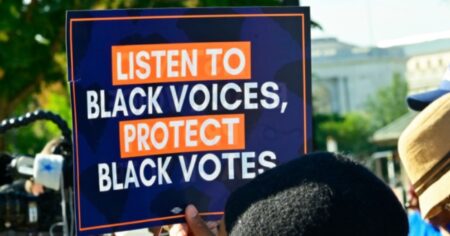
That process could again be used to decide cases on transgender rights, conversion therapy, and the limits of presidential authority. In Little v. Hecox and West Virginia v. B.P.J., transgender students are asking the Court to overturn laws that prevent them from competing on teams that match their gender identity. The United States filed briefs opposing those challenges. “It doesn’t seem likely to me that the challengers of both laws are likely to prevail,” Goldenberg stated, noting that the government’s arguments were “sharp in tone” and clearly presented. The PBS NewsHour described this year’s docket as “a reflection of the cultural and partisan clashes of American politics.” One of the most significant cases, Louisiana v. Callais, will determine whether the state must create another majority-Black congressional district under the Voting Rights Act. The case follows Allen v. Milligan, which required Alabama to add a second Black-majority district. The late Justice Ruth Bader Ginsburg once warned that removing protections from the Voting Rights Act was “like throwing away your umbrella in a rainstorm because you are not getting wet.”
Another case, Chiles v. Salazar, challenges Colorado’s law banning conversion therapy for minors. The lawsuit claims the ban violates free speech and religious liberty. Medical and mental health organizations have long described conversion therapy as dangerous and harmful to young people. In National Republican Senatorial Committee v. Federal Election Commission, former Senator JD Vance is asking the Court to strike down restrictions on how political parties and candidates can coordinate campaign spending. William Jay of Goodwin Procter said the lawsuit “blurs the line between giving and spending.” He said the longstanding rule that giving money to candidates can create corruption risks while spending personal funds counts as free speech is now in question.
The Court will also consider Learning Resources, Inc. v. Trump, a case challenging tariffs imposed under the International Emergency Economic Powers Act. “There was no relationship between the products and the drug trafficking cited to justify the tariffs,” said Morgan Ratner of Sullivan and Cromwell. She explained that the case tests how far presidents can extend their authority during so-called national emergencies. SCOTUSblog reported that the Court has added several other cases touching on guns, property rights, and government power, including a challenge to Hawaii’s law that prevents people from carrying handguns on private property without the owner’s consent. The Court will also review disputes over compensation for property confiscated in Cuba and how the Fifth Amendment’s takings clause applies in those cases.
Legal analyst Elie Mystal wrote in The Nation that the Court “has been corrupted and weaponized” and now functions as “an antidemocratic enforcement mechanism of the Republican political agenda.” He said Democrats missed an opportunity to push for real reform after the Dobbs ruling that overturned Roe v. Wade. Mystal said, “The Supreme Court does not have the final say over how we have to live as a society. We do.” The PBS NewsHour reported that the Court’s current majority now favors what is known as originalism, the belief that the Constitution should be interpreted as it was understood when first ratified, rather than as a living document that evolves with society. Scholars said this view has already changed national law on abortion, guns, affirmative action, and federal regulation.
The Court’s rulings this term are expected to affect elections, education, civil rights, and the limits of government power. Public confidence in the judiciary has reached record lows. One panelist at the D.C. Bar discussion said, “Every ruling this term will tell us something about what kind of country we still are.”