


Like skyscrapers, improv comedy or even a good hot dog, the cellphone was born in Chicago but quickly claimed by New York City as its own.
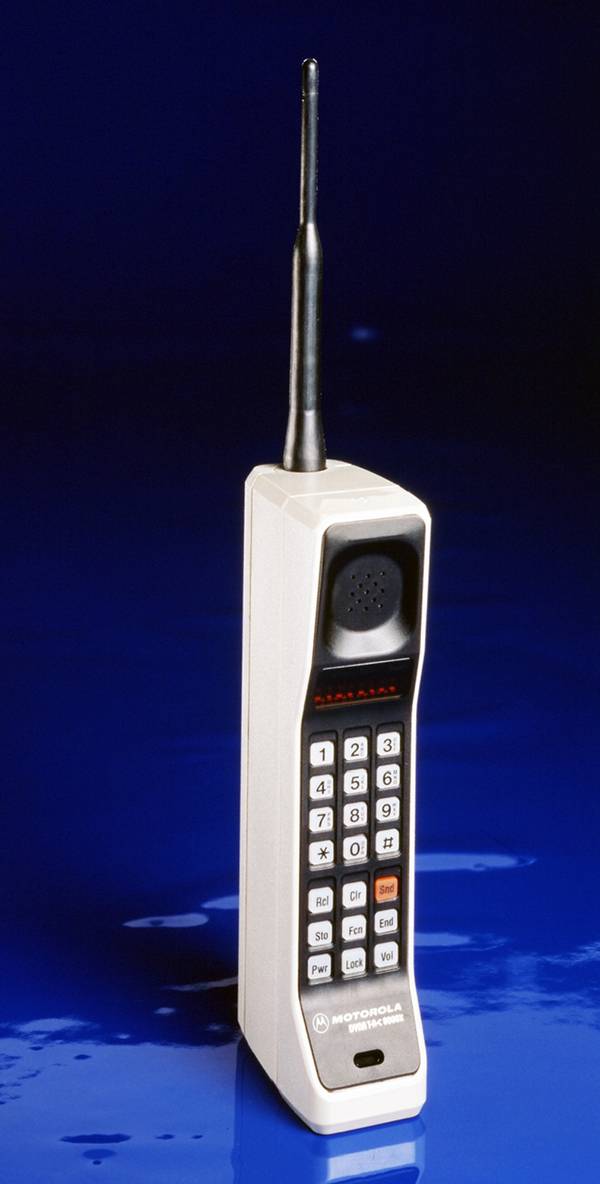
Motorola executive Martin Cooper was standing on Sixth Avenue just blocks from Radio City Music Hall in Manhattan on April 3, 1973 — 50 years ago today — when he dialed his Chicago-built cellphone prototype. The 2.5-pound, 10-inch-long model’s inspiration came from a bespoke, two-way radio system that the company created in the 1960s for the Chicago Police Department.
Cooper officially claimed the first-ever cellphone call in history when Joel Engel — his rival at AT&T — answered.
“Joel was very polite to me, but to this day he’s not sure he ever got that phone call,” Cooper said. “But he doesn’t reject the possibility that he did get it. And I don’t blame him for that.”
Soon anyone with a cellphone would be able to make phone calls “while riding in a taxicab or bus, walking down the street, sitting in a theater or other building, or shopping,” the Tribune wrote the next day.
Cooper and seven others share U.S. Patent No. 3,906,166, published Oct. 17, 1973, for a “Radio Telephone System,” which included both the phone and the tower network to connect it.
Though it would be another decade before Motorola sold the DynaTAC 8000X to the public for more than $12,000 in today’s money, Cooper’s call was the start of a technological revolution.
The 94-year-old recently spoke with the Tribune during an interview, which, ironically, was not conducted on a phone but via Zoom. The conversation, edited for clarity, is below:
Q: In your book (“Cutting the cord: The cellphone has transformed humanity”) you say that the best precursor to the cellphone was a two-way radio system Motorola built for the Chicago Police Department in the 1960s. What gave you the idea to cut the cord on that mechanism?

A: That system was the most modern of any police department in the world. Police superintendent (O.W.) Wilson was trying to revolutionize the Chicago police force. They were in trouble at the time.
[ The Summerdale Scandal and the case of the babbling burglar ]
Every police officer was stuck in a car — it kind of isolated them from the people. So (Wilson) asked if there was some way to get his officers better connected but still be mobile enough to move out of their cars.
So to me, this was heaven because at that time I had been promoted to work in portable products. Until then, our whole business was two-way radios in cars. We were trying to sell to people the freedom to be anywhere — we just had to come up with the technology to do this.
And so we created a special radio just for (Wilson). It was a portable handset — a little brick that had a microphone and antenna — that attached to the officer’s shoulder. A wire connected the handset to a speaker that the officer wore on his belt. And that little detail made the model work in both the car and on the street.
It turns out that this really was a cellular system.
Q: What made it cellular?

A: We have a lot of little cells (a series of geographic areas — each with its own electronic device that receives and transmits signals — that are connected to create a communications system) throughout Chicago now. Hundreds of cells. When you’re talking in any one cell you are using a transmitter in the middle of that cell. But if you move to another cell, then the call just automatically moves to another transmitter without you even being aware of it. You just have a continuous conversation. It really is wonderful technology.
I think I get it.
It’s very good that you don’t understand it — because you shouldn’t. The value of technology is that the person using the technology doesn’t need to know how it works. They can just take advantage of it.
Q: Was part of the challenge then, in creating a cellphone, figuring out how to make it so that the phone could move efficiently from cell to cell?
A: That was the big challenge in cellular. For the police department that was not a challenge.
The typical police conversation — police officers are very disciplined — is less than 15 seconds. The conversations are short, so they would never move from one cell to another quickly.
When people talk to each other on the telephone, the average conversation is two and a half minutes. You can move a lot in two and a half minutes. When you drive through Chicago now, you could be in a different cell every 10 seconds.
Q: Where did your innovative thinking come from?
A: I’m not sure — we’re not going to make this a psychology session. In my early years, though my folks were entrepreneurs and they both worked really hard. They were immigrants from what today is Ukraine.
I spent a lot of time alone and became an avid reader, dreamer and science fiction advocate. I like to tell people that I’m an engineer and engineers are supposed to be fixing today’s problems, but I’m a pretty good futurist so I have a different way of thinking. My tendency is to look in the future and, without today’s restrictions, think about how would I want the world to be and then try to move in that direction. But if you spend too much time in the future, then you’ll never get anything done.
Q: That said, now take me back to the past. What was it like prepping for the April 3, 1973 press conference in New York City where you were going to introduce reporters to the cellphone?
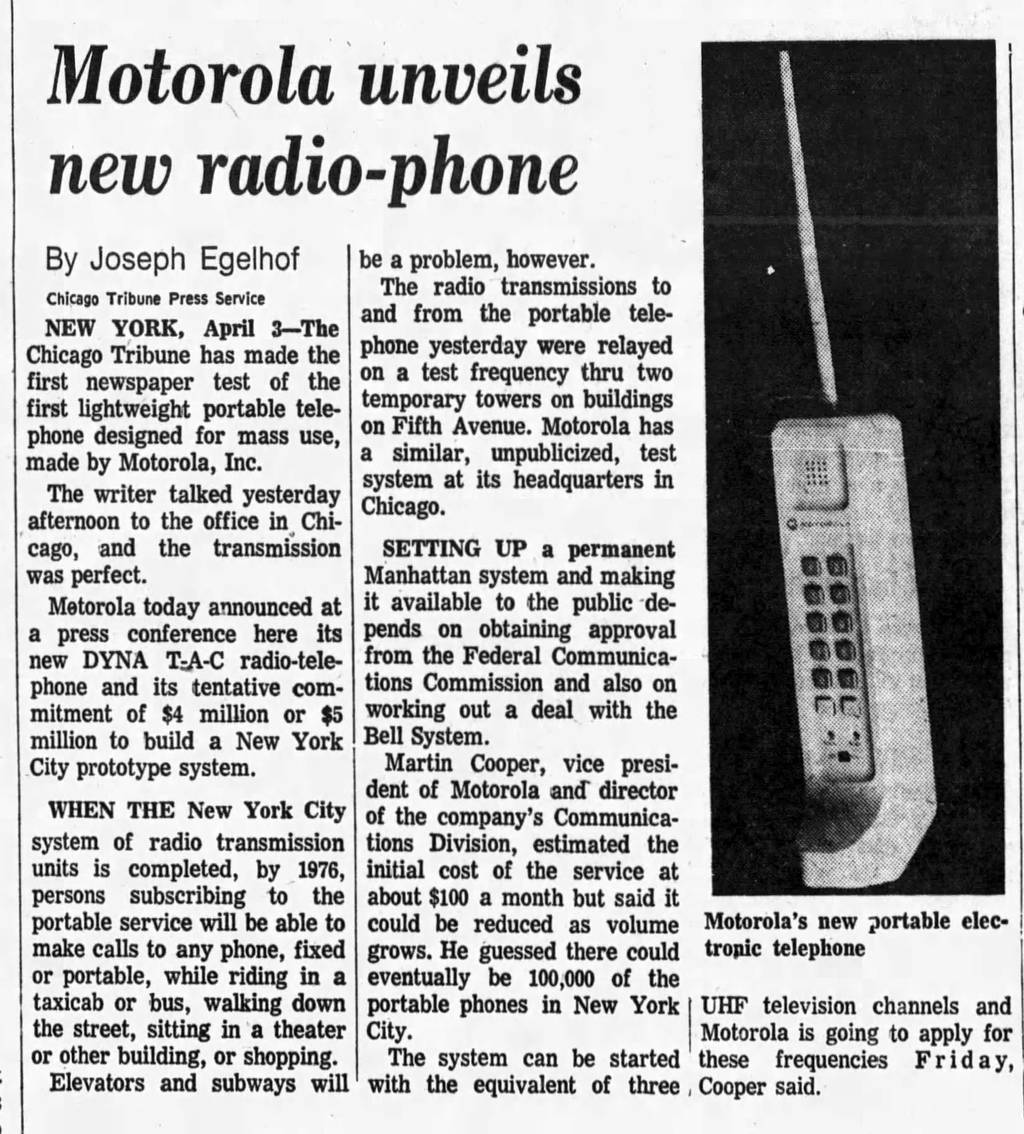
A: Oh, well, you just can’t imagine. It was a miracle what my team did — just incredible. The number of brick phones that they had to make over a period of three months. To have the right new antenna we had an all new frequency band to be able to talk and listen at the same time. We operated over hundreds of radio channels.
All of these things had been done previously in big boxes. We had to put all that into a small handset.
Today, an iPhone has a couple billion transistors in one little chip. We were using individual transistors wired up by an engineer with a soldering iron.
We were at the Hilton (Midtown) hotel in New York in the two-story penthouse suite, which used to be where Elizabeth Taylor and Richard Burton stayed. It had a big fancy bed and a piano. Our engineers were sitting there in this great environment fixing things on this (prototype) because it wasn’t quite right.
I told reporters that we are going to demonstrate the freedom that the cellphone is going to bring to people. Let’s do it out on the street.
Recognizing the unreliability of our phone, we had two of them and an engineer was standing by just in case my phone failed.
And, amazingly enough, I don’t know if you know about New Yorkers, but they’re not friendly like Chicago people. You’re invisible to them when you’re walking down the street. And here they have this person standing there talking on what looks like a strange telephone, and there were people stopping and looking at us.
Q: Who did you call and what did you say in the first cellphone call?
A: You know, not everybody welcomed our view of what the future of the world would be. AT&T — no I shouldn’t call it AT&T because it was a very different company then — Bell Labs was ready to introduce cellular telephony. But their version of that was car telephones. Can you believe that?
Q: Which Motorola already had, right?
A: Yes. We had been trapped in our homes and offices by a copper wire and now they’re going to trap us in our cars. We just didn’t think that was right.
But the Bell system went ahead with their version of this thing, which was the car telephone, and the guy that ran their program was Joel Engel.
I didn’t figure out who I was going to call until the last minute, and it occurred to me, “Why don’t I call Joel?”
Q: Did he answer?
A: I called up Joel’s phone and, amazingly, he answered the phone.
I said, “Hi Joel, it’s Marty Cooper.”
He said, “Hi Marty.”
I said, “Joel, I’m calling you on a cellphone — a real cellphone. A personal, handheld, portable cellphone.”
Q: You mention in your book that you wanted to work for Bell after college, but weren’t yet qualified to do so. So how did it feel to rub it in his face a little bit?
A: Well, as you can tell, it was a very good feeling.
Q: There were many different designs produced by your team for the cellphone prototype including a flip phone, one nicknamed banana and another called “the shoe.” Why did you ultimately go with the brick design?
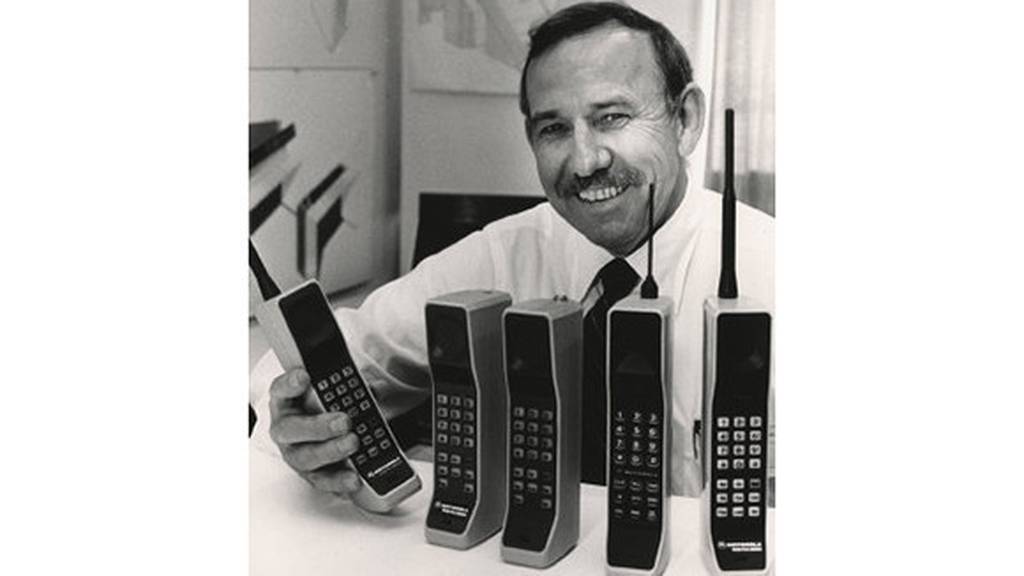
A: We had three months to come up with a design before the demonstration. The more complicated the phone (design) was, the more things that could break.
We took a vote and everyone on the team decided to go with the simplest version. What could go wrong with the brick?
The guy who designed it was Rudy Krolopp. He took his whole team and put them on this project and never charged a nickel to my department. The guy who built it was Ken Larson. Don Linder was the guy who actually put the phone together.
I was just the luckiest person in the world to have a team of brilliant people.
Q: How did you choose the name for it? DynaTAC?
A: DynaTAC stands for Dynamic Adaptive Total Area Coverage. That was my dream — when you traveled throughout a city, you were dynamically changing channels all the time.
Q: I’ve seen conflicting reports on your inspiration for the cellphone — was it “Star Trek” or Dick Tracy? Dick Tracy was first published in the Chicago Tribune so I hope you say that.
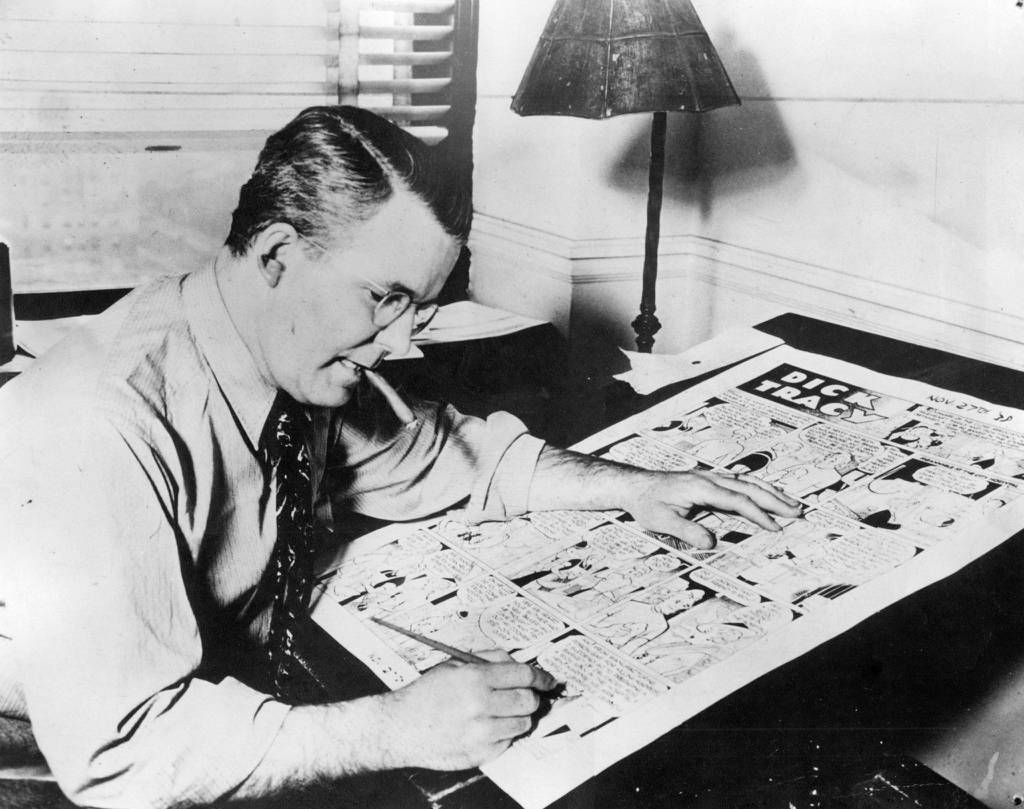
A: The idea of a person using this thing with a device on your wrist, you’ll be happy to know that it was Dick Tracy.
When I got the job of running Motorola’s portable products division, my one objective was to make a wrist phone. Sure enough, at one point, I made one but it was huge.
[ Vintage Chicago Tribune: Orphan Annie, Dick Tracy and the rise of newspaper comics ]
Q: You mentioned earlier there are two DynaTAC prototypes. Where are those now?
A: Well, one of them is in my office. The guy who built it took the insides out and put them inside a Lucite cylinder. And the other one, Don Linder — who was the real engineer for it — he’s got it. Someday I hope he contributes it to the Smithsonian.
Q: The time between when you made the first phone call and when the phone became available to the public was about 10 years. Who was your target audience for it? Who did you think would buy it because the model was very expensive when it hit the market, correct?

A: That’s exactly right. The portable cellphone in 1983, when they first introduced the thing, it cost almost $5,000. In 1983 dollars, it would be like $12,000 today.
Aside from that, it didn’t work that well. The cells were a little too big so you had to be in a good coverage area in order to make a call.
Q: In “Wall Street,” the 1987 movie, Michael Douglas’s character walks on a beach while making a phone call on a DynaTAC 8000X. When did you realize that people were not only becoming receptive to this technology, but that soon everyone would have one?
A: We didn’t believe that when we started out. But we also knew at $12,000, not many people would buy it.
Guess who were the first people who benefited from the cellphone? Think about it for a second. Real estate agents do two things — show homes or answer the phone when somebody wants to buy a home. The cellphone meant they could do both at the same time.
Today, about two-thirds of people in the entire world have a cellphone. And a majority of them are using those cellphones because they’re essential to their existence — it’s how they make money, stay alive, keep in touch with people.
By the way, I want to mention that my wife Arlene Harris, who is much smarter than I am, invented the system by which most people in the world use their cellphones — prepaid cellular. When people buy their cellphones, it doesn’t come with airtime. She invented the concept where you buy the phone, then pay for the time as you use it.
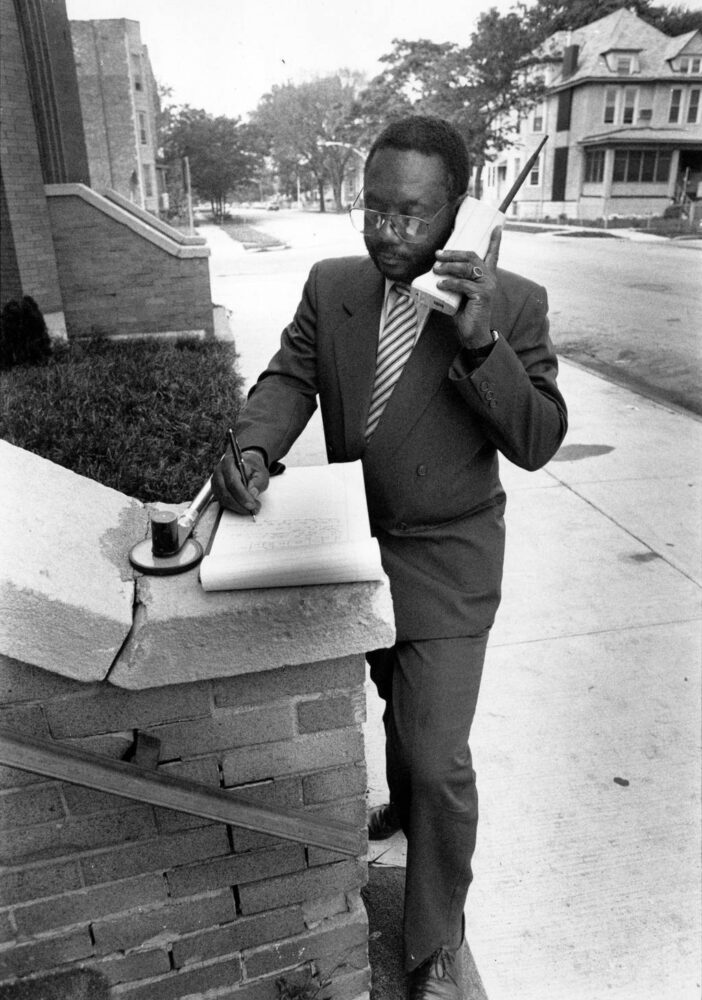
Q: As you said, everybody has a cellphone now. Did you ever imagine how many different functions the cellphone would have? We use it like to take pictures, to take videos, to order food and to track our steps. Did you ever envision that, one day, we’d be able to do this much with it?
A: Oh, not at all. We were so proud of all the technological breakthroughs we made just to place a person-to-person call. But my excuse is that in 1973 there was no Internet, right? There were no cordless phones. The digital camera had not been invented yet. So, it would have been a stretch for us to imagine that you could ever squeeze all of those features into this small device.
Q: What type of cellphone do you use? Do you have any favorite apps?
A: Whenever a manufacturer comes out with new features on a cellphone, then they are always guaranteed a sale because I have to try out the latest thing. Now, I’m using an iPhone. I have several hundred apps thinking someday I might use that, but really I only use about a dozen of them regularly.
The reason that I like the iPhone specifically is I’m very aggressive about physical fitness. You have to be if you want to try to stay alive. I work very hard at that. My iPhone connects to my iWatch, which is waterproof. Would you believe that my watch not only measures how fast I’m swimming, it also knows what stroke I’m swimming? It knows how many laps I swim and when I stop. It’s quite amazing and that’s just one application.
The second thing that’s very important to me is my hearing. I was in the Navy and I used to fire pistols that made huge noises so I pretty much destroyed my hearing. I wear hearing aids that when you call me on my iPhone, the signal goes right through the iPhone and into them.
I have another app that measures my sleeping habits and tells me exactly how many hours of deep REM sleep I get — and criticizes me when I don’t go to sleep on time. That’s one of my favorite apps.
Q: I think I need to start monitoring my health on my iPhone then, too, if that’s a feature that you enjoy — and look forward to being bugged by your phone or your watch whenever you’re not doing your normal routine.
A: Yeah, exactly. I am critical of the modern phone just because of that. You know, the phone has become an extension of you. So why should you have to customize your phone by selecting among 4 million apps, which is how many there are in the Apple Store.
There really ought to be in your phone an artificial intelligence that knows you, knows your personality and has watched you for a few weeks in order to figure out exactly what you want and need in a specific app — it would even go find it or manufacture it for you. In the next 10 years, you’re going to find cellphones will be much easier to use.
Q: Have you been tempted to type your name into an artificial intelligence chatbot and see what it tells you about yourself?
A: I’ve done that, as a matter of fact. I created a thing called the Law of Spectral Efficiency, which is a very technical thing. People call it Cooper’s Law. So, for the fun of it, I went to ChatGPT and said, “Could you tell me what Cooper’s Law is and who created it?”
It ended up with a pretty good answer, but it said the law was created by H. Seymour Cooper who lives in Georgia. I responded, “My name is Martin Cooper and I created Cooper’s Law.”
ChatGPT said, “Well, you’re right.” But then it said cwas a totally different thing.
Artificial intelligence has a little ways to go, but it still does some incredible things. It’s another place where people are going to have to learn how to handle new technologies — and it’s not going to be easy.

Q: What advice do you have for creative thinkers, futurists, like yourself?
Afternoon Briefing
Daily
Chicago Tribune editors’ top story picks, delivered to your inbox each afternoon.
A: Well, I’ve been very lucky to be associated with people who have taught me a few things. The founder of Motorola once made a comment that I live by: Do not fear failure, reach out. I have lived by that. I have had more failures than you could imagine — even in my history at Motorola. I also, fortunately, had enough successes so they tolerated me for 30 years. But the ability to reach out is essential, the ability to take risks. And you just have to know the satisfaction that comes out of having an idea of seeking it out and having a world accept it — there is just nothing more glorifying and satisfying than that.
Q: What do you think the cellphone of the future will be like?
A: I think that what we call a cellphone today is going to be very different 10 years from now and 20 years from now. Besides artificial intelligence, it’s going to have all kinds of devices that measure things in our body, anticipate diseases and zap them before they become diseases. No diseases. Can you imagine a world with no disease?
I think, too, that the whole nature of education is going to change because students will have access to all the information in the world. And teachers will have to teach more important things like how to discriminate between good and bad information, about ethics and things of that nature. So, we’re only at the very beginning of how the cellphone is going to contribute to the future of humanity.
Subscribe to the free Vintage Chicago Tribune newsletter, join our Chicagoland history Facebook group and follow us on Instagram for more from Chicago’s past.
Twitter @rumormill


