


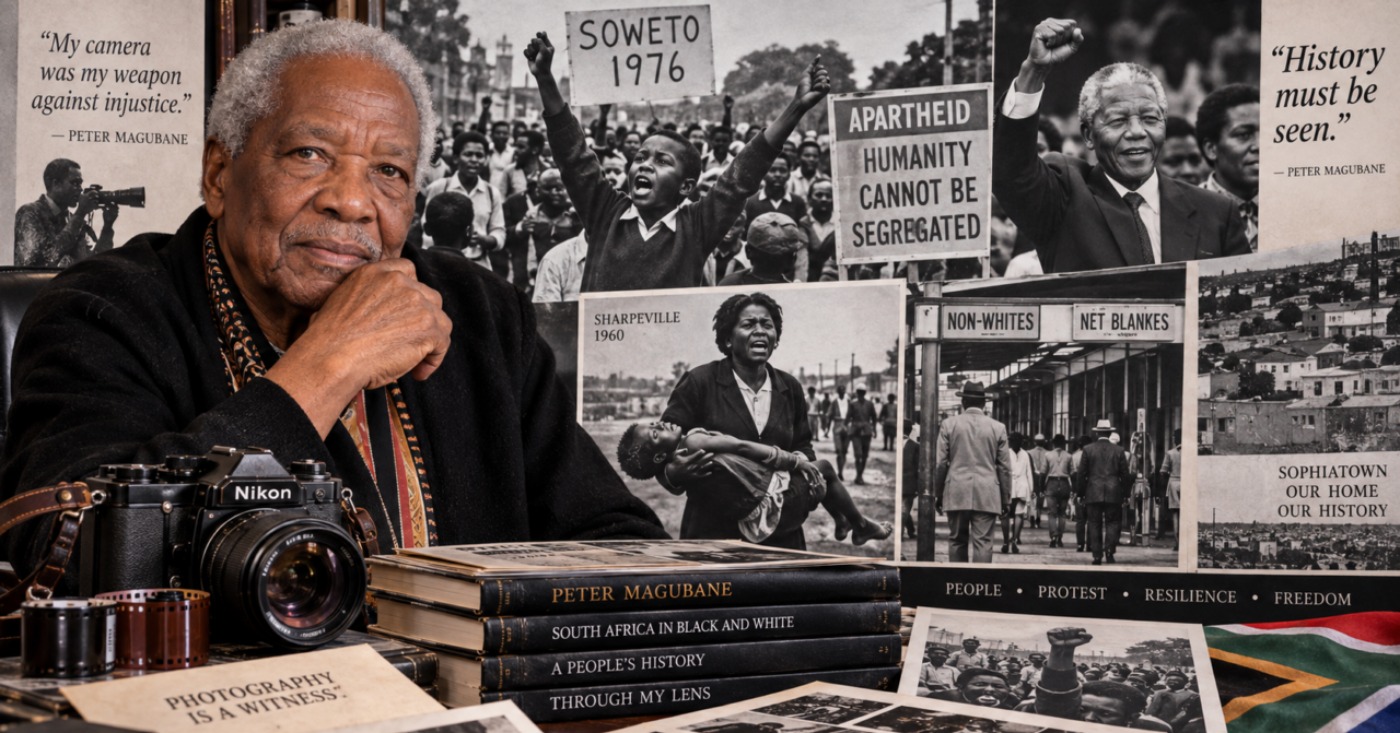
Peter Magubane was more than a photographer. He was a witness, storyteller, historian and courageous chronicler of one of the most turbulent periods in South African history. Born on January 18, 1932, in Vrededorp, Johannesburg, and raised in Sophiatown, Magubane discovered photography as a young boy after receiving a Kodak Brownie camera. That simple camera would eventually become his instrument for documenting the lives, struggles and determination of Black South Africans. He died on January 1, 2024, at the age of 91, leaving behind one of the most important photographic archives of South Africa’s apartheid era.
Magubane’s professional journey began at Drum magazine in 1954. He initially worked as a driver and messenger, but his ambition was to become a photographer. Under the mentorship of Drum’s legendary chief photographer Jürgen Schadeberg, Magubane developed his skills and began photographing major political and social events. His first significant assignment involved covering the 1955 African National Congress convention. From that point forward, photography became his way of documenting a country undergoing enormous change.
The South Africa that Magubane photographed was governed by apartheid, a system that legally enforced racial segregation and discrimination. For Black South Africans, everyday life was shaped by restrictions on where they could live, work and travel. Magubane did not limit himself to photographing politicians or famous leaders. He photographed ordinary people—children, workers, families and communities—giving the outside world a visual record of what apartheid meant in everyday life.
One of the defining moments of Magubane’s career came in 1960, when he photographed the aftermath of the Sharpeville Massacre. His photographs helped bring international attention to the violence surrounding resistance to apartheid. He also photographed the 1956 women’s anti-pass march, the Rivonia Trial involving Nelson Mandela and other activists, and numerous other events that became part of South Africa’s historical record.
Magubane paid an enormous personal price for his work. In 1969, he was arrested while photographing protesters outside Pretoria Central Prison. He was subsequently held in solitary confinement for 586 days. After his release, the apartheid government placed him under a banning order that severely restricted his ability to work and move freely. Yet the restrictions did not convince him to abandon photography. Instead, they demonstrated just how powerful the authorities believed his photographs could be.
In 1976, Magubane documented the Soweto Uprising, when thousands of Black students protested against the apartheid government’s education policies. His photographs captured young people confronting police violence and became some of the most internationally recognized images of the uprising. Despite the danger, Magubane continued photographing what was happening around him. His work transformed individual moments of protest into permanent historical evidence that could not easily be erased.
His creativity was matched by his determination to get the picture. Because authorities restricted photographers and attempted to prevent journalists from documenting certain events, Magubane sometimes concealed his camera in unusual places, including a hollowed-out Bible, bread and other objects. These methods allowed him to continue working when openly carrying a camera could attract police attention. His photographs demonstrated that documentary photography sometimes requires not only technical ability but extraordinary courage and resourcefulness.
After Nelson Mandela was released from prison in 1990, Magubane entered another important chapter of his career. He became Mandela’s official photographer and documented the transition toward democracy, including significant moments surrounding South Africa’s first democratic election and the Truth and Reconciliation Commission. The photographer who had spent decades documenting resistance now had the opportunity to photograph a country moving toward a new political era.
Magubane’s legacy extends far beyond the individual photographs he made. He published numerous books, exhibited internationally and received major honors, including an honorary Doctor of Literature from the University of Cape Town in 2010. His photographs remain part of the historical record because they show not only the brutality of apartheid but also the humanity, resilience and determination of the people who lived through it.
Peter Magubane ultimately demonstrated the extraordinary power of photography. He understood that a photograph can preserve a moment long after the people who witnessed it are gone. His camera recorded injustice, resistance, suffering, courage and eventually freedom. For photographers today, his life offers an enduring lesson: photography is not simply about making beautiful pictures—it can also be about seeing clearly, standing close to history and making sure that important stories are never forgotten. Magubane’s photographs gave South Africa a visual memory, and his life’s work reminds every photographer that sometimes the most important picture is the one that history needs someone brave enough to make.
Based on reporting by The Positive Community.
The post Peter Magubane: a Camera Against Apartheid appeared first on BlackPressUSA.